
Analytical chemistry and cell culture tool
OD600 Cell Density Calculator
Estimate cell density from an OD600 reading using blank correction, dilution factor, and a chosen cells-per-OD conversion factor. The calculator also reports corrected OD600, undiluted OD600, total cells, and optional CFU/mL.
Spectrophotometry calculator
Estimate cell density from OD600
Enter a blank-corrected or raw OD600 reading, dilution factor, and organism-specific conversion factor to estimate cells per mL.
This reading is in a common working range for many culture measurements.
Verify critical lab calculations independently before using them in real experiments.
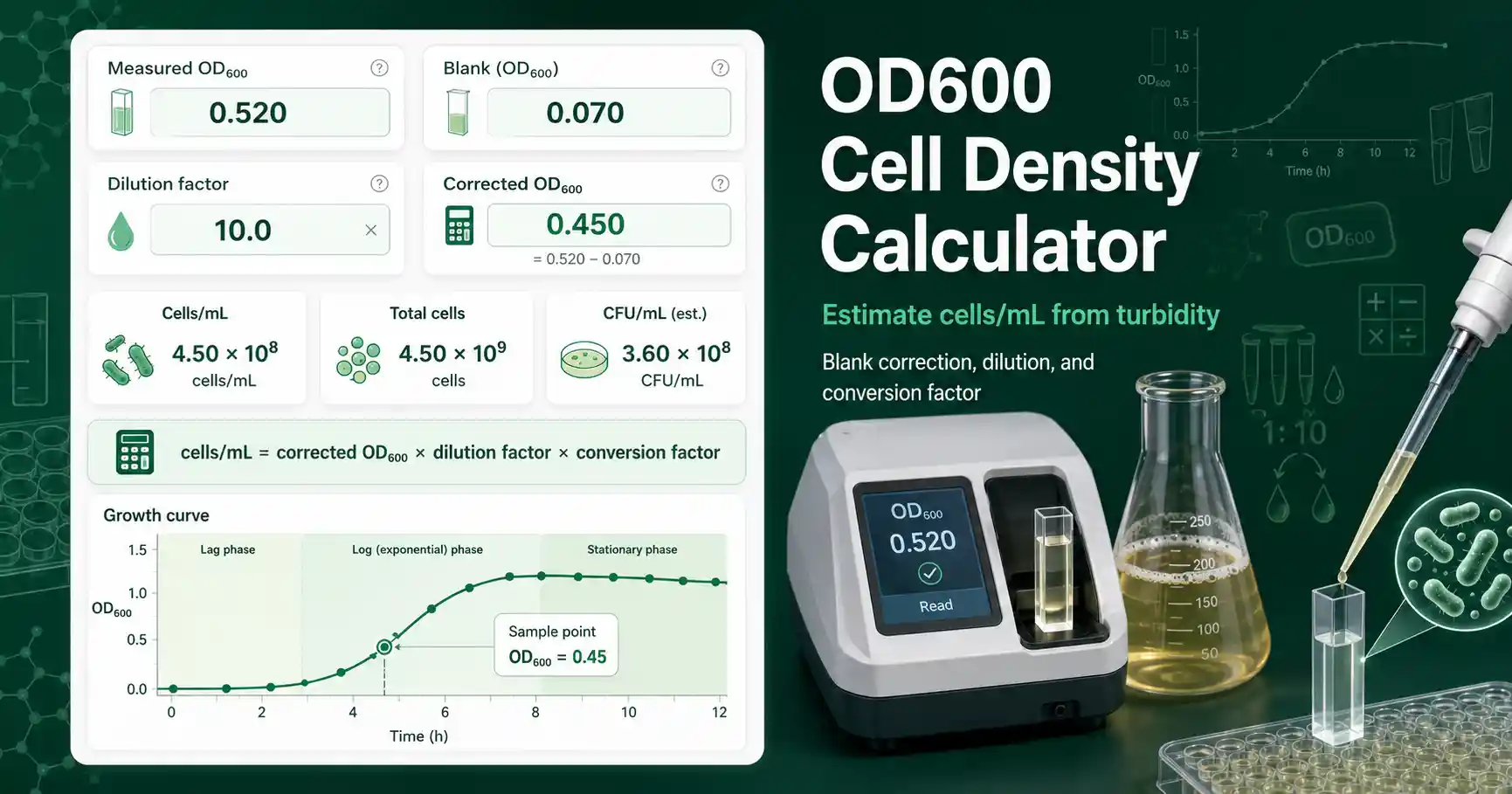
OD600 Cell Density Calculator for culture estimates
The OD600 Cell Density Calculator converts an optical density reading at 600 nm into an estimated cell concentration. It is useful for bacterial growth monitoring, yeast culture checks, teaching exercises, and quick culture planning. The tool accepts measured OD600, blank OD600, dilution factor, and a conversion factor in cells per mL per OD unit. It corrects the raw reading by subtracting the blank. It then multiplies the corrected value by the dilution factor. Finally, it converts the corrected undiluted OD600 into cells/mL.
OD600 is a turbidity measurement rather than a direct count of live cells. Suspended cells scatter light, and the instrument reports that scattering as optical density. Larger cells, clumped cells, cell debris, and the optical path of the instrument can change the reading. This is why the same OD600 value can represent different cell counts in different organisms or instruments. A default E. coli factor of 8 × 10^8 cells/mL per OD600 unit is a common approximation. A calibrated factor is better for publishable or critical work.
Use this calculator when you need a quick estimate before induction, harvest, transformation preparation, growth-curve plotting, or dilution planning. Use a CFU/mL Calculator when you have colony counts and want a viability-based result. Use a Calibration Curve Calculator when you have standards that connect OD600 readings to measured cell counts for your own instrument.
OD600 Calculator formula and assumptions
The calculator uses cells/mL = (measured OD600 − blank OD600) × dilution factor × conversion factor. The blank should match the medium or buffer used in the sample. The dilution factor should describe how much the sample was diluted before reading. A 1:5 dilution uses a dilution factor of 5. A 1:20 dilution uses a dilution factor of 20.
The conversion factor has the largest effect on the final estimate. For E. coli, many educational examples use 8 × 10^8 cells/mL per OD600 unit. For yeast, a lower or different factor is often used because cell size and scattering behavior differ. For mixed cultures, unusual media, microplate readings, and nonstandard path lengths, a local standard curve gives a stronger result. Peer-reviewed work on microbial OD calibration shows that OD-to-cell-count conversion depends on calibration and measurement conditions, not only on one universal constant. Read a calibration-focused OD measurement paper from NCBI.
Good OD600 practice
Blank the instrument with the same medium.
Dilute dense cultures before reading.
Keep the corrected OD600 inside the instrument's linear range.
Use the same cuvette, path length, or plate settings for comparisons.
Record the conversion factor in lab notes and reports.
OD600 Cell Density Calculator worked example
Given values: measured OD600 = 0.45, blank OD600 = 0.03, dilution factor = 5, and E. coli conversion factor = 8 × 10^8 cells/mL per OD600 unit. First subtract the blank from the measured reading. Corrected OD600 = 0.45 − 0.03 = 0.42. Next correct for the dilution. Undiluted OD600 = 0.42 × 5 = 2.10. Then convert OD600 into cell density. Cells/mL = 2.10 × 8 × 10^8 = 1.68 × 10^9 cells/mL.
If the culture volume is 10 mL, the estimated total cell count is 1.68 × 10^10 cells. If a viability estimate of 92% is used, the approximate CFU/mL is 1.55 × 10^9 CFU/mL. This CFU/mL value is only an estimate because OD600 does not separate live cells from dead cells. A plate count is still needed when viable colony-forming units matter.
OD600 result interpretation
A low corrected OD600 can be sensitive to small blank errors. If the corrected reading is near zero, recheck the blank and sample mixing. A mid-range corrected OD600 is usually easier to interpret. A high OD600 can underestimate true density if the reading is outside the linear range. Dilution helps bring the reading into a more reliable range. Always multiply the corrected diluted reading by the dilution factor to recover the original culture density.
Students can use this tool to understand the link between turbidity and cell density. Teachers can use it to demonstrate why blank correction and dilution matter. Lab workers can use it for quick culture estimates before routine workflow decisions. Researchers can use it for planning calculations, but should calibrate the factor for the exact strain, medium, vessel, and instrument when accuracy matters. Verify critical lab calculations independently before using them in real experiments.
Lab Questions About OD600 Cell Density
Can OD600 directly measure live cells?
OD600 estimates turbidity, so it includes light scattering from live cells, dead cells, cell debris, and other suspended particles. CFU/mL requires a viability assumption or a colony count assay.
Why should I dilute a high OD600 sample?
High OD600 readings often move outside the instrument's linear range. Diluting the culture and multiplying by the dilution factor usually gives a more reliable estimate.
What conversion factor should I use for E. coli?
A common educational approximation is 8 × 10^8 cells/mL per OD600 unit. The best factor comes from a calibration curve made with the same strain, medium, cuvette or plate, and instrument.