
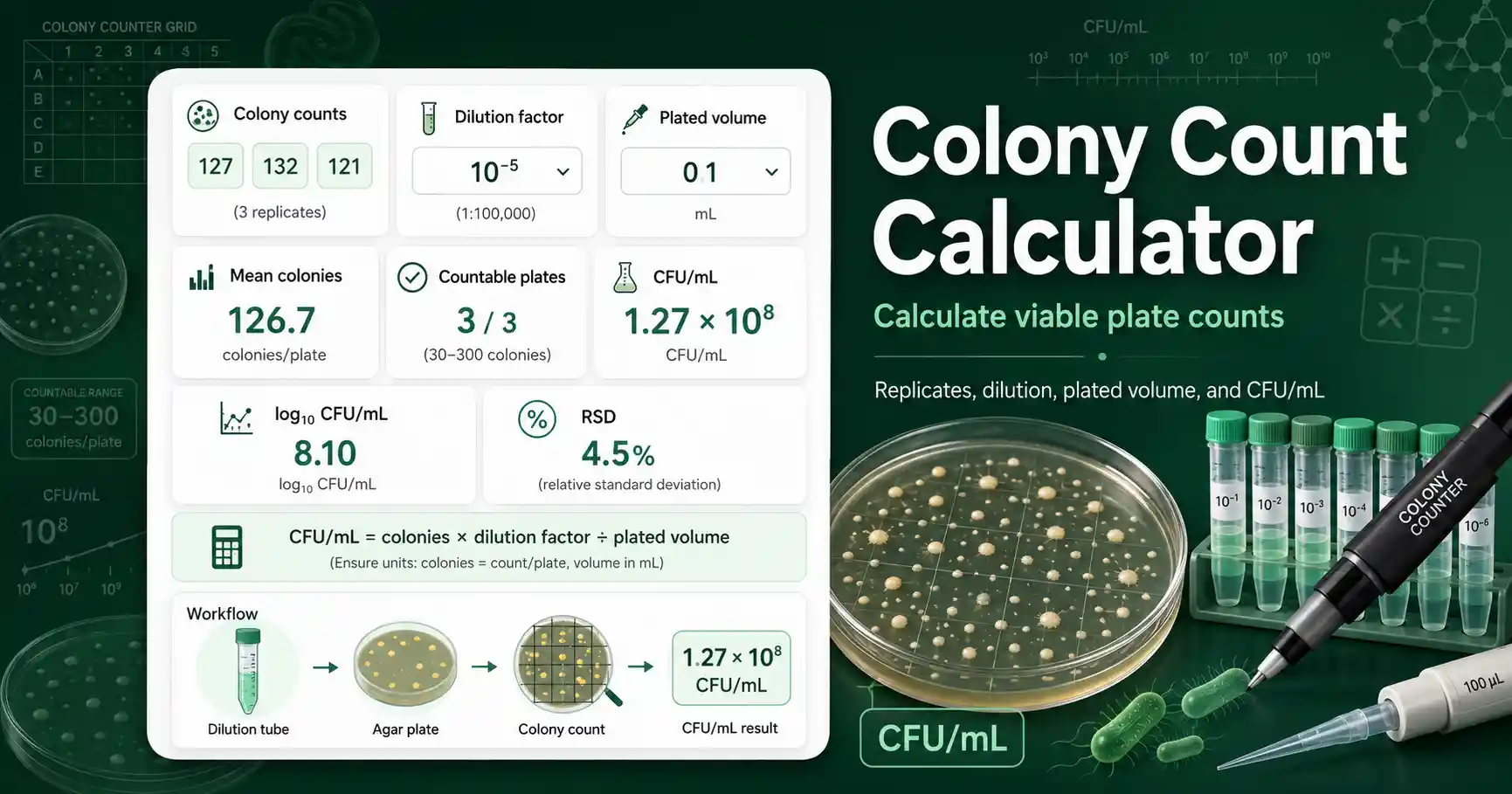
Colony Count Calculator for plate count results
This Colony Count Calculator helps you turn colony counts from dilution plates into a clear viable count result. It calculates CFU/mL from the average colony count, the reciprocal dilution factor, and the plated volume in milliliters. The tool also reports log10 CFU/mL because many microbiology reports and growth comparisons use logarithmic values. Students can use it to check homework calculations. Teachers can use it to demonstrate how dilution and plated volume change the final answer. Lab workers can use it as a fast arithmetic check before entering results into a notebook or spreadsheet.
The calculator accepts one plate or several replicate plates. You can paste values separated by commas, spaces, or new lines. It checks each plate against the selected countable colony range. The default range is 30 to 300 colonies, which is a common teaching-lab guideline for viable plate counts. You can change that range when your course, assay, or laboratory method uses a different rule. The result uses countable plates when possible because plates with too few colonies have large sampling error and plates with too many colonies can suffer from crowding.
Colony Count Calculator formula
The main formula is CFU/mL = mean colonies × dilution factor ÷ plated volume in mL. The mean colonies value comes from the accepted replicate plates. The dilution factor is the reciprocal of the dilution that was plated. A 10^-5 dilution has a dilution factor of 100000. A plated volume of 100 µL equals 0.1 mL. Unit conversion matters because using 100 instead of 0.1 mL would make the final answer 1000 times too small.
The calculator also computes standard deviation and relative standard deviation when you enter more than one usable plate. RSD helps you judge whether replicate plates agree well enough for reporting. A low RSD suggests the plate counts are consistent. A high RSD suggests pipetting variation, uneven spreading, counting error, or a dilution mix-up. The tool does not decide whether a plate should be rejected for scientific reasons. It gives you the arithmetic and status labels so you can apply the method rules correctly.
How to interpret colony count results
A CFU/mL result estimates viable colony-forming units in the original sample. It does not always equal the exact number of living cells because one colony can grow from one cell, a pair of cells, or a clump. The result depends on the organism, growth medium, incubation condition, dilution accuracy, and plate quality. A plate with 145 colonies from a 10^-5 dilution usually gives a more reliable estimate than a plate with 5 colonies from a very dilute sample. A plate with 650 colonies may underestimate the sample because colonies can overlap or become hard to distinguish.
Use the result as a calculation aid, not as proof that the experiment was perfect. Check that the dilution label matches the tube you plated. Check that the plated volume is entered in the correct unit. Check that all replicate plates came from the same dilution and method step. Check whether your lab asks for CFU/mL, CFU/g, log10 CFU/mL, or total CFU in a full sample. For a broader background on viable plate count principles, see this LibreTexts plate count explanation.
When to use colony counts instead of turbidity
Colony counting is useful when you need an estimate of viable cells that can grow into colonies under the chosen culture conditions. Turbidity tools estimate cell density from optical density and do not separate live cells from dead cells. If you are comparing plate counts with turbidity readings, the OD600 Cell Density Calculator can help you organize the optical estimate. If you only need the direct viable count formula without replicate review, the CFU/mL Calculator is the simpler related tool.
Researchers often use colony counts to compare treatments, time points, or storage conditions. Students often use them to learn serial dilution logic. Teachers can show how the same colony count gives different CFU/mL values when the plated volume changes. Lab workers can use the calculator to catch common unit errors before reporting. The most common mistakes are entering the dilution fraction instead of the reciprocal dilution factor, mixing µL and mL, and averaging plates from different dilutions without a clear method.