
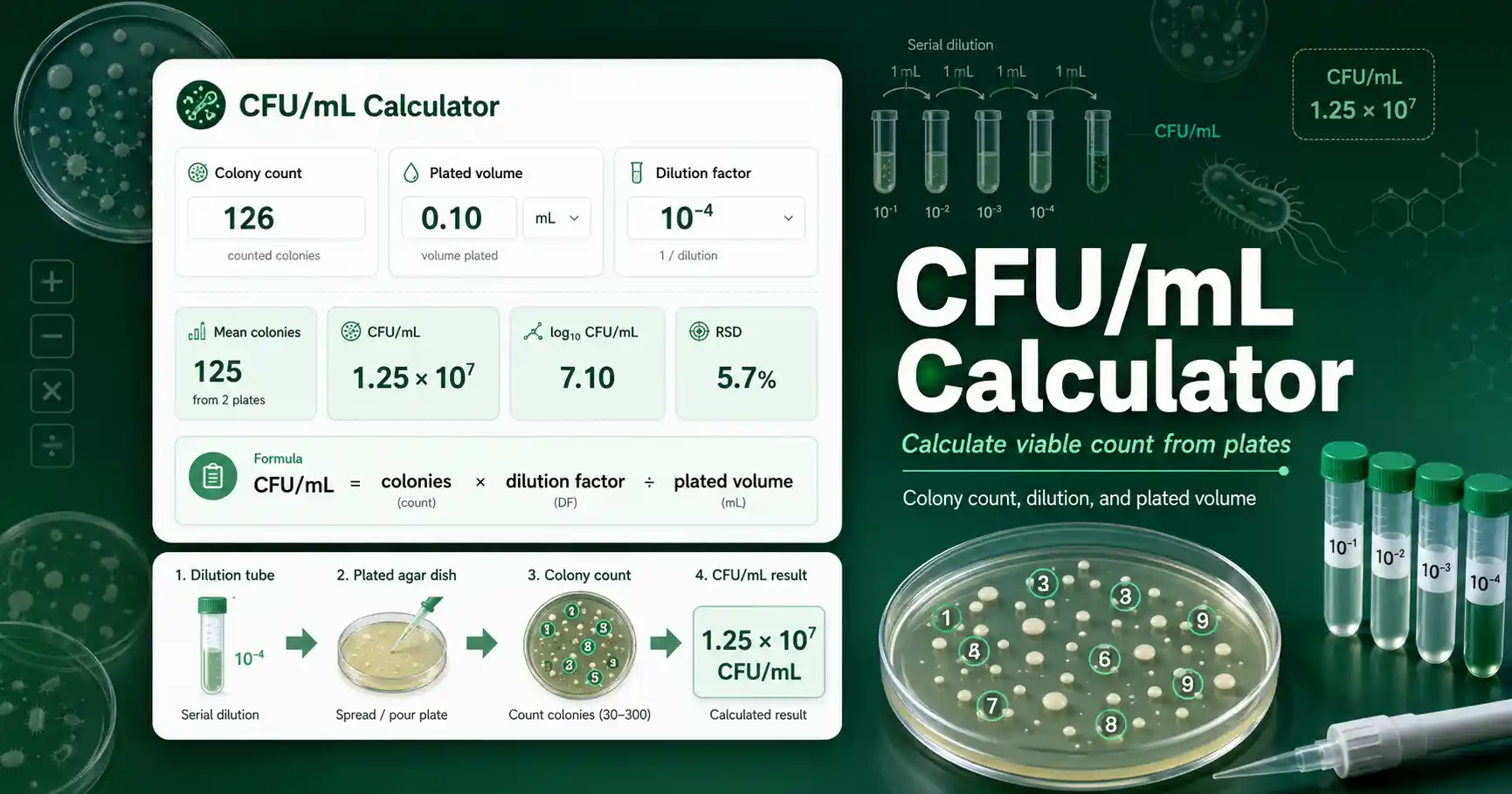
CFU/mL Calculator for viable plate counts
This CFU/mL Calculator estimates the concentration of colony-forming units in an original sample. It uses the number of colonies on a plate, the reciprocal dilution factor, and the volume plated in milliliters. A colony-forming unit is not always one single cell. It represents a viable unit that produced one visible colony under the selected culture conditions.
The calculator is useful when a student needs to calculate CFU/mL from a serial dilution. It is also useful when a teacher wants to check homework examples quickly. Lab workers can use it to review plate-count arithmetic before recording a result in a notebook. Researchers can use it as a quick educational check before moving results into a validated analysis workflow.
The main formula is simple: CFU/mL equals colony count multiplied by dilution factor, then divided by plated volume in mL. If you plate 100 µL, the calculator converts that value to 0.1 mL. If you enter a dilution plated as 10^-6, the calculator uses a dilution factor of 1,000,000. This is why a small plated volume and a high dilution can produce a large CFU/mL value.
The page accepts one count or several replicate counts. When you enter replicate plates, the tool calculates the mean colony count, sample standard deviation, and relative standard deviation. These values help you see whether the replicate plates agree. Replicates with very different counts may show pipetting variation, uneven mixing, plating error, or biological variation in the sample.
A common teaching rule is to prefer plates with a countable number of colonies. Many microbiology labs use 30 to 300 colonies as a practical range for spread-plate calculations, and LibreTexts gives the common plate-count formula using colony count and dilution factor in its viable plate count explanation. Very low counts can carry high relative uncertainty. Very crowded plates can merge colonies and undercount the sample.
CFU/mL Calculator formula and assumptions
The calculator assumes that the entered colony count came from a plated dilution of the original sample. It assumes that the dilution exponent describes the final dilution on the plate. It assumes that the plated volume was measured correctly. It also assumes that the visible colonies came from viable units able to grow under the incubation conditions.
The calculator does not identify organisms. It does not judge incubation temperature, medium choice, colony morphology, or contamination. It does not replace an approved lab SOP. It gives the arithmetic result from the values you enter.
Units matter in this calculation. A volume of 100 µL is 0.1 mL, so dividing by 0.1 multiplies the result by 10. A volume of 1 mL does not add this extra multiplier. Entering 100 as mL instead of µL would make the result too small by a factor of 1,000.
Dilution notation also matters. A 10^-5 plate has a dilution factor of 100,000. A 10^-6 plate has a dilution factor of 1,000,000. One exponent error changes the final CFU/mL by tenfold.
Use the Colony Count Calculator when you want help organizing plate counts before choosing which counts to use. Compare culture turbidity with the OD600 Cell Density Calculator when you want an approximate optical-density estimate beside viable-count data.
CFU/mL Calculator worked example
Given values: colony count = 87 colonies, plated volume = 100 µL, dilution plated = 10^-6.
Formula: CFU/mL = colonies × dilution factor ÷ plated volume in mL.
Substitution: CFU/mL = 87 × 1,000,000 ÷ 0.1.
Result: CFU/mL = 870,000,000, or 8.7 × 10^8 CFU/mL.
Interpretation: The original undiluted sample is estimated to contain 8.7 × 10^8 viable colony-forming units per milliliter under the selected plate-count conditions.
This example is reasonable because 87 colonies falls inside the common countable range. The 100 µL plated volume adds a tenfold multiplier because it is one tenth of a milliliter. The 10^-6 dilution adds a one-million-fold correction. The final result should usually be reported with sensible significant figures, not with unnecessary decimals.
CFU/mL result interpretation for lab reports
A CFU/mL value should be reported with the dilution, plated volume, and colony count used. This makes the calculation traceable. A good lab report may state the selected plate count, the dilution plated, the plated volume, and the final CFU/mL in scientific notation. Scientific notation keeps large values readable.
The log10 CFU/mL value helps when comparing samples that differ by orders of magnitude. A result of 1 × 10^8 CFU/mL has a log10 value of 8. A result of 5 × 10^6 CFU/mL has a log10 value near 6.70. Log values are common in growth curves, antimicrobial tests, and viability comparisons.
Use caution with plates that have zero colonies. A zero count can mean the plated dilution was too high, the sample had no recoverable colonies, or the method conditions did not support growth. The calculator will show zero when zero colonies are entered, but that result needs experimental context. Use caution with plates that are too numerous to count because merged colonies can hide viable units.
Student Questions About CFU/mL
What does a CFU/mL value mean?
CFU/mL estimates the number of viable colony-forming units in one milliliter of the original sample. It is based on visible colonies, dilution, and plated volume.
Which colony count should I enter?
Enter counts from plates that are readable and appropriate for your method. Many teaching labs use the 30 to 300 colony range as a practical guide for spread plates.
How do I enter a 10^-6 dilution?
Enter 6 in the dilution exponent field. The calculator converts 10^-6 to a dilution factor of 1,000,000 for the CFU/mL formula.
Can I enter replicate plates?
Yes. Enter replicate colony counts separated by commas, spaces, or new lines. The calculator uses the mean count and also reports sample SD and RSD.
Always check whether your plate count, dilution series, plated volume, and incubation method match your class instructions or laboratory SOP. Verify critical lab calculations independently before using them in real experiments.