
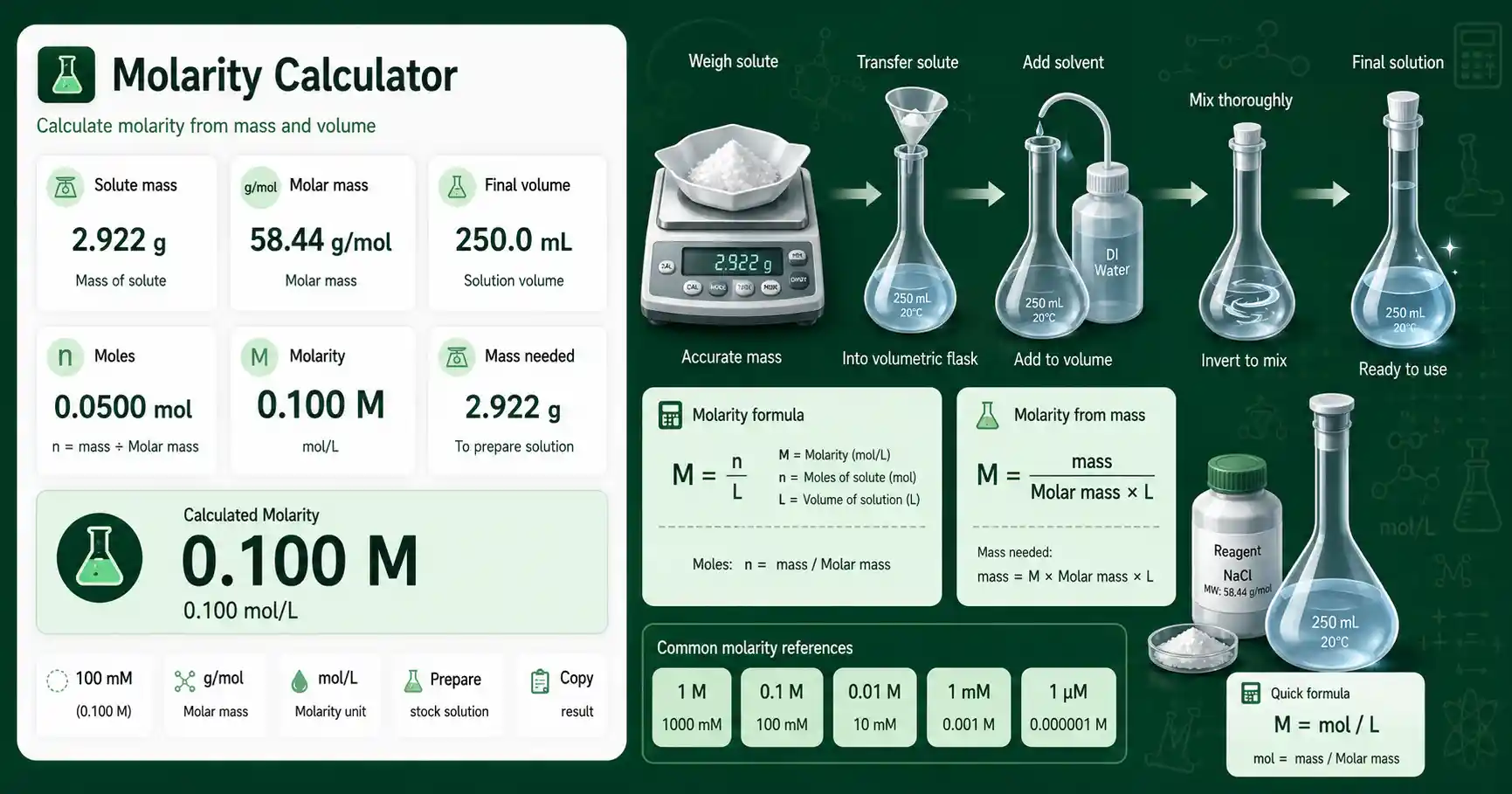
Molarity Calculator formula for lab solutions
Molarity is the number of moles of solute in one liter of final solution. The usual unit is mol/L, which chemists write as M. This calculator uses the formula M = n ÷ V, where n is moles and V is liters. When you enter mass instead of moles, the tool first divides the mass in grams by the molar mass in g/mol. It then divides the resulting moles by the final solution volume in liters. This makes the tool useful for students solving chemistry problems and for lab workers preparing stock solutions.
The calculator accepts mass in grams, milligrams, or micrograms. It accepts volume in liters, milliliters, or microliters. It reports the result as the most readable molarity unit, such as M, mM, µM, or nM. The input molar mass must match the exact compound or hydrated salt that you weighed. For example, anhydrous sodium chloride and a hydrated salt have different molar masses. A wrong molar mass creates a wrong concentration even if the arithmetic is correct.
Calculate molarity from mass and volume
Use the calculate mode when you already weighed a solute and brought the solution to a known final volume. Enter the measured mass, select the mass unit, enter the molar mass, and enter the final solution volume. The result shows the molarity and the amount of solute in moles. This is helpful when a bottle label gives molecular weight in g/mol and your notebook records a weighed mass. Students can use the same workflow to check textbook exercises about solution concentration. Lab workers can use it to confirm a reagent stock before making working dilutions.
The most common mistake is using solvent volume instead of final solution volume. If you add 0.5 g of solute to a flask and then fill to the 100 mL mark, the final volume is 100 mL. It is not the volume of water you poured before the final adjustment. Another common mistake is mixing mL and L without conversion. This tool converts the selected volume unit to liters before applying the molarity equation. For more background on molarity, OpenStax explains solution concentration and dilution equations in its Chemistry 2e molarity section.
Molarity Calculator worked example
Suppose you dissolve 5.844 g of NaCl and make the final volume exactly 1.000 L. The molar mass of NaCl is 58.44 g/mol. First calculate moles: 5.844 g ÷ 58.44 g/mol = 0.1000 mol. Then calculate molarity: 0.1000 mol ÷ 1.000 L = 0.1000 M. The result is a 0.100 M NaCl solution, which is also 100 mM. This interpretation tells you that each liter of the final solution contains 0.100 moles of dissolved NaCl.
A smaller volume works the same way. If you need 250 mL of 100 mM NaCl, the preparation mode converts 100 mM to 0.100 M and 250 mL to 0.250 L. It multiplies 0.100 mol/L by 0.250 L to get 0.0250 mol. It then multiplies 0.0250 mol by 58.44 g/mol to get 1.461 g. You would weigh about 1.46 g of NaCl, dissolve it, and bring the final volume to 250 mL. Verify critical lab calculations independently before using them in real experiments.
Prepare molar stocks and working solutions
Use the prepare solution mode when you know the target concentration and final volume. This is common for buffer components, salts, small molecules, dyes, inhibitors, and teaching lab reagents. A 1 M stock requires more mass than a 100 mM stock of the same compound at the same volume. A 500 mL preparation requires twice the mass of a 250 mL preparation at the same molarity. The calculator makes these volume and concentration relationships clear before you start weighing.
After preparing a concentrated stock, you may need to dilute it into a working solution. For that workflow, a solution dilution calculator can help with C1V1 = C2V2. If your task is to calculate how much solid compound to weigh from a desired molarity and volume, a mass from molarity calculator follows the same chemistry from a preparation-focused direction. Use the method that matches the information you already have.
Molarity units and expected ranges
A molar solution has one mole of solute per liter of solution. A millimolar solution has one thousandth of a mole per liter. A micromolar solution has one millionth of a mole per liter. A nanomolar solution has one billionth of a mole per liter. General chemistry examples often use M or mM. Molecular biology reagents often use mM, µM, or nM. Very concentrated stocks can be difficult to dissolve, so the calculated mass should also make chemical sense for the compound and solvent.
Molarity changes with temperature when volume changes, but this effect is often small for routine classroom and bench calculations. The tool does not correct for density, purity, hydration state, or solution contraction unless those are already reflected in the mass and molar mass you enter. If a reagent certificate lists purity, you may need to correct the weighed mass. If a compound is supplied as a hydrate or salt form, use the molar mass of that supplied form. The calculator gives an arithmetic result, not a guarantee of solubility, stability, or experimental performance.