
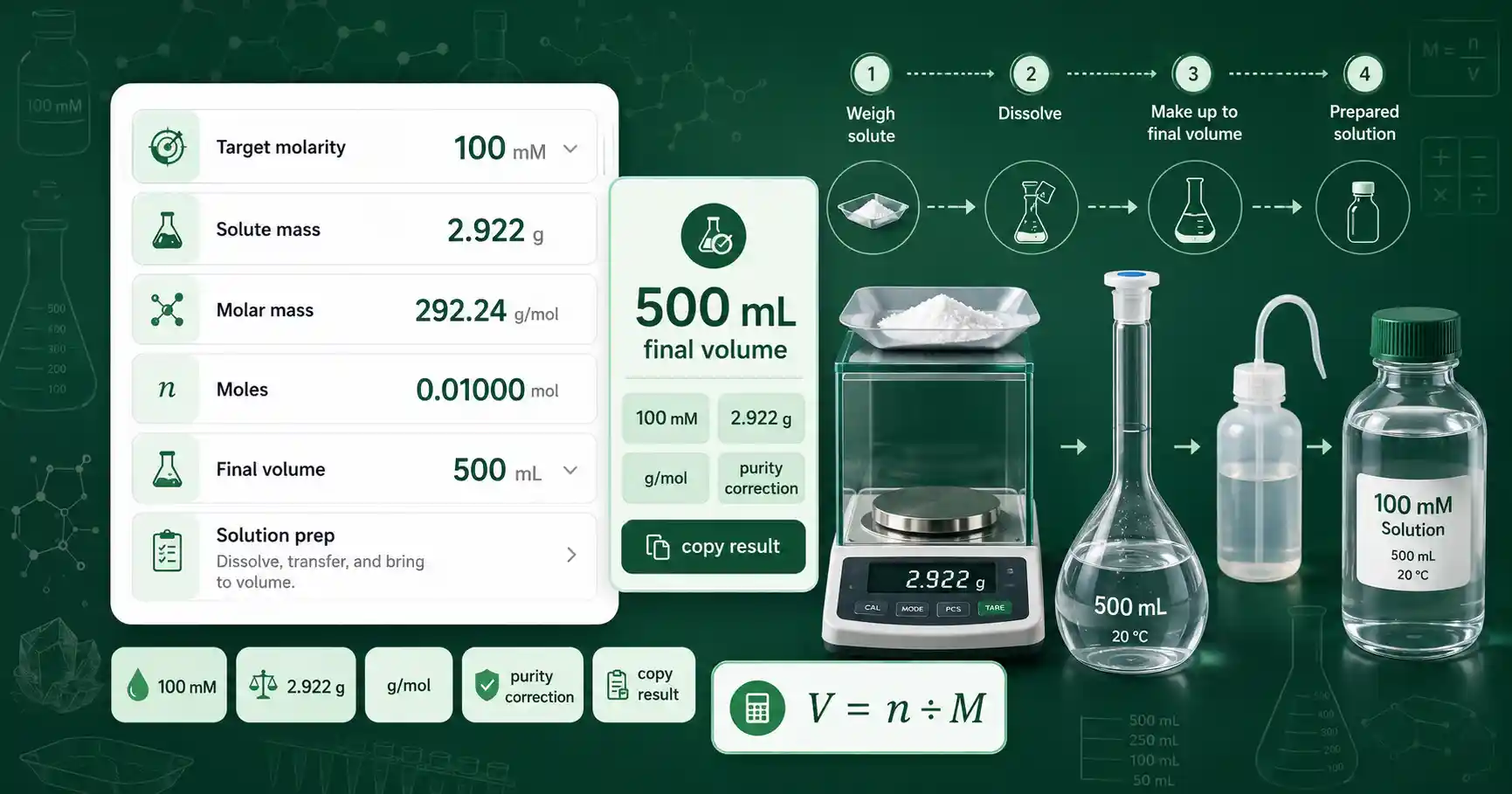
Volume from Molarity Calculator formula
This calculator finds the final solution volume needed to reach a target molarity from a known solute mass. It first converts the weighed mass into grams. It then divides that mass by molar mass to calculate moles of solute. Finally, it divides moles by molarity in mol/L. The formula is volume = moles ÷ molarity. Since moles = mass ÷ molar mass, the complete formula is volume = (mass ÷ molar mass) ÷ molarity.
The tool accepts target concentration units such as M, mM, µM, and nM. It accepts mass units such as g, mg, µg, and ng. It reports the final solution volume in the most useful unit, such as L, mL, µL, or nL. This helps students and lab workers avoid unit mistakes when mass is measured in milligrams but concentration is written in millimolar. The result is the final volume of the solution, not simply the amount of water or buffer to add.
Molarity means moles of solute per liter of solution, as explained in the OpenStax Chemistry 2e molarity section. That definition is important because volume in molarity refers to the final solution volume. In careful solution preparation, you dissolve the solute in less than the final volume first. You then bring the solution up to the calculated volume using suitable solvent or buffer. This method is more accurate than adding the full calculated volume of solvent directly to the dry solid.
Calculate final volume from mass and molarity
Use this calculator when the amount of solid reagent is fixed. You may have a pre-weighed compound, a small remaining amount in a tube, or a known mass from a reagent label. The calculator answers a direct question: what final volume gives the desired molar concentration from that mass? This is the reverse of calculating mass from a target volume. It is useful when you do not want to waste material or when you need to prepare the most concentrated practical stock from a limited sample.
The basic mode uses target molarity, solute mass, and molar mass. Advanced mode adds reagent purity and a maximum container volume check. Purity correction is useful when the label gives a purity such as 95%, 98%, or 99%. If purity is below 100%, the active mass is lower than the weighed mass. That means the calculated final volume should also be lower for the same target molarity.
If you already know the target volume and need to find mass instead, use the Mass from Molarity Calculator. If you need to review concentration from moles and volume, the Molarity Calculator gives the standard forward calculation. These tools use the same molarity relationship but solve for different unknown values. Choosing the correct unknown prevents confusion when preparing stocks, standards, buffers, and classroom chemistry solutions.
Volume from Molarity Calculator worked example
Suppose you have 2.922 g of sodium chloride and want to make a 100 mM NaCl solution. The molar mass of NaCl is 58.44 g/mol. First, convert the target concentration to mol/L. A concentration of 100 mM equals 0.100 M. The mass is already in grams, so it can be used directly.
Calculate moles as 2.922 g ÷ 58.44 g/mol. This gives 0.0500 mol of NaCl. Now calculate volume as 0.0500 mol ÷ 0.100 mol/L. The result is 0.500 L. This equals 500 mL. The interpretation is that 2.922 g of NaCl should be made up to a final solution volume of 500 mL to produce 100 mM NaCl.
In the lab, you would not usually add exactly 500 mL of water to the dry salt. You would dissolve the salt in less than 500 mL, transfer it to suitable glassware, and bring the final volume to 500 mL. This distinction matters because solutes can change final volume after dissolving. The calculated volume is the final mark, not the starting solvent amount.
Final solution volume interpretation
A larger weighed mass gives a larger final volume at the same molarity. A higher target molarity gives a smaller final volume for the same mass. A higher molar mass gives fewer moles for the same mass, so the final volume becomes smaller. A lower purity value also gives fewer active moles, so the final volume becomes smaller. These relationships help you check whether a result makes chemical sense before you use it.
If the result is extremely small, the preparation may not be practical with ordinary pipettes or volumetric tools. A volume of a few nanoliters or less is not suitable for routine solution preparation. In that case, prepare a more dilute intermediate solution or weigh more material if possible. If the result is extremely large, recheck whether you entered mM as M or mg as g. Very large volumes often reveal a unit mismatch.
This calculator does not check solubility. Some compounds cannot dissolve at the calculated concentration. It does not check pH, ionic strength, temperature, hydration state, safety hazards, sterility, or long-term stability. It also does not know whether your reagent needs a special solvent. Always follow the reagent datasheet, safety information, and your laboratory protocol. Verify critical lab calculations independently before using them in real experiments.
Common mistakes in volume from molarity calculations
Do not use the wrong molar mass. Hydrates, salts, hydrochloride forms, sodium salts, and solvates can have different molar masses from the free compound. Use the exact formula weight listed for the reagent you are weighing. Do not confuse molecular weight in kDa with small-molecule molar mass unless you are intentionally working with proteins or peptides. For proteins, the numeric value in Da matches g/mol, but sequence composition and modifications still matter.
Do not treat 100 mM as 100 M. Millimolar means one thousandth of a molar. Do not treat milligrams as grams. A 10 mg input is 0.010 g, not 10 g. Do not ignore purity when the compound is supplied with an assay value below 100%. A purity adjustment can be important for expensive inhibitors, standards, dyes, and analytical reagents.
Do not confuse final volume with diluent volume. The solvent volume added is usually less than the final volume because the solute occupies space and can change solution volume. Do not round too aggressively when preparing small volumes. Use appropriate significant figures based on your balance, pipette, flask, and protocol. A calculator can reduce arithmetic mistakes, but it cannot replace practical lab judgment.
When to use a volume from molarity tool
Students can use this page to understand how mass, moles, molarity, and volume connect. Teachers can use the worked example to create concentration practice problems. Lab workers can use it when a reagent has already been weighed and the final stock volume must be chosen. Researchers can use it when preparing limited stocks of inhibitors, dyes, salts, standards, or custom compounds. It is also useful when a small leftover reagent amount must be converted into a usable molar stock.
A practical use case is preparing a 10 mM inhibitor stock from 5 mg of compound. Another use case is deciding how much buffer volume to use for a pre-weighed salt sample. A third use case is checking whether a desired target concentration would require a final volume that is too small or too large. The calculator gives a fast estimate, and the interpretation text helps you decide whether the preparation is realistic.