
Analytical chemistry calculator
Beer-Lambert Law Calculator
Use this Beer-Lambert Law Calculator to calculate concentration, absorbance, molar absorptivity, or path length from spectrophotometer data. The tool supports blank correction, dilution factor correction, common concentration units, and clear result interpretation for lab reports and teaching.
Spectrophotometry calculator
Calculate Beer-Lambert Law Results
Enter absorbance, path length, molar absorptivity, and concentration data to solve the Beer-Lambert law without showing invalid lab values.
Calculated concentration
c = (A − blank) / (ε × l)
- Corrected absorbance: 0.6
- Cuvette concentration: 50 µM
- Original concentration after dilution factor 1: 50 µM
This is the concentration of the solution measured in the cuvette. It assumes the absorptivity is correct for the wavelength and analyte.
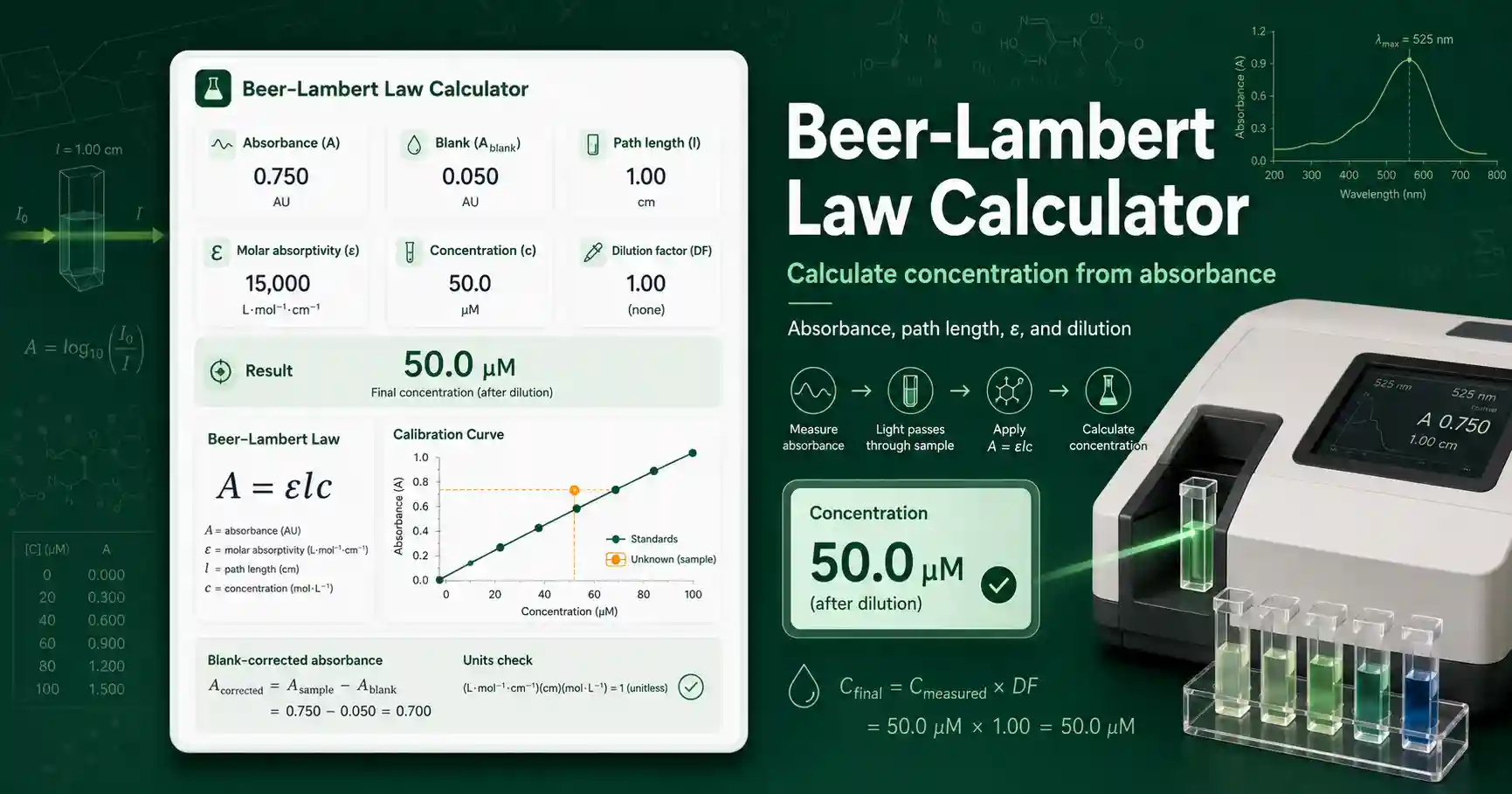
Beer-Lambert Law Calculator formula
The Beer-Lambert law connects absorbance to concentration, path length, and molar absorptivity. The equation is A = εlc, where A is absorbance, ε is molar absorptivity, l is path length in centimeters, and c is concentration in mol/L. Absorbance has no unit because it is based on a light intensity ratio. Molar absorptivity usually uses L mol⁻¹ cm⁻¹. A standard cuvette usually has a 1 cm path length. A microplate well may have a shorter effective path length, so the chosen path length matters.
This calculator is useful when you need to calculate concentration from absorbance. It also works when you need to calculate expected absorbance from a known standard. Advanced mode can solve for ε when you know the concentration and path length. Advanced mode can also solve for path length when absorbance, ε, and concentration are known. For a simpler concentration-only workflow, the Absorbance to Concentration Calculator may be faster. For standards with a measured slope and intercept, the Calibration Curve Calculator is usually a better match.
The calculation assumes that the absorbing molecule follows a linear absorbance response at the selected wavelength. It assumes the blank correction represents the solvent, reagent, or matrix background. It assumes the molar absorptivity value belongs to the same analyte, solvent, wavelength, and temperature conditions. It assumes the spectrophotometer response is still inside the reliable linear range. High absorbance values can reduce accuracy because little transmitted light reaches the detector. Many routine assays work best with absorbance values below about 1 to 2, but the exact range depends on the instrument and method.
Students can use the calculator to check spectrophotometry homework and learn how each variable changes the result. Teachers can use it to demonstrate why doubling concentration doubles absorbance under ideal conditions. Lab workers can use it to estimate an unknown concentration from a measured absorbance and a known ε value. Researchers can use it as a quick check before building a more detailed standard curve. The result should not replace assay validation, calibration checks, or method-specific acceptance criteria.
Blank correction matters because cuvettes, solvents, buffers, and reagents can absorb light. A sample absorbance of 0.60 with a blank of 0.05 gives a corrected absorbance of 0.55. Dilution factor matters when the measured sample was diluted before reading. If the cuvette concentration is 20 µM and the dilution factor is 5, the original sample concentration is 100 µM. Unit conversion matters because ε expects concentration in mol/L. The calculator converts mM, µM, and nM into mol/L before solving the equation.
A good result should match the scale of the experiment. If a dye with ε = 12,000 L mol⁻¹ cm⁻¹ gives A = 0.60 in a 1 cm cuvette, the concentration should be in the micromolar range. If the calculator returns millimolar concentration for a strongly absorbing dye, check the unit selection and molar absorptivity. If the calculated path length is far from the cuvette or plate format, check the entered concentration. Chemistry LibreTexts gives a helpful overview of the Beer-Lambert law and its direct proportionality between absorbance, concentration, and path length in spectrophotometry in this educational reference.
Beer-Lambert Law Calculator worked example
Suppose a sample has absorbance 0.60 at the selected wavelength. The cuvette path length is 1 cm. The molar absorptivity is 12,000 L mol⁻¹ cm⁻¹. The blank absorbance is 0.00. The dilution factor is 1 because the measured sample was not diluted.
Given values
Absorbance = 0.60
Path length = 1 cm
Molar absorptivity = 12,000 L mol⁻¹ cm⁻¹
Formula and substitution
c = A / (ε × l)
c = 0.60 / (12,000 × 1)
c = 0.00005 mol/L
The result is 50 µM. This means the cuvette solution contains 50 micromoles of analyte per liter under the selected wavelength and ε value. If the sample had been diluted 10-fold before measurement, the original sample concentration would be 500 µM. The final value should be reported with the method wavelength, path length, and any dilution factor.
You Might Ask About Beer-Lambert Law Calculator
What does the Beer-Lambert Law Calculator solve?
It solves concentration, absorbance, molar absorptivity, or path length when the other Beer-Lambert law variables are known.
Why does the calculator ask for path length?
Path length affects absorbance directly, so a 1 cm cuvette and a shorter microplate path can give different absorbance values for the same solution.
Can I use this calculator for diluted samples?
Yes. When solving concentration, enter the dilution factor to estimate the original sample concentration from the measured cuvette concentration.
What should I verify before using the result in lab work?
Verify the wavelength, blank, path length, dilution factor, and molar absorptivity source. Verify critical lab calculations independently before using them in real experiments.