
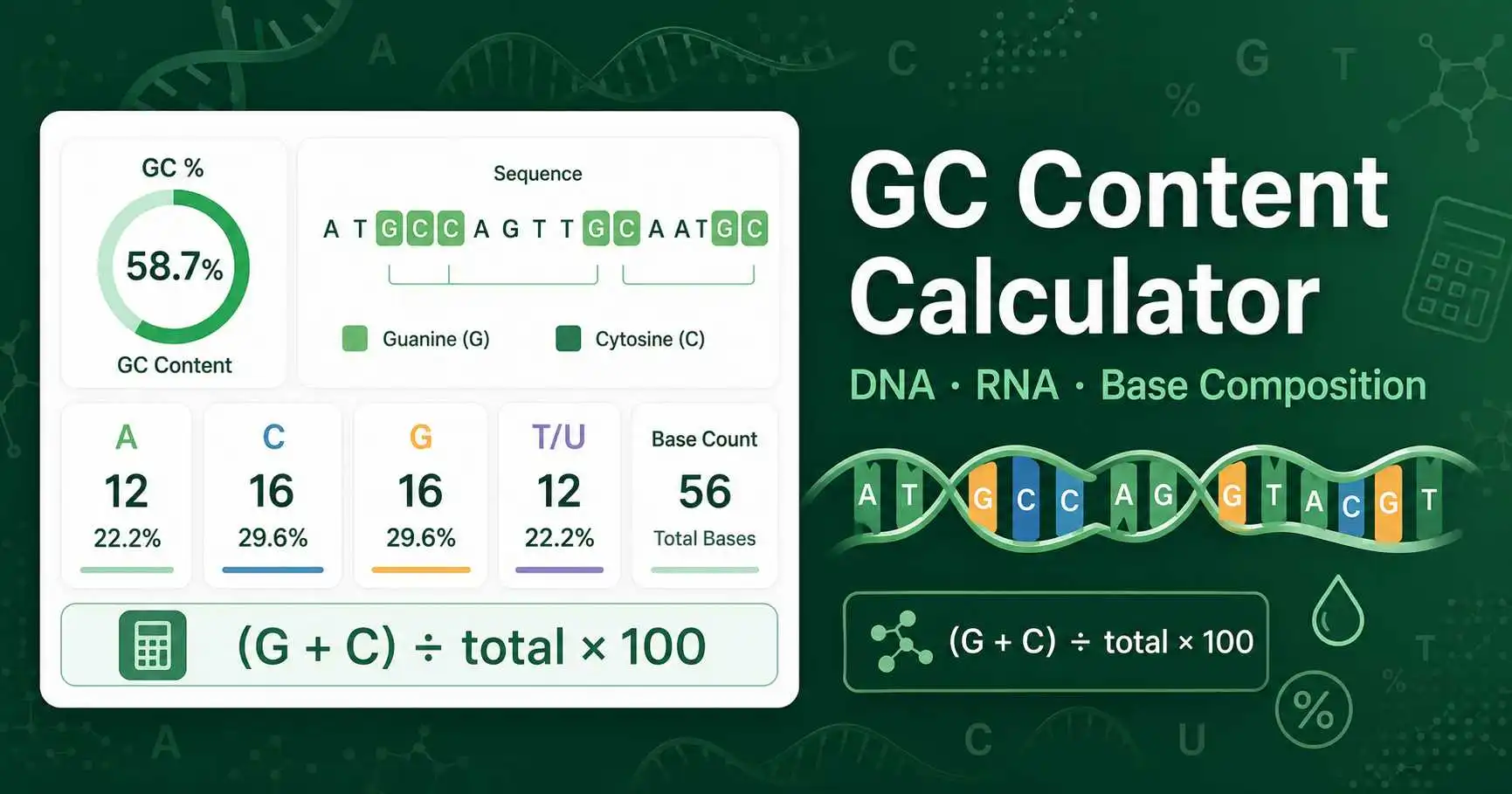
GC Content Calculator meaning
A GC Content Calculator measures how much of a DNA or RNA sequence is made of guanine and cytosine. The result is shown as a percentage of valid nucleotide bases. Students use this value to understand base composition. Lab workers use it to review primers, oligos, amplicons, plasmid regions, and short sequence fragments.
GC content matters because G-C base pairs have three hydrogen bonds, while A-T or A-U pairs have two. A sequence with more G and C bases can have a higher melting temperature and stronger local stability. This is why GC percentage is often checked during primer design, PCR planning, qPCR assay review, cloning preparation, and sequence annotation.
How this GC Content Calculator works
Paste a sequence into the input box and choose DNA or RNA. DNA mode accepts A, C, G, and T. RNA mode accepts A, C, G, and U. The calculator removes FASTA headers, line breaks, spaces, and numbers. It counts valid bases and excludes ambiguous symbols from the final percentage.
The formula is simple: GC content equals G plus C divided by total valid bases, multiplied by 100. For example, a 20-base DNA primer with 5 G bases and 5 C bases has 10 GC bases. Its GC content is 10 divided by 20, or 50 percent.
GC Content Calculator results explained
The main result is GC percentage. The tool also shows A, C, G, and T or U counts, AT or AU content, GC skew, and a reverse complement. GC skew compares G and C counts. It can help students see whether one GC base is more common than the other in the entered sequence.
In many quick primer checks, a GC content range around 40 to 60 percent is a common starting point. Low-GC primers may bind weakly. High-GC primers may need adjusted denaturation or annealing conditions. The best range still depends on sequence length, target region, polymerase, salt concentration, and assay design.
Using GC content for primers and oligos
Primer design needs more than one value. GC content helps you judge base balance, but it does not prove that a primer is specific or efficient. After checking GC percentage, review melting temperature, primer length, 3′ end composition, self-complementarity, and expected amplicon size.
For a wider primer review, use the Oligo Analyzer. For a temperature-focused estimate, compare the result with the Primer Tm Calculator. The National Human Genome Research Institute gives a concise definition of GC content as the proportion of bases in DNA or RNA that are guanine or cytosine.NHGRI GC content glossary
Common GC content mistakes to avoid
Do not mix T and U in the same mode. Choose DNA for sequences with T and RNA for sequences with U. Do not include primer names or notes inside the sequence field unless they are FASTA headers starting with the greater-than symbol. Ambiguous letters such as N are useful in some sequence formats, but they do not have a known GC identity, so this tool excludes them from the percentage calculation.
Also check sequence direction. GC percentage is the same in both directions, but reverse complement output depends on strand direction. Most primers and oligos are written 5′ to 3′. If you paste the wrong strand, your interpretation may not match the intended lab design.
When students and lab workers should use it
Students can use this calculator for genetics, molecular biology, biochemistry, and biotechnology assignments. It helps explain base composition, hydrogen bonding, primer stability, melting temperature, and sequence comparison. Teachers can use the output in worksheets, practical demonstrations, and lab report examples.
Lab workers can use it as a quick screening step before ordering an oligo or reviewing a PCR target. For real experiments, verify critical values with your lab protocol, a validated primer design tool, and the oligo supplier’s final order page.