
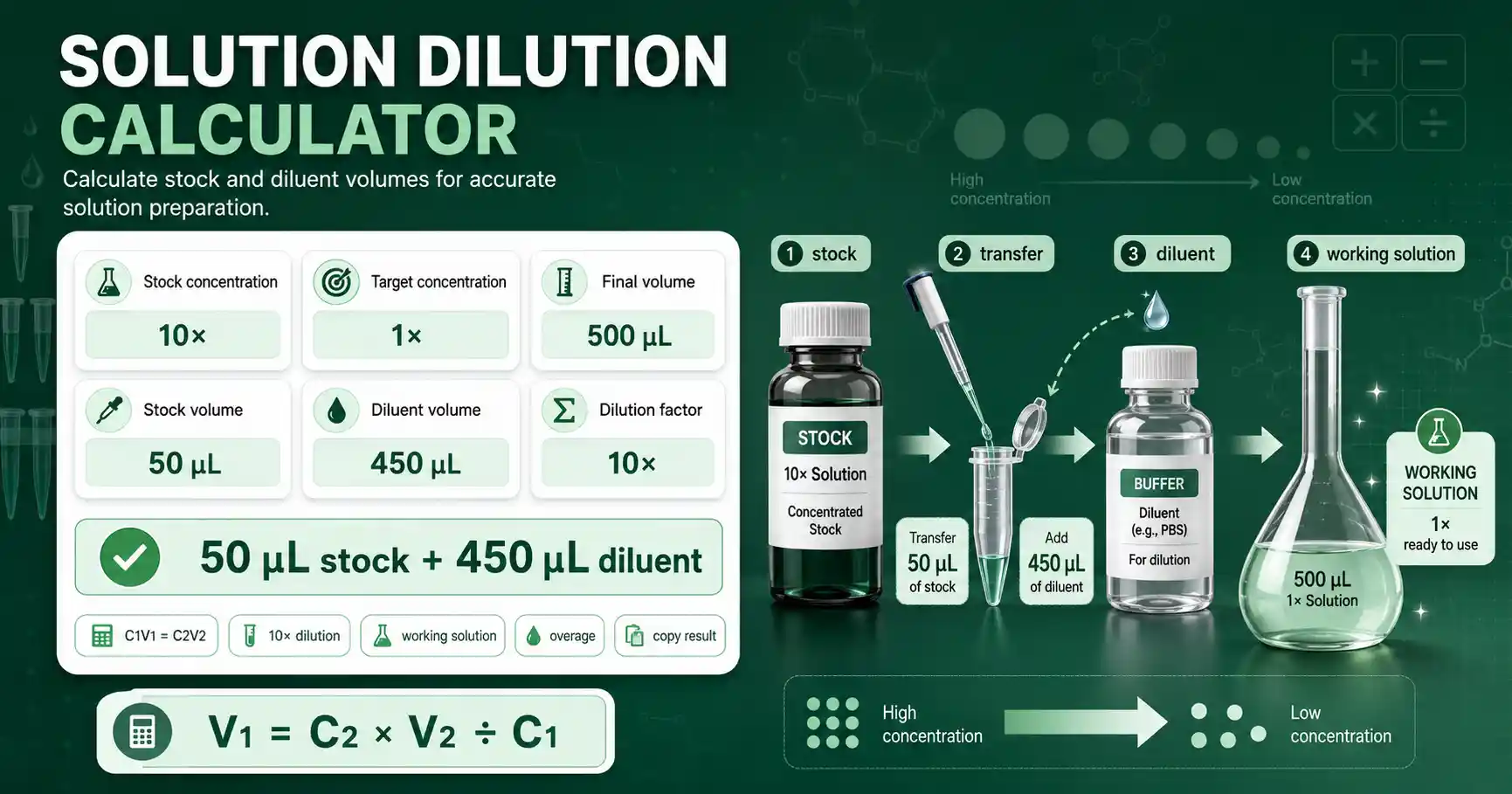
Solution Dilution Calculator for stock-to-working solutions
This Solution Dilution Calculator helps you prepare a working solution from a concentrated stock. It calculates the stock volume, diluent volume, dilution factor, and adjusted final volume. The tool is useful for buffers, primers, antibodies, dyes, enzyme stocks, standards, chemical reagents, and classroom concentration problems. It works best when the final solution should have the same chemical identity as the stock but at a lower concentration. It does not replace protocol review, reagent safety checks, or compatibility checks.
The required inputs are stock concentration, target concentration, and final volume. The stock concentration is the concentration of the solution you already have. The target concentration is the concentration you want to prepare. The final volume is the amount of working solution you need after mixing stock and diluent. The diluent is usually water, buffer, solvent, media, or another compatible liquid. The calculator also supports optional overage, which helps when you need extra volume for pipetting loss.
Solution Dilution Calculator formula
The calculator uses C1V1 = C2V2. C1 is the stock concentration. V1 is the stock volume that must be transferred. C2 is the target concentration. V2 is the final working solution volume. Rearranged for stock volume, the formula becomes V1 = C2 × V2 ÷ C1. The diluent volume is final volume minus stock volume. This method is the same concentration-volume relationship taught in many chemistry courses, including the OpenStax section on molarity and dilution.
A dilution can only lower concentration. If the target concentration is higher than the stock concentration, the calculator shows an error. If the stock and target units belong to the same unit family, the calculator converts them before calculating. For example, 1 mM and 100 µM are compatible molar units. Likewise, 1 mg/mL and 100 µg/mL are compatible mass concentration units. The tool does not convert between molar concentration and mass concentration because that requires molecular weight.
Solution dilution worked example
Suppose you have a 100 µM primer stock and need 500 µL of a 10 µM working solution. The given values are C1 = 100 µM, C2 = 10 µM, and V2 = 500 µL. Use V1 = C2 × V2 ÷ C1. Substitute the values: V1 = 10 × 500 ÷ 100. The stock volume is 50 µL. The diluent volume is 500 − 50 = 450 µL. The interpretation is simple: mix 50 µL of 100 µM stock with 450 µL of compatible diluent to make 500 µL of 10 µM solution.
If you add 10% overage, the calculator first changes the preparation volume from 500 µL to 550 µL. The stock volume becomes 10 × 550 ÷ 100 = 55 µL. The diluent volume becomes 495 µL. The concentration stays 10 µM because the stock-to-final volume ratio remains the same. Overage only changes the amount prepared, not the intended final concentration.
How to interpret stock volume and diluent volume
Stock volume is the amount of concentrated solution that carries the solute into the final mixture. Diluent volume is the amount of liquid added to bring the solution to the final volume. The dilution factor is stock concentration divided by target concentration. A 100 µM stock diluted to 10 µM has a dilution factor of 10. That means the final solution contains one tenth of the original stock strength. A 1 mg/mL stock diluted to 0.2 mg/mL has a dilution factor of 5.
The result should be checked against your pipette range. If the calculated stock volume is 0.3 µL, it is usually too small for accurate routine pipetting. In that case, prepare a larger final volume or make an intermediate dilution first. The tool flags small stock volumes when they fall below your selected minimum pipetting volume. This helps prevent calculations that are mathematically correct but impractical at the bench.
When to use a solution dilution calculator
Students can use this calculator to learn how concentration and volume connect in solution preparation. Teachers can use it to demonstrate why a lower target concentration needs a smaller stock fraction. Lab workers can use it to scale a protocol from one tube to many wells. Researchers can use it to prepare primer working stocks, dye solutions, protein standards, drug treatments, enzyme stocks, and assay reagents. It also helps avoid common spreadsheet mistakes when switching between microliters and milliliters.
Use the C1V1 C2V2 Calculator when you want a focused equation solver for any one missing variable. Use the Working Solution Calculator when you want a broader reagent preparation workflow. For this page, the main goal is simple stock-to-target dilution. The calculator assumes ideal mixing and additive volumes. It does not account for volume contraction, pH shift, precipitation, degradation, solvent limits, or biological activity changes after dilution.
Common solution dilution mistakes to avoid
Do not mix concentration families without the needed molecular weight conversion. Do not enter the final volume as the diluent volume. Do not forget that final volume means the total volume after stock and diluent are combined. Do not use a target concentration higher than the stock concentration. Do not pipette below the reliable range of your pipette. Do not assume that water is the right diluent for every reagent. Buffers, salts, enzymes, proteins, solvents, and cells may require specific diluents to stay stable.
A correct dilution calculation still needs practical review. Confirm that the reagent is soluble at the target concentration. Confirm that the diluent matches the protocol. Confirm that the stock concentration label is current. Confirm whether the stock has already been diluted. Verify critical lab calculations independently before using them in real experiments.