
Chemistry calculator
Molecular Formula Mass Calculator
Calculate formula mass, molar mass, atom counts, and percent composition from a chemical formula with brackets, hydrates, and element symbols.
Formula mass calculator
Calculate molecular formula mass
Enter a chemical formula. The calculator parses brackets, hydrate dots, atom counts, and element symbols.
Use standard capitalization. CO means carbon plus oxygen, while Co means cobalt.
Examples include H2O, NaCl, MgCl2, Ca(OH)2, Al2(SO4)3, Fe(NO3)3, and CuSO4·5H2O.
| Element | Atoms | Mass part | Percent |
|---|---|---|---|
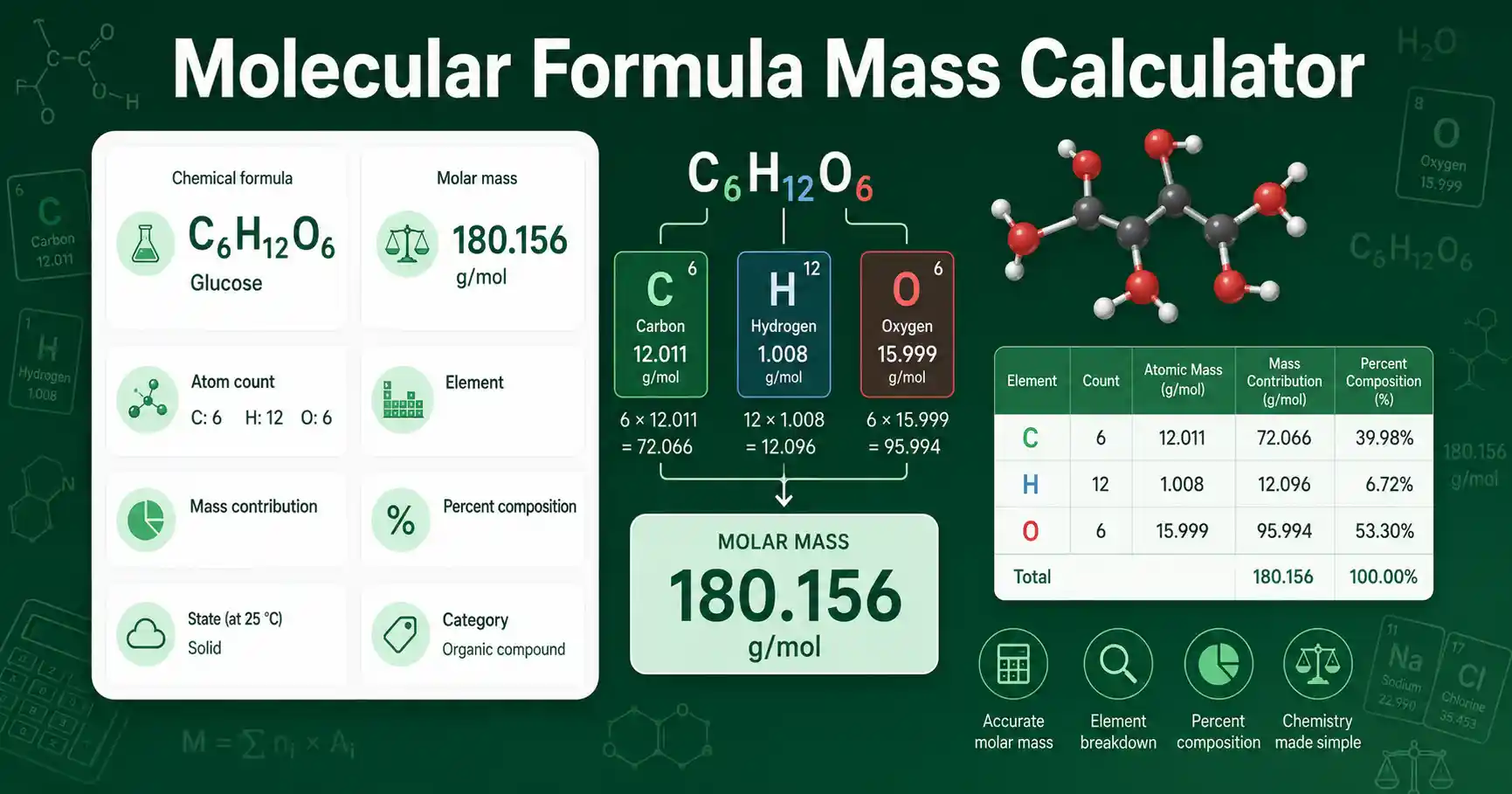
| CCarbon | 6 | 72.066 | 40.002% |
| HHydrogen | 12 | 12.096 | 6.714% |
| OOxygen | 6 | 95.994 | 53.284% |
Use this value as the molar mass when converting between grams and moles for the exact formula shown. Verify critical lab calculations independently before using them in real experiments.
Molecular Formula Mass Calculator for chemical formulas
The Molecular Formula Mass Calculator finds the mass of one formula unit and the molar mass of one mole of that formula. It reads the element symbols, counts the atoms, multiplies each atom count by its atomic mass, and adds the values.
Use it for formulas such as H2O, CO2, NaCl, C6H12O6, Ca(OH)2, Al2(SO4)3, and CuSO4·5H2O. The tool is helpful for students who need a fast check before mole conversions, mass percent problems, or stoichiometry calculations.
Teachers can use the result table to show how every element contributes to the final mass. Lab learners can use the molar mass result before preparing classroom solutions, checking worksheet answers, or reviewing reagent labels.
If you need to identify an element symbol first, use the Periodic Table Tool. If you want the mass percentage of each element as a separate chemistry exercise, use the Percent Composition Calculator after you confirm the formula.
How to use Molecular Formula Mass Calculator correctly
Enter the chemical formula exactly as it appears in your problem. Capitalization matters because Co means cobalt, while CO means carbon and oxygen.
Use ordinary numbers after element symbols to show atom counts. For example, H2O contains two hydrogen atoms and one oxygen atom.
Use parentheses when a group repeats. Ca(OH)2 means the OH group appears twice, so the formula contains one calcium atom, two oxygen atoms, and two hydrogen atoms.
Use a middle dot or period for hydrates. CuSO4·5H2O tells the calculator to add five water molecules to the copper sulfate formula unit.
The calculator reports formula mass in g/mol because the same numerical value is used for molar mass when converting grams to moles. It also reports total atoms and the mass contribution from each element.
Do not enter reaction coefficients unless you intentionally want the mass for multiple formula units. For a compound molar mass, enter the compound formula only.
Molecular Formula Mass Calculator formula and assumptions
The calculator uses the standard classroom method for formula mass. It adds the mass contribution from every element in the formula.
Formula mass = Σ(element atom count × atomic mass)
In glucose, C6H12O6, the calculator uses six carbon atoms, twelve hydrogen atoms, and six oxygen atoms. Each count multiplies the corresponding atomic mass.
Atomic weights can vary slightly because real elements may contain different isotope mixtures. For reference data, NIST provides atomic weights and isotopic composition information in its Atomic Weights and Isotopic Compositions resource.
This page uses rounded educational masses, so the answer is appropriate for learning, homework checks, and general classroom chemistry. Use the exact atomic-weight table required by your instructor, instrument method, or quality system when small differences matter.
Molecular Formula Mass Calculator worked example
Given: calculate the molar mass of glucose, C6H12O6.
Atom counts: carbon = 6, hydrogen = 12, oxygen = 6.
Formula: formula mass = Σ(element atom count × atomic mass).
Substitution: (6 × 12.011) + (12 × 1.008) + (6 × 15.999).
Calculation: 72.066 + 12.096 + 95.994 = 180.156 g/mol.
Result: glucose has a formula mass of about 180.156 g/mol.
Interpretation: one mole of glucose molecules has a mass of about 180.156 grams under the rounded atomic masses used here.
Molecular Formula Mass Calculator results explained
The main result tells you the molar mass of the formula in grams per mole. You can use that value to convert grams to moles or moles to grams.
The total atom count shows how many atoms appear in one displayed formula unit. It is not the number of atoms in one mole; one mole contains Avogadro-scale numbers of formula units.
The element table shows each element separately. It lists the atom count, atomic mass, mass contribution, and percent of the final mass.
A large atom count does not always mean the largest mass contribution. Hydrogen often appears many times in organic formulas, but oxygen, sulfur, chlorine, metals, and heavier atoms may contribute more mass per atom.
A hydrate result includes the water molecules after the dot. This can make the molar mass much higher than the anhydrous compound, so hydrate notation should never be ignored.
Molecular Formula Mass Calculator mistakes to avoid
Do not use lowercase element symbols at the start of an element. Enter NaCl, not nacl, because element symbols follow strict capitalization rules.
Do not confuse a subscript with a coefficient. H2O is one water molecule formula unit, while 2H2O represents two water formula units in a reaction context.
Do not forget parentheses around repeated groups. MgOH2 is not the same as Mg(OH)2 because the second formula repeats the entire hydroxide group.
Do not ignore waters of crystallization in hydrate formulas. CuSO4 and CuSO4·5H2O have different molar masses and give different mass-to-mole conversions.
Do not overstate precision. Rounded atomic masses give useful classroom answers, but analytical chemistry may require a specified reference table and significant-figure rules.
Molecular Formula Mass Calculator use cases in chemistry
Students can use the calculator to check mole conversion homework. If a problem gives 3.50 g of NaCl, the molar mass helps convert that mass into moles.
Teachers can use the element breakdown to explain why formula mass is an additive calculation. The table makes the hidden arithmetic visible.
Lab workers can use the tool as a quick educational check before preparing non-critical classroom solutions. Critical lab calculations should still be verified independently before real experimental use.
Researchers and teaching assistants can use it to sanity-check reagent formula entries in teaching notes, worksheets, or lab report templates.
Student questions about molecular formula mass
What does molecular formula mass mean?
Molecular formula mass is the sum of the atomic masses in the displayed formula. For ionic compounds, many teachers call the same calculation formula mass rather than molecular mass.
Can I use g/mol for an ionic compound?
Yes. The numerical formula mass is commonly written as molar mass in g/mol when you work with one mole of formula units.
Why is my answer slightly different from a textbook?
Textbooks may round atomic masses differently. Carbon may appear as 12.01 or 12.011, and those small differences can change the final decimal places.
Does the calculator balance chemical equations?
No. This tool calculates the mass of a formula. Balancing a chemical equation is a separate stoichiometry step.