
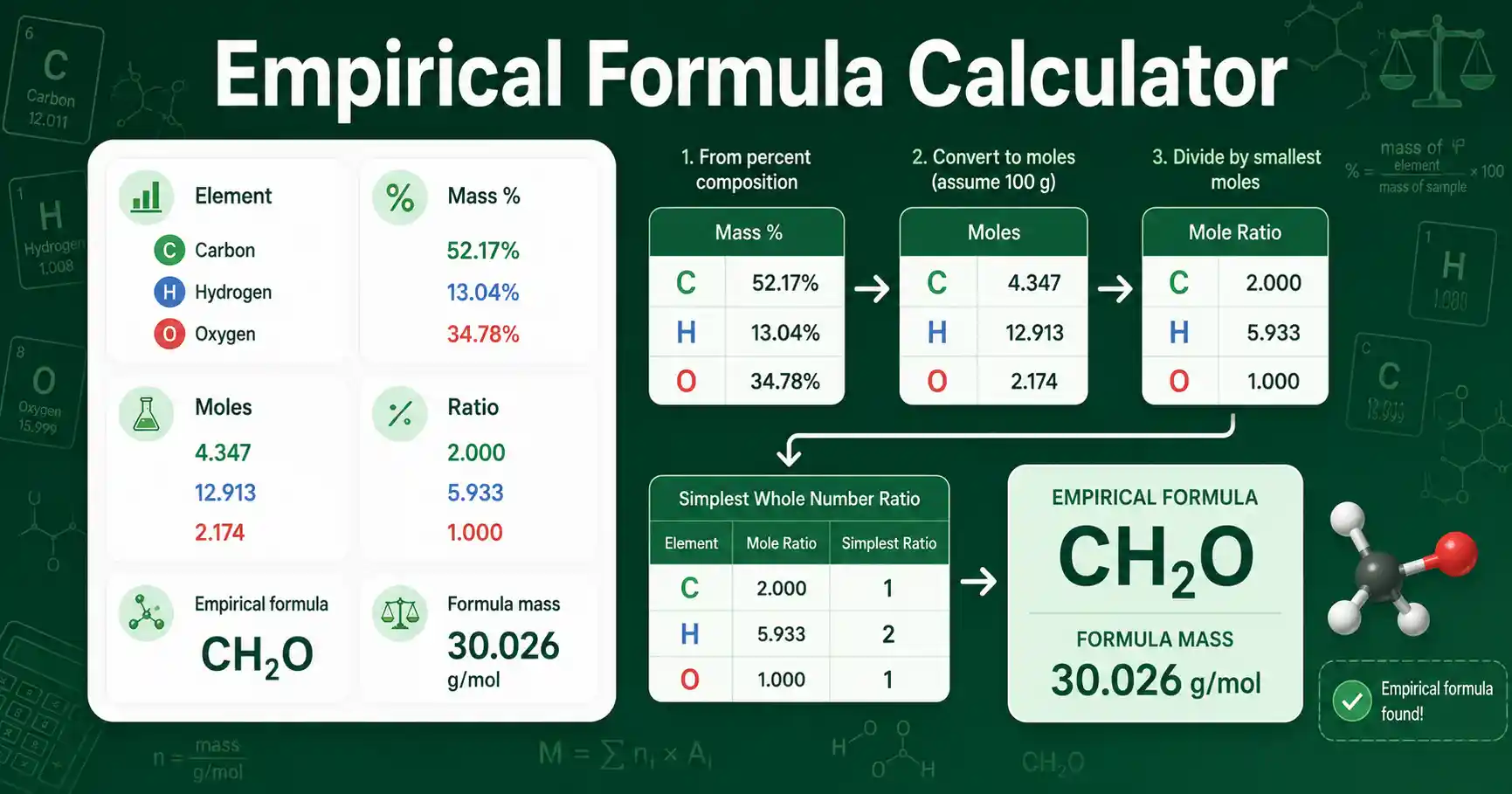
Empirical Formula Calculator for percent composition and mass data
This Empirical Formula Calculator finds the simplest chemical formula from elemental composition data. It works with mass percentages, such as carbon 40.00%, hydrogen 6.71%, and oxygen 53.29%. It also works with measured masses from an elemental analysis problem. The calculator converts each element amount into moles using atomic mass. It then divides every mole value by the smallest mole value. The final formula uses the smallest whole-number ratio that fits the data.
Students can use the calculator to check general chemistry homework. Teachers can use it to demonstrate why percentage data becomes mole data before it becomes a formula. Lab workers can use it as a quick learning aid when reviewing elemental analysis results. Researchers can use it for rough composition checks, but critical analytical work should always be verified independently with the original data and method.
The empirical formula is not always the molecular formula. For example, glucose has the molecular formula C6H12O6, but its empirical formula is CH2O. If a known molecular molar mass is available, the advanced field can compare it with the empirical formula mass and suggest a molecular formula multiplier.
How to use Empirical Formula Calculator correctly
Choose percent composition when your data is given as percentages by mass. In that mode, the calculator treats each percentage as grams in a 100 g sample. Choose mass composition when your data gives actual element masses from one sample. Any consistent mass unit can work because only mole ratios are needed.
Enter each element symbol in standard chemical notation, such as C, H, O, Na, Cl, Fe, or Mg. Enter a positive value for the element amount. Add more rows when a compound contains more than three elements. Combine duplicate element rows before calculating. For composition data from a known formula, the Percent Composition Calculator can help convert formula mass into element percentages first.
The output table shows atomic mass, moles, raw ratio, and rounded whole-number ratio. The raw ratio is useful because values such as 1.50, 1.33, 1.25, and 1.67 often need multiplication by 2, 3, 4, or 3 before the final subscripts make sense.
Empirical Formula Calculator method and assumptions
The core method is mass to moles, moles to ratio, and ratio to formula. For each element, the tool divides the mass by the atomic mass to calculate moles. It divides all mole values by the smallest mole value. It then rounds the ratio to the nearest practical whole-number formula.
Moles of element = mass of element ÷ atomic mass
Raw ratio = element moles ÷ smallest mole value
Empirical formula mass = sum of atomic masses × empirical subscripts
The calculator assumes the listed elements account for the compound being analyzed. It also assumes the composition values are reliable enough for rounding. OpenStax explains the same general idea in its section on determining empirical and molecular formulas.
If you already know the empirical formula and only need its mass, the Molecular Formula Mass Calculator is the faster next step.
Empirical Formula Calculator worked example
Suppose a compound contains 40.00% carbon, 6.71% hydrogen, and 53.29% oxygen by mass. In a 100 g sample, that equals 40.00 g C, 6.71 g H, and 53.29 g O. Convert each mass to moles.
Given: C = 40.00%, H = 6.71%, O = 53.29%
Moles: C = 40.00 ÷ 12.011 = 3.330 mol
Moles: H = 6.71 ÷ 1.008 = 6.657 mol
Moles: O = 53.29 ÷ 15.999 = 3.331 mol
Divide by smallest: C = 1.00, H = 2.00, O = 1.00
Result: empirical formula = CH2O
The result means the simplest atom ratio is one carbon atom, two hydrogen atoms, and one oxygen atom. If the molecular molar mass is about 180.16 g/mol, divide 180.16 by the empirical formula mass of about 30.03 g/mol. The factor is close to 6, so the molecular formula is C6H12O6.
Empirical Formula Calculator results explained
The empirical formula result gives the smallest whole-number atom ratio. A result of CH2O does not mean the compound has only four atoms per molecule. It means carbon, hydrogen, and oxygen occur in a 1:2:1 ratio. The empirical formula mass gives the molar mass of that simplest ratio unit.
The molecular formula estimate is only valid when the known molar mass is trustworthy. If the molar-mass factor is close to a whole number, the molecular formula can be found by multiplying every empirical subscript by that whole number. If the factor is not close to a whole number, the composition data, molar mass, element list, or rounding may need review.
Small rounding differences are normal. Percent compositions from textbooks often round to two decimal places. Real analytical values may contain experimental error. The calculator helps with the arithmetic, but you should still judge whether the rounded ratio is chemically reasonable.
Empirical Formula Calculator mistakes to avoid
Do not use percentages as direct subscripts. Convert percentages to masses and then to moles first. Do not divide by atomic number. Use atomic mass in grams per mole. Do not round mole values too early because early rounding can change the final ratio.
Watch ratios that sit near common fractions. A raw ratio near 1.5 usually becomes 3 after multiplying all ratios by 2. A ratio near 1.33 usually becomes 4 after multiplying by 3. A ratio near 1.25 usually becomes 5 after multiplying by 4. These steps explain why empirical formula problems often need one extra multiplication step after dividing by the smallest mole amount.
Check that percent values are close to 100% when the problem gives percentages. If the total is far from 100%, the data may be incomplete or the values may represent a mass sample instead. Verify critical chemistry calculations independently before using them in graded work, reports, or real lab decisions.
Empirical Formula Calculator use cases in chemistry
A student can use the calculator after a combustion analysis problem to convert carbon, hydrogen, and oxygen percentages into a simple formula. The table makes it easier to see where the subscripts came from. This helps students write a clear homework solution instead of only copying a final formula.
A teacher can use the calculator during class to compare empirical formula and molecular formula. The optional molar-mass field shows why CH2O and C6H12O6 describe different levels of chemical information. It also helps explain why a molecular mass measurement is needed before a molecular formula can be chosen.
A lab worker can use the tool as a quick check when reviewing an elemental composition report. The calculator is useful for education and preliminary checking. It does not replace validated analytical software, instrument methods, or quality-control review.
Student Questions About Empirical Formula Calculator
Can I calculate empirical formula from percentages?
Yes. Treat each percentage as grams in a 100 g sample, convert each mass to moles, divide by the smallest mole amount, and round to the simplest whole-number ratio.
Why does the empirical formula use whole numbers?
A formula represents relative atom counts. Atoms are counted as whole particles, so the mole ratio must be converted into whole-number subscripts.
Is empirical formula the same as molecular formula?
No. The empirical formula is the simplest atom ratio. The molecular formula gives the actual atom count in one molecule and may be a whole-number multiple of the empirical formula.
What should I check before using the answer in homework?
Check element symbols, atomic masses, percentage totals, mole conversions, and rounding. If a ratio is close to 1.5, 1.33, 1.25, or 1.67, multiply all ratios before choosing subscripts.