
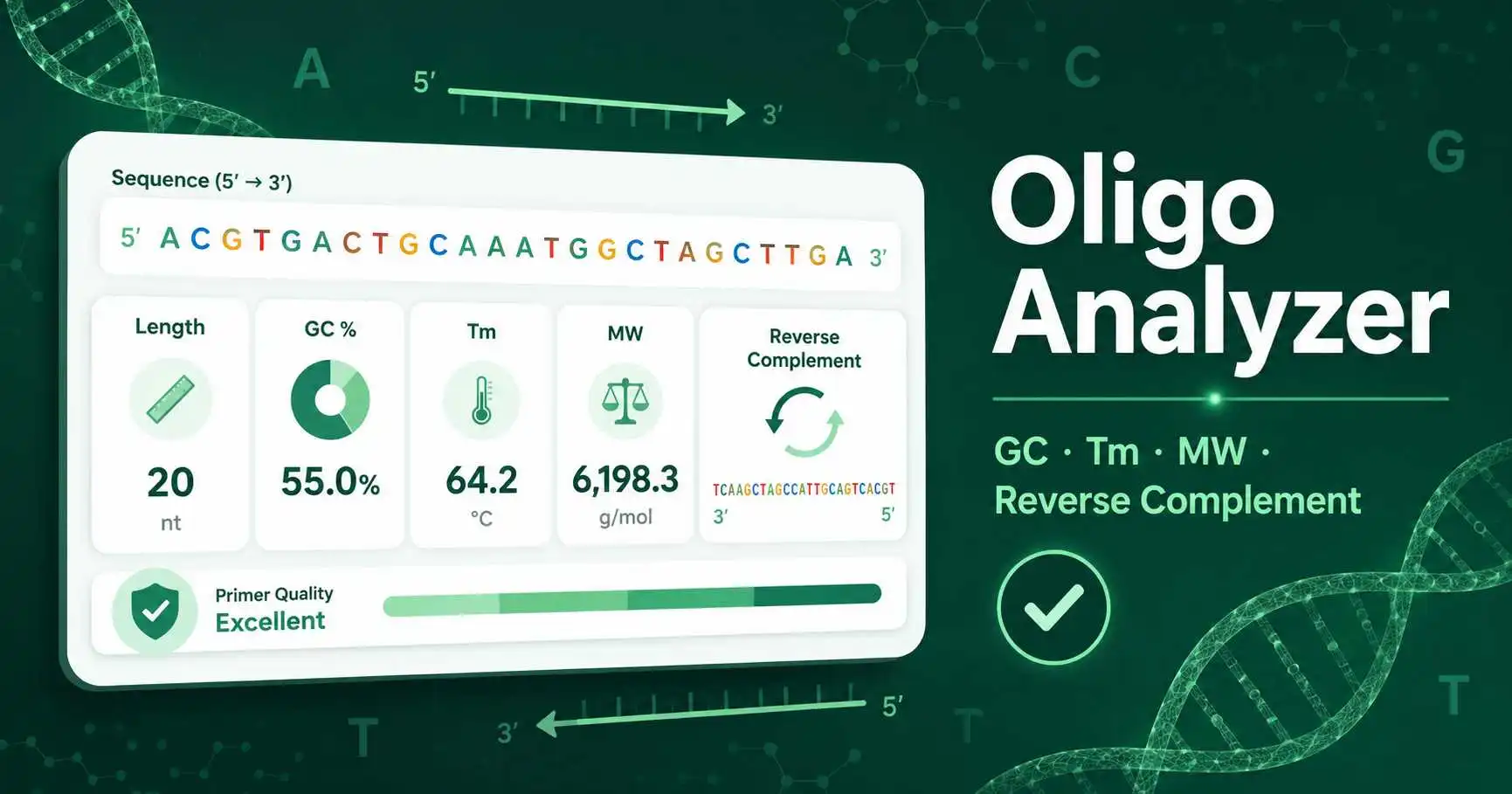
What the Oligo Analyzer calculates
An Oligo Analyzer is a sequence calculator for short DNA or RNA oligonucleotides. It helps you inspect the basic properties of a primer, probe, synthetic oligo, or short nucleotide sequence before you use it in PCR, qPCR, cloning, sequencing, or classroom exercises.
This tool calculates sequence length, base composition, GC content, estimated melting temperature, molecular weight, complement, reverse complement, 3' GC clamp, homopolymer runs, and simple self-complementarity signals. These values help you decide whether an oligo looks reasonable or needs more review.
How to use Oligo Analyzer for DNA or RNA
Paste the sequence in the input box and choose DNA or RNA mode. DNA mode accepts A, C, G, and T. RNA mode accepts A, C, G, and U. You can paste a plain sequence or a FASTA-style sequence. The tool ignores FASTA headers, spaces, line breaks, and numbers.
Use Basic mode for quick primer checks. Use Advanced mode when you want to adjust monovalent salt concentration for the Tm estimate. The result cards show the most important values first, so students and lab workers can scan the output quickly.
Oligo Analyzer formulas and assumptions
GC content is calculated as G plus C divided by total valid bases, then multiplied by 100. AT content for DNA and AU content for RNA are calculated in the same way. Molecular weight is estimated from standard unmodified single-stranded nucleotide residue masses.
For short oligos below 14 bases, this tool uses the Wallace rule: 2°C for each A or T/U base and 4°C for each G or C base. For longer oligos, it uses a salt-adjusted empirical estimate. These formulas are helpful for education and quick screening, but they are not a full nearest-neighbor thermodynamic model.
If you need a more detailed vendor-style check before ordering primers, compare the result with the IDT OligoAnalyzer, which includes oligo properties such as Tm, GC content, molecular weight, and secondary-structure checks. IDT OligoAnalyzer
Oligo Analyzer results for PCR primers
For many routine PCR primers, a length near 18-25 nucleotides, GC content around 40-60%, and a Tm near 55-65°C are common starting targets. These are not fixed rules. A primer can still work outside these ranges if the template, polymerase, annealing temperature, and assay design support it.
The 3' end matters because DNA polymerase extends from that end. A modest GC clamp can improve binding, but too much 3' complementarity can increase primer-dimer risk. This analyzer gives a simple warning when the 3' end may pair with another part of the same oligo.
For a deeper temperature-focused check, compare this page with the Primer Tm Calculator. If your main question is only the percentage of G and C bases, use the GC Content Calculator.
Common mistakes before ordering an oligo
Do not mix DNA and RNA letters in the same mode. If your sequence contains U, choose RNA mode. If your sequence contains T, choose DNA mode. Also avoid copying primer names, punctuation, or ambiguity codes into a simple exact-sequence calculation unless the tool supports those symbols.
Check the direction of the sequence before you interpret the reverse complement. Most primer sequences are written 5' to 3'. If you paste a sequence in the wrong direction, the reverse complement and 3' end interpretation will not match your intended primer design.
Long homopolymer runs, very low GC content, very high GC content, and strong self-complementarity can make amplification less reliable. This tool flags these issues, but it does not replace experimental optimization or a full primer design workflow.
Who should use this Oligo Analyzer
Biology students can use it to understand nucleotide composition, primer Tm, and reverse complement logic. Chemistry students can use it to connect molecular weight with concentration calculations. Teachers can use it for classroom examples, worksheets, or practical molecular biology demonstrations.
Lab workers and researchers can use it for quick screening before a more detailed check. It is useful when reviewing primers for PCR, checking short synthetic DNA, preparing a simple lab report, or explaining why two primers with different GC content may need different annealing temperatures.
What to verify before real lab use
Verify the final sequence, strand direction, target specificity, primer pair compatibility, expected amplicon size, polymerase recommendation, annealing temperature, and supplier-specific modification details. For qPCR, also check primer efficiency, standard curve behavior, melt curve quality, and no-template controls.
Treat this Oligo Analyzer as a fast educational and planning tool. For critical experiments, confirm the design with your lab protocol, supplier tool, supervisor, or a validated thermodynamic model.