
Protein and peptide analysis
Peptide Mass Calculator
Calculate peptide molecular mass, kDa, m/z, and practical nmol-to-microgram conversion values from an amino acid sequence.
Peptide mass calculator
Calculate peptide mass and m/z
Paste a peptide sequence, choose average or monoisotopic residue masses, and add simple modification shifts.
Monoisotopic mass
2.846 kDa · 26 amino acids
1,423.876
2+
2.846 µg
0.003 µg
0 Da
Peptide Mass Calculator formula
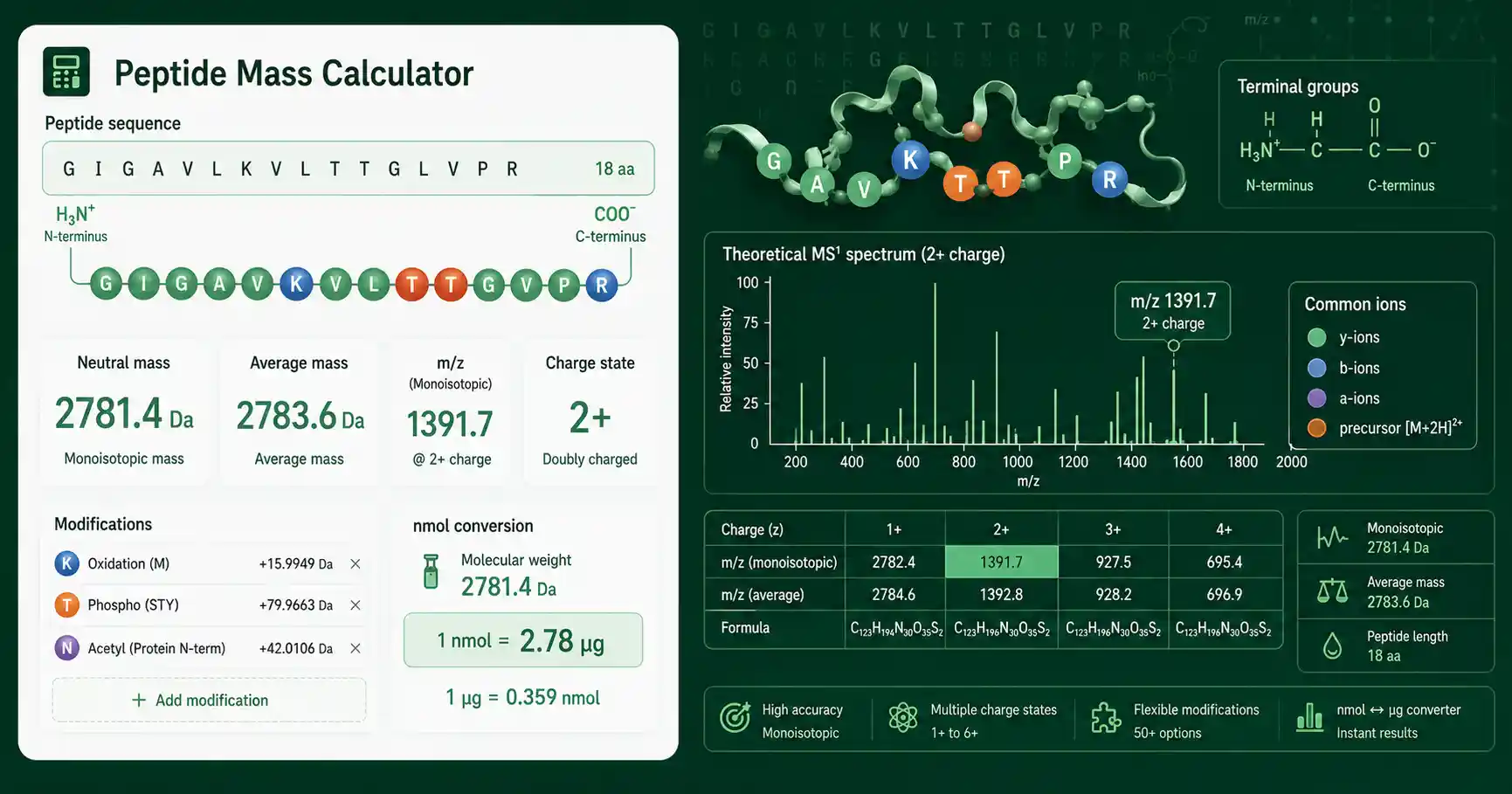
This calculator estimates peptide mass from a one-letter amino acid sequence. It sums residue masses and adds the mass of water for the free N-terminus and C-terminus. You can choose monoisotopic mass for exact-mass checks or average mass for general wet-lab reporting. The tool also converts neutral peptide mass into m/z for a selected charge state by adding protons and dividing by charge.
The basic formula is peptide mass = sum of residue masses + H2O + selected mass shifts. For m/z, the formula is m/z = (neutral mass + z × proton mass) ÷ z. A peptide with a neutral mass of 2781.4 Da at charge 2+ gives an m/z near 1391.7. The result helps with peptide ordering, sample preparation, and mass spectrometry planning.
Peptide Mass Calculator worked example
Given peptide sequence: GIGAVLKVLTTGLPALISWIKRKRQQ. Select monoisotopic mass and charge state 2+. The calculator cleans the sequence, counts valid amino acids, adds water, and reports neutral mass. It then calculates m/z for the 2+ ion. The nmol conversion tells you how many micrograms equal one nanomole of peptide.
Use the custom mass shift field when you know a simple total modification mass. Use the oxidation and phosphorylation fields for common quick checks. For complex labels, unusual residues, isotope tags, or protected peptides, verify the final value with your peptide supplier or instrument software.
Practical peptide mass notes
Students can use the page to learn how residue masses form peptide molecular weight. Lab workers can use it to prepare peptide stocks in nmol, pmol, or micrograms. Researchers can use it to compare expected mass with observed mass spectra. Always verify critical lab calculations independently before ordering expensive custom peptides or using mass values in real experiments.
Calculate larger protein molecular weights.Amino Acid Composition Calculator
Check residue counts and percentages.Extinction Coefficient Calculator
Estimate UV280 absorbance from sequence.
Questions About Peptide Mass
Does the result include water?
Yes. The calculator adds one water molecule to the summed residue masses for a free peptide chain.
Can I use the mass for peptide stock preparation?
Yes, for standard peptides. Check supplier documentation when your peptide has special terminal caps, labels, salts, or purity corrections.