
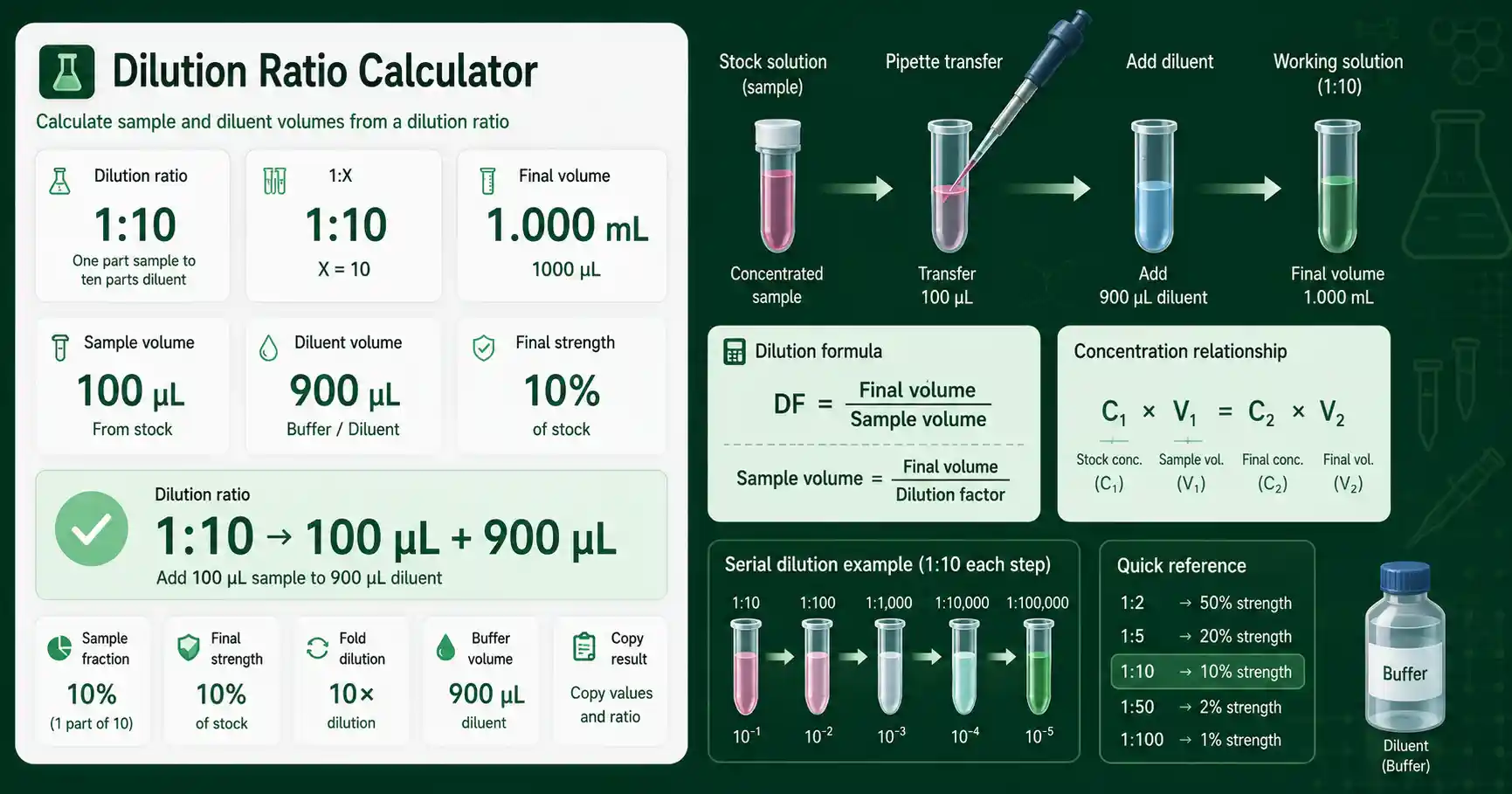
Dilution Ratio Calculator result explained
Dilution Ratio Calculator helps you turn routine laboratory inputs into a clear result without scattered manual arithmetic.
The calculator is designed for students, teachers, wet-lab workers, and researchers who need a fast check before writing a protocol.
It keeps the tool at the top of the page, gives the formula near the result, and shows practical interpretation after the calculation.
The page uses short labels, large input fields, copy buttons, examples, and reset controls so it is easier to use on mobile and desktop screens.
Dilution Ratio Calculator result formula
For a 1:X ratio, sample volume = final volume ÷ X and diluent volume = final volume − sample volume.
The most common mistake is mixing units before the calculation.
Another common mistake is treating a screening estimate as a final experimental guarantee.
This tool avoids silent results when an input is empty, negative, zero, or outside a useful range.
A 1:10 dilution means one part sample in ten total parts, not one part sample plus ten parts diluent.
Dilution Ratio Calculator result worked example
For a 1:10 dilution with 1000 µL final volume, sample volume is 100 µL and diluent volume is 900 µL.
The result tells you what to pipette, what concentration to expect, or what sequence feature was found.
Use the copy result button when you want to transfer the calculation into a notebook, worksheet, or protocol draft.
Practical lab use
Students can use this page to understand the relationship between the input values and the final result.
Lab workers can use it as a quick pre-check before preparing tubes, buffers, standards, or sequence screens.
Researchers can use it to compare alternative setups before selecting the final experimental design.
The calculator is intentionally conservative in its warnings because real samples, instruments, and protocols add context that a browser tool cannot fully know.
Always compare the output with your reagent label, supplier instructions, and local lab protocol.
Questions users often ask
Can I use this result directly in the lab?
Use it as a planning calculation, then independently verify critical values before real experiments.
Why does the calculator reject some inputs?
Values such as zero volume, negative concentration, invalid sequence characters, or impossible dilution conditions would create misleading results.
Does the result replace protocol optimization?
No. It helps avoid arithmetic mistakes, but protocol performance still depends on sample quality, reagent behavior, and assay conditions.
For background reading, see the OpenStax solution concentration section.