
PCR Master Mix Calculator direct answer
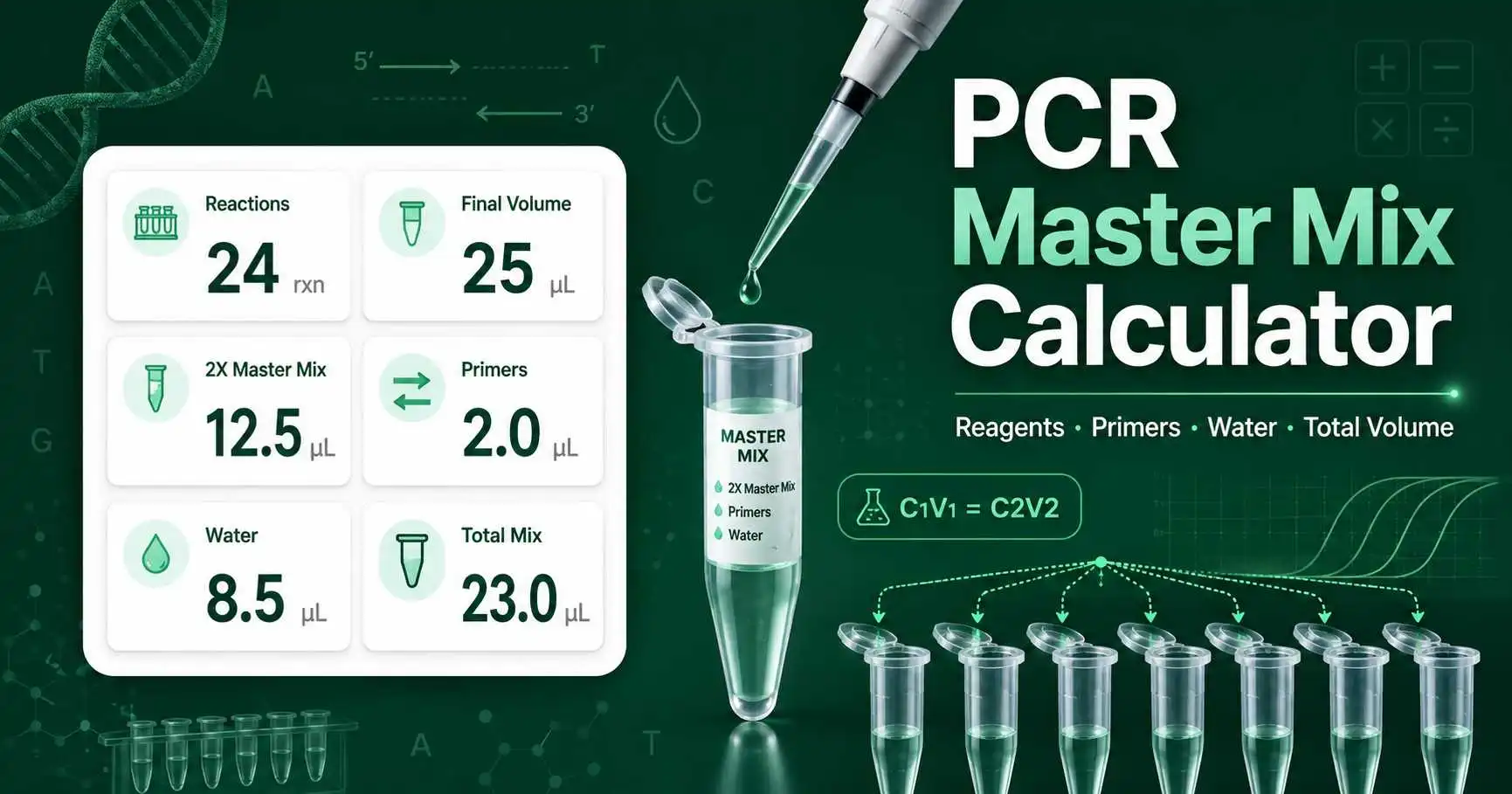
A PCR Master Mix Calculator helps you prepare one shared reagent mix for multiple PCR reactions. It calculates how much water, primer, polymerase mix, buffer, dNTP, MgCl2, and other reagents you need per reaction and for the full batch.
The main goal is simple. You reduce repeated pipetting, keep reaction conditions consistent, and lower the chance of missing a reagent. This is useful for PCR tubes, strips, and 96-well PCR plates.
PCR master mix formula for total volume
The calculator uses the dilution equation for concentration-based reagents:
C1 is the stock concentration. V1 is the volume you add. C2 is the desired final concentration. V2 is the final PCR reaction volume. For primers, the calculator rearranges the equation as V1 = C2 × V2 ÷ C1.
For a 2X PCR master mix, the rule is easier. A 2X mix should become 1X in the final reaction, so it usually takes half of the final reaction volume. In a 25 µL reaction, that means 12.5 µL of 2X master mix.
How to use PCR Master Mix Calculator
Select the PCR mix format first. Choose 2X PCR master mix if your reagent already contains DNA polymerase, reaction buffer, MgCl2, and dNTPs. Choose separate components if you prepare the reaction from buffer, dNTPs, magnesium, polymerase, primers, template, and water.
Enter the number of PCR reactions. Add extra volume for pipetting loss. Many protocols prepare extra master mix because small liquid losses occur in pipette tips and tube walls. Then enter the final reaction volume, template volume, primer stock concentration, and target final primer concentration.
The result table separates master mix components from template DNA. In most experiments, you prepare the master mix without template. You then aliquot the same master mix into each tube or well and add a different template sample separately.
Worked example for 24 PCR reactions
Suppose you need 24 PCR reactions. Each reaction is 25 µL. You use a 2X PCR master mix, 10 µM forward primer, 10 µM reverse primer, 0.4 µM final primer concentration, and 1 µL template DNA. You want 10% extra master mix.
The calculator scales 24 reactions by 10%. That means you prepare enough master mix for 26.4 reactions. For each reaction, 2X master mix is 12.5 µL. Each primer volume is 1 µL because 0.4 × 25 ÷ 10 = 1. Water is 9.5 µL because 25 - 12.5 - 1 - 1 - 1 = 9.5.
For the batch, you prepare 330 µL of 2X master mix, 26.4 µL forward primer, 26.4 µL reverse primer, and 250.8 µL water. You then add 24 µL template separately across the 24 reactions, usually 1 µL per tube or well.
Use case 1: routine PCR tube setup
A student may need to amplify one gene from several bacterial colony templates. The primer pair and PCR conditions stay the same, but each template differs. In that case, the student prepares one master mix without template and adds different colony lysates to separate tubes.
This reduces variation. Each tube receives the same primer concentration, dNTP concentration, polymerase amount, and buffer condition. The only planned difference is the template DNA.
Use case 2: 96-well PCR plate preparation
A lab worker may prepare a PCR plate with many samples and controls. Manual pipetting becomes error-prone when each well needs six or seven separate reagents. A master mix reduces this to one shared mix plus template.
The extra-volume setting is important for plates. Reservoir dead volume and repeated multichannel pipetting can consume more liquid than expected. A 10% overage is often easier than recalculating each component manually.
2X PCR master mix versus custom PCR components
A 2X master mix is convenient. It usually includes DNA polymerase, dNTPs, MgCl2, buffer, salts, and stabilizers. You add primers, template, and water. Sigma-Aldrich describes PCR master mix as a premixed reagent system that can reduce pipetting and mixing errors in PCR setup.Sigma-Aldrich PCR Master Mix
A custom PCR component setup gives more control. You can adjust MgCl2, primer concentration, dNTP concentration, and polymerase amount. This is useful during optimization, troubleshooting, or when your lab protocol requires a specific enzyme buffer system.
Practical PCR setup problem
A teacher can use this calculator in a lab class. Give students a target setup: 16 reactions, 20 µL each, 10% extra, 10 µM primers, and 0.2 µM final primer concentration. Ask them to calculate primer volume by hand and then compare it with the calculator.
The primer volume is 0.2 × 20 ÷ 10 = 0.4 µL per reaction. That small volume is difficult to pipette accurately for one tube, but it becomes easier in a master mix. For 17.6 scaled reactions, the primer total becomes 7.04 µL for each primer.
Common PCR master mix mistakes
Do not forget to exclude template DNA when different samples go into different tubes. Do not include template in the shared mix unless every reaction should receive the same template. Always add negative controls and positive controls when the experiment needs them.
Check units before you calculate. Primer stock is often in µM. dNTP stock may be in mM. MgCl2 stock is usually in mM. Buffer concentration may be written as 10X or 5X. A unit mismatch can create large volume errors.
If your water volume becomes negative, your selected components exceed the final PCR volume. Reduce primer volume, template volume, or reagent volume. You can also increase the final reaction volume if your protocol allows it.
When to use related PCR calculators
Use this calculator when you need reagent volumes for PCR setup. Use the Annealing Temperature Calculator when you need a starting annealing temperature based on primer Tm. Use the PCR Product Size Calculator when you need to estimate the expected amplicon length from primer positions.
A master mix calculator does not design primers or confirm target specificity. It only helps you convert a planned PCR recipe into accurate per-reaction and batch volumes.
What to verify before running PCR
Verify the polymerase datasheet, reaction buffer, MgCl2 requirement, primer concentration, template amount, cycling conditions, expected amplicon size, and control reactions. Also confirm whether your master mix already contains loading dye, MgCl2, or tracking dye.
Treat the output as a planning aid. For real lab work, follow your lab protocol and confirm critical volumes independently before setting up reactions.