
Chemistry reference tool
Periodic Table Tool
Search the periodic table by element name, symbol, atomic number, group, period, category, state, and rounded atomic mass for chemistry learning.
Element lookup dashboard
Search elements, groups, and categories
Filter the periodic table by symbol, name, atomic number, category, period, or group. Click any element to view its learning summary.
Showing the first 24 matches. Add a more specific search term to narrow the list.
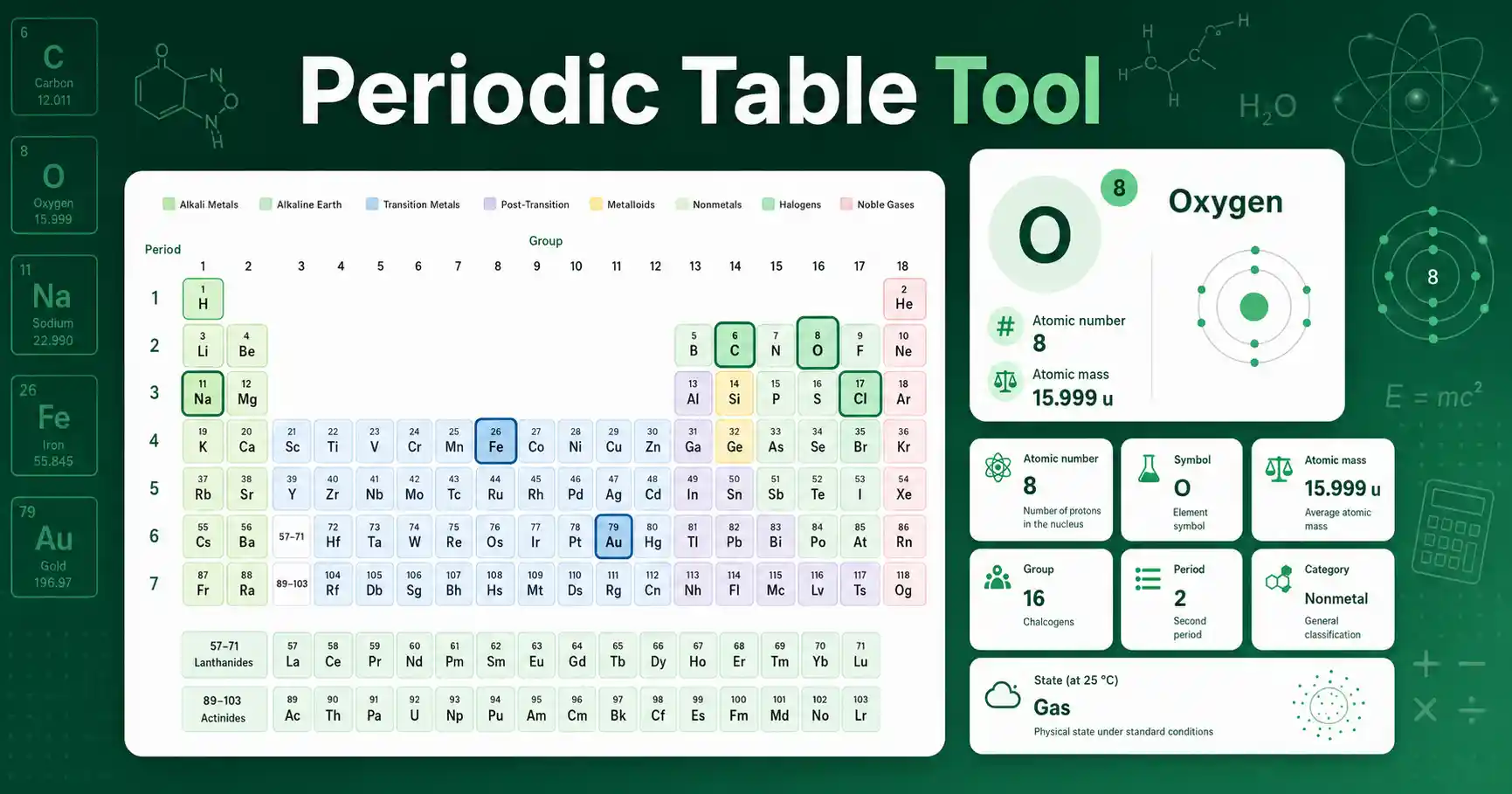
Periodic Table Tool for element lookup
The Periodic Table Tool helps students, teachers, and lab learners find element facts quickly. It brings together atomic number, chemical symbol, element name, rounded atomic mass, group, period, category, and room-temperature state in one searchable interface.
Use the tool when you need to identify an element from a symbol such as Na, Fe, or Cl. You can also search by a full name such as sodium, iron, or chlorine.
The interactive table is useful before using a Molecular Formula Mass Calculator. A formula mass problem depends on the correct element symbols and atomic masses.
The tool is also useful before solving Percent Composition Calculator problems. Percent composition requires each element mass contribution, so element lookup comes first.
How to use Periodic Table Tool correctly
Enter a symbol, name, atomic number, category, group, or period in the search box. The result list updates as you type and the selected element card stays visible for quick reading.
Use the category filter to isolate alkali metals, alkaline earth metals, transition metals, post-transition metals, metalloids, nonmetals, halogens, noble gases, lanthanides, or actinides.
Use the period filter to focus on a horizontal row. Use the group filter to focus on a vertical family when an element has a standard group number from 1 to 18.
Click any tile in the periodic grid or any row in the result list to open that element. Copy the selected element summary when you want a clean note for homework or a lab worksheet.
Read the group, period, and category together. These three fields explain far more than the symbol alone because they connect an element to periodic trends.
Periodic Table Tool method and data assumptions
The periodic table arranges elements by increasing atomic number. Atomic number equals the number of protons in the nucleus, so it defines the element identity.
Periods run left to right across the table. Groups run top to bottom and often show elements with related outer-electron patterns and related chemical behavior.
This tool uses rounded educational atomic masses for quick chemistry calculations. Some elements have natural isotope variation, and some radioactive elements are shown with bracketed mass numbers rather than ordinary standard atomic weights.
For official atomic-weight context and periodic table updates, the International Union of Pure and Applied Chemistry provides a reference periodic table of elements.
Treat the displayed masses as learning values. Use the exact reference table required by your teacher, exam board, instrument method, or laboratory quality system when precision matters.
Periodic Table Tool worked example
Given: a student sees the symbol Mg in a formula and needs to identify the element before calculating mass.
Lookup step: type Mg in the search box or click magnesium in period 3, group 2.
Result: Mg is magnesium, atomic number 12, category alkaline earth metal, with a rounded atomic mass near 24.305 u.
Use in calculation: one Mg atom contributes about 24.305 g/mol to one mole of a compound formula unit.
Interpretation: if the formula is MgCl₂, magnesium contributes one Mg mass unit, while chlorine contributes two Cl mass units.
Check: the group 2 position agrees with magnesium chemistry because alkaline earth metals commonly form 2+ ions in introductory examples.
Periodic Table Tool results explained
The atomic number identifies the element. Hydrogen has atomic number 1, carbon has atomic number 6, and oxygen has atomic number 8.
The symbol is the short chemical abbreviation used in formulas and equations. Some symbols come from Latin names, which is why sodium is Na and potassium is K.
The atomic mass is the value commonly used for molar mass estimates in classroom chemistry. A carbon value near 12.011 means one mole of carbon atoms has a mass near 12.011 grams under the standard convention used for learning.
The category helps you predict broad behavior. Noble gases sit at group 18, halogens sit at group 17, and alkali metals sit at group 1 except hydrogen.
The room-temperature state helps students connect the periodic table to physical observations. Most elements are solids, several are gases, and bromine and mercury are liquids near room temperature.
Periodic Table Tool mistakes to avoid
Do not confuse atomic number with atomic mass. Atomic number counts protons, while atomic mass represents a weighted mass value or a representative isotope mass number.
Do not assume every displayed atomic mass is exact for every sample. Natural isotopic composition can shift measured atomic weight slightly.
Do not treat a period number as a charge. Period tells you the row, not the ion charge.
Do not treat every group as having the same simple charge rule. Introductory trends help, but transition metals and many heavier elements need more context.
Do not copy a symbol with wrong capitalization. CO means carbon and oxygen, while Co means cobalt.
Periodic Table Tool use cases in chemistry
Students can use the tool to decode formulas, write element names, and prepare for molar mass calculations. It gives enough context to move from a symbol to a usable chemistry value.
Teachers can use the tool during lessons on groups, periods, metals, nonmetals, metalloids, and periodic trends. The category filters make it easy to show one family at a time.
Lab learners can use the tool to check symbols on reagent bottles, worksheet tables, and chemical equations. It supports quick reference, not clinical or hazardous handling decisions.
Researchers and wet-lab professionals can use it as a lightweight educational lookup page when explaining formula mass, isotope notation, or elemental composition to students and trainees.
User Queries About Periodic Table Tool
Can I search by atomic number?
Yes. Enter a number such as 8, 26, or 79 to find oxygen, iron, or gold.
Can I search by element category?
Yes. The search box and category filter can narrow the table to metals, nonmetals, metalloids, halogens, noble gases, lanthanides, and actinides.
Can I use the masses for lab reports?
You can use the rounded values for educational estimates when your course allows them. Use the reference table required by your instructor or lab method for assessed or regulated work.
Why does the tool show lanthanides and actinides separately?
The separate rows keep the main table readable. They also show the f-block clearly without forcing a very wide layout on mobile screens.