
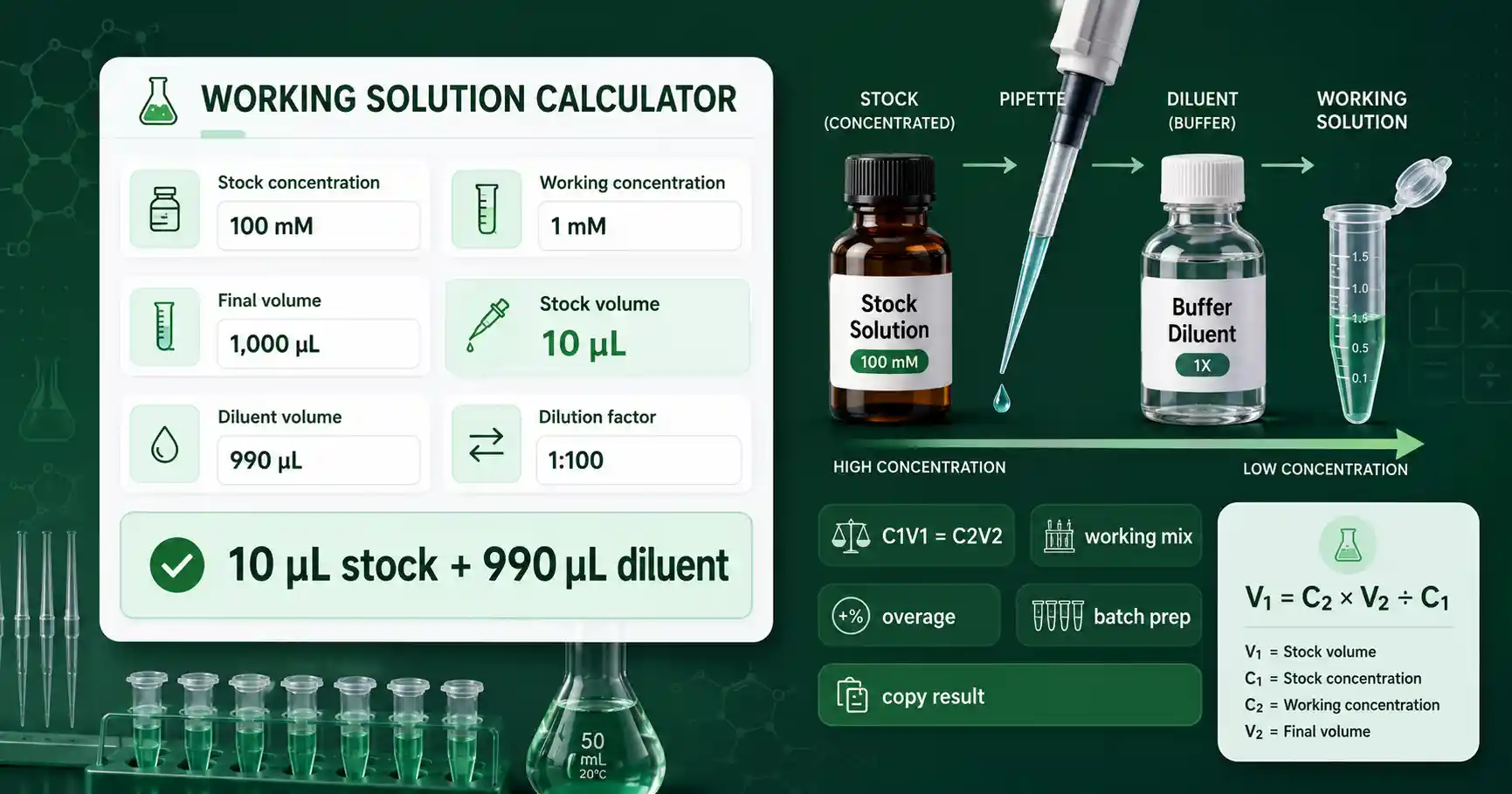
Working Solution Calculator formula for stock dilutions
A working solution is the usable reagent concentration that goes into an assay, reaction, gel, plate, tube, or buffer. A stock solution is usually more concentrated, so you dilute it before use. This calculator uses the dilution relationship C1V1 = C2V2. C1 is the stock concentration. V1 is the stock volume you need to pipette. C2 is the desired working concentration. V2 is the final volume of the working solution.
The tool calculates V1 as C2 × V2 ÷ C1. It then calculates diluent volume as final volume minus stock volume. It also reports the dilution factor, stock fraction, total final volume, and a practical note about pipetting. The calculator accepts molar units such as M, mM, µM, and nM. It also accepts mass concentration units such as g/L, mg/mL, µg/mL, ng/mL, ng/µL, and % w/v. Stock and target units must describe the same type of concentration, because a molar value cannot be directly compared with a mass concentration unless molecular weight is used separately.
Prepare a working solution from a concentrated stock
Use this tool when you already have a stock and need a lower concentration for bench use. For example, you may dilute an antibiotic stock, enzyme substrate, primer stock, antibody stock, inhibitor stock, dye solution, or assay reagent. Enter the stock concentration exactly as it appears on the tube or lab notebook. Enter the working concentration required by the protocol. Enter the final volume you want to prepare. The calculator returns the amount of stock to add first and the amount of diluent needed to reach the final volume.
A good working solution calculation starts with compatible units. A 100 mM stock can be diluted to 10 µM because both values are molar concentrations. A 10 mg/mL protein stock can be diluted to 50 µg/mL because both values are mass concentrations. A 20% w/v stock can be diluted to 1% w/v because both describe mass per volume. Do not mix mM with mg/mL unless you first convert with the correct molar mass. OpenStax gives a helpful overview of molarity and dilution relationships in its solution concentration lesson.
Working Solution Calculator worked example
Suppose you have a 100 mM stock solution and you need 1.0 mL of a 10 µM working solution. Convert 100 mM to 100,000 µM so both concentrations are in the same unit. Use V1 = C2 × V2 ÷ C1. Substitute the values: V1 = 10 µM × 1000 µL ÷ 100,000 µM. The stock volume is 0.1 µL. The diluent volume is 999.9 µL.
The arithmetic is correct, but 0.1 µL is too small for many routine pipetting workflows. A better plan is to prepare an intermediate dilution, such as 1 mM or 100 µM, and then dilute that intermediate into the final working solution. This example shows why calculation and practical pipetting judgment must work together. A calculator can identify the required volume, but the lab worker must decide whether the volume is realistic for the available equipment. Verify critical lab calculations independently before using them in real experiments.
Batch working solution preparation for many reactions
The batch mode helps when one working solution will be used across many reactions or samples. Enter the volume needed per reaction, the number of reactions, and the extra overage percentage. The calculator multiplies the per-reaction volume by the reaction count and then adds overage. It then calculates stock and diluent volumes for the full batch. This is useful for qPCR mixes, enzyme assays, staining solutions, microplate wells, inhibitor treatments, and teaching lab demonstrations.
Overage prevents the final tube from running short after pipette dead volume, liquid clinging to tips, or small handling losses. A 10% overage is common for multiwell work, but your protocol may need more or less. The calculator does not force one overage value because different workflows have different losses. Small-volume microplate work often needs more planning than a single tube dilution. Large-volume buffer preparation may need less overage if the solution is transferred cleanly.
Common mistakes when preparing working solutions
One common mistake is reversing the stock and target concentrations. A dilution only works when the target concentration is lower than the stock concentration. Another mistake is forgetting to convert mL to µL before manual calculation. A third mistake is adding the calculated diluent volume first and then accidentally exceeding the final volume after adding stock. In most protocols, you add stock and diluent so the final mixture volume equals the planned volume.
Another frequent error is treating 1:100 and 100-fold as different when they are often used to describe the same final dilution factor. A 1:100 dilution usually means 1 part stock in 100 total parts. It does not usually mean 1 part stock plus 100 parts diluent. The calculator reports the stock fraction and fold dilution to reduce this confusion. If your protocol defines ratios differently, follow the protocol wording and check the arithmetic.
Working solution use cases in molecular biology
Molecular biology labs use working solutions every day. A concentrated primer stock may be diluted into a PCR working concentration. A dye stock may be diluted before gel loading or staining. A buffer additive may be diluted from a 100× stock into a 1× working concentration. A drug stock may be diluted into cell culture medium for a treatment condition. An enzyme substrate stock may be diluted into an assay buffer immediately before measurement.
If you are preparing concentrated material from powder first, use the Stock Solution Calculator before planning the working dilution. If you want the same equation in a direct dilution layout, the C1V1 C2V2 Calculator can help you solve for stock volume, final volume, or concentration. These related calculations connect reagent preparation, stock storage, and day-of-use dilution. They also make lab notebook entries easier to review because every volume has a clear source.
How to interpret the working solution result
The stock volume tells you how much concentrated solution to transfer. The diluent volume tells you how much buffer, water, medium, or assay diluent to add. The final volume tells you the total volume after stock and diluent are combined. The dilution factor tells you how many times lower the working solution is than the stock. The stock fraction tells you what percentage of the final mixture came from stock.
A large dilution factor can produce very small stock volumes. A very small stock volume can be harder to pipette accurately. A stock fraction above 50% means the target is close to the stock concentration. A stock fraction below 1% may suggest that an intermediate dilution would improve accuracy. The result is a planning aid, not a guarantee of final chemical activity. Solubility, stability, adsorption to plastic, freeze-thaw history, and mixing quality can all affect real working concentration.