
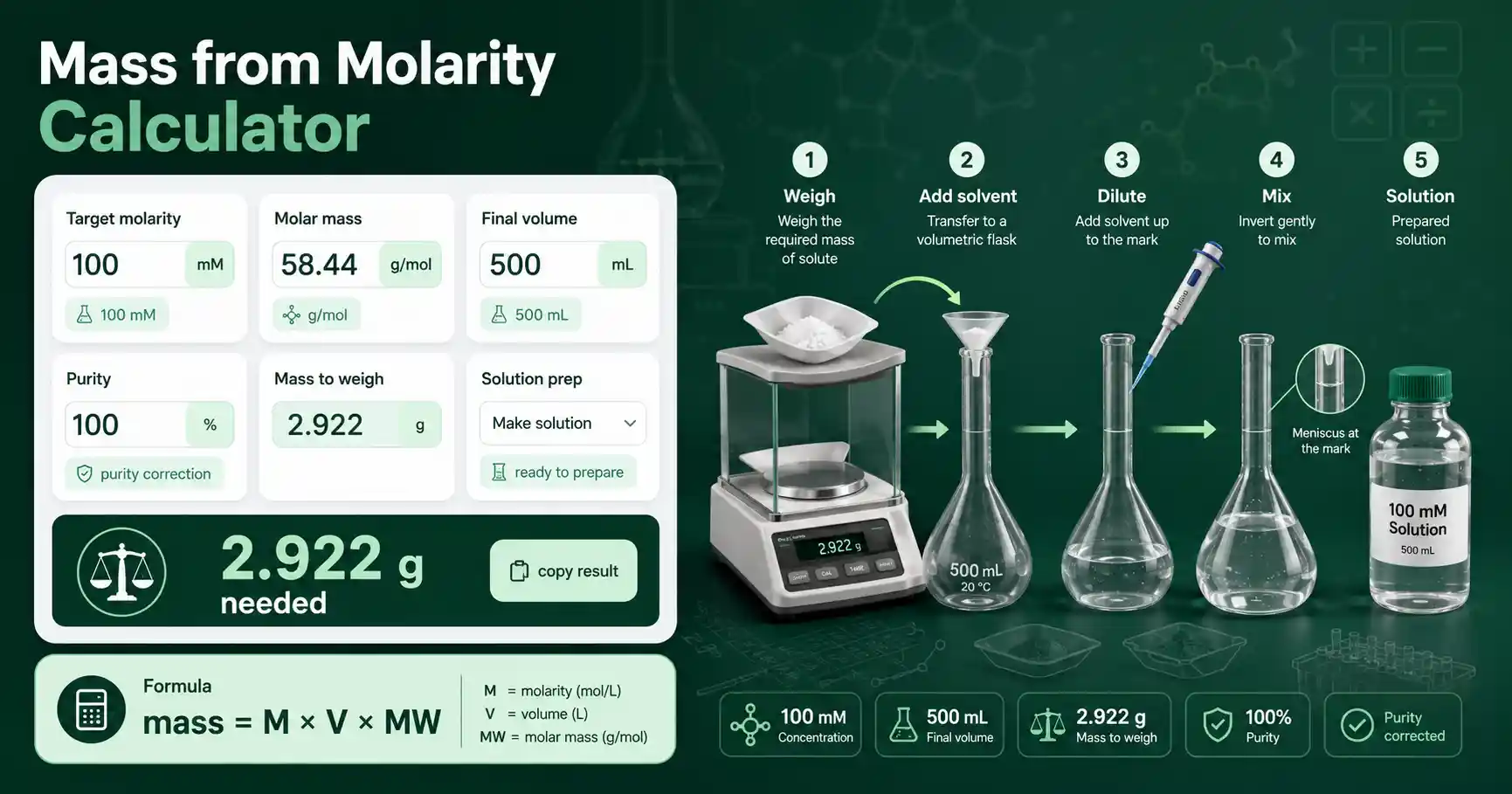
Mass from Molarity Calculator formula
This calculator finds the mass of solute required to make a solution at a chosen molarity. It uses the target concentration, final solution volume, and molar mass. The core relationship is mass equals molarity multiplied by volume multiplied by molar mass. Molarity must be in mol/L for the formula to work. Volume must be in liters for the formula to work. Molar mass must be in g/mol because the final mass is first calculated in grams.
The calculator accepts concentration units such as M, mM, µM, and nM. It accepts volume units such as L, mL, and µL. It converts the units internally before doing the calculation. You can use it for salts, buffers, stains, antibiotics, inhibitors, classroom chemistry solutions, and many molecular biology reagents. It helps avoid common manual errors caused by moving between millimolar, microliter, milliliter, and gram units.
The chemistry definition of molarity is moles of solute per liter of solution, and OpenStax gives a clear introduction to this relationship in its Chemistry 2e molarity section. Use the final solution volume, not the volume of solvent added at the start. A dry compound may change the final volume after it dissolves. In careful preparation, dissolve the solute in less than the final volume and then bring the solution up to the final mark.
Calculate grams from molarity and volume
The calculation starts by converting the target concentration into mol/L. It then converts the final volume into liters. The calculator multiplies these values to find moles of solute. It then multiplies moles by molar mass to find grams of solute. If you use advanced mode, the tool also corrects for reagent purity, overage, and the number of batches.
Purity correction matters when a reagent label lists a purity below 100%. For example, a 98% pure compound needs a slightly higher weighed mass than a 100% pure compound. Overage is useful when you want a small extra amount to cover pipetting loss, dead volume, or transfer loss. Batch count is useful when you prepare several identical bottles or tubes at once. The result card shows the best mass unit so that tiny amounts appear as µg or ng instead of very small grams.
If the calculated mass is very small, you should not automatically weigh it directly. Many lab balances cannot weigh a few micrograms accurately. In that case, prepare a stronger stock solution first and dilute it later with a tool such as the Molarity Calculator. Very small masses are also sensitive to static, moisture, and transfer loss.
Mass from Molarity Calculator worked example
Suppose you want to prepare 500 mL of 100 mM NaCl. The molar mass of NaCl is 58.44 g/mol. The target molarity is 100 mM, which equals 0.100 M. The final volume is 500 mL, which equals 0.500 L. The formula is mass = molarity × volume × molar mass.
Substitute the values as 0.100 mol/L × 0.500 L × 58.44 g/mol. The moles needed are 0.0500 mol. The mass needed is 2.922 g. This means you would weigh 2.922 g of NaCl, dissolve it in less than 500 mL of solvent, and then adjust the final solution volume to 500 mL. If the reagent were 99% pure and you wanted 5% overage, advanced mode would increase the final weighed amount.
The interpretation is simple. The calculated mass supplies the number of moles needed for the target molar concentration. The volumetric step controls the final concentration. Weighing the correct mass but making up to the wrong volume gives the wrong molarity. Using the wrong molar mass also gives the wrong number of moles.
Reagent mass calculation mistakes to avoid
Do not confuse millimolar with molar. A 100 mM solution is 0.100 M, not 100 M. Do not enter molecular weight in kDa or Da unless it matches the g/mol value needed for the formula. For small molecules, formula weight in g/mol is usually the correct value. For proteins and peptides, molecular weight in Da is numerically equivalent to g/mol, but you still need to understand the chemical form being prepared.
Always check whether the reagent is an anhydrous compound, hydrate, hydrochloride salt, sodium salt, or another salt form. The correct molar mass is the molar mass of the exact material on the bottle. If the label says magnesium chloride hexahydrate, use the hexahydrate molar mass. If the label gives assay purity, use advanced mode to correct the weighed amount. If the reagent absorbs water easily, weigh quickly and follow your lab protocol.
This tool calculates a theoretical mass. It does not check solubility, pH, temperature effects, stability, sterility, or safety limits. Some reagents dissolve slowly or require a specific solvent. Some solutions require pH adjustment after dissolution. Some compounds are hazardous and need special handling. Always verify critical lab calculations independently before using them in real experiments.
When this solution preparation tool is useful
Students can use this calculator to learn the connection between moles, molarity, volume, and molar mass. Teachers can use it to build practice problems for concentration units. Lab workers can use it to prepare routine buffers, salts, and reagent stocks. Researchers can use it for quick planning before writing a detailed protocol. The tool is especially helpful when the target volume is in mL but the concentration is in mM.
A common lab use is preparing a 1 M Tris stock, a 100 mM salt solution, or a 10 mM inhibitor stock. Another use is scaling a preparation from 10 mL to 250 mL without rewriting the equation by hand. You can also combine this calculator with the Volume from Molarity Calculator when you know the mass and want to find the final volume instead. Related dilution tools then help convert concentrated stocks into working solutions.