
Tris Buffer Calculator
Calculate Tris base and Tris-HCl amounts from target pH, pKa, total concentration, and final volume. Use it for educational buffer math, protocol planning, and lab report checks.
Calculate Tris buffer amounts
Enter target pH, pKa, concentration, and final volume. The calculator splits total Tris into Tris base and Tris-HCl forms.
Tris buffer recipe
Base fraction: 46.55%. Acid fraction: 53.45%.
Method: Henderson-Hasselbalch ratio using pH = pKa + log10([Tris base]/[Tris-HCl]). Verify critical lab calculations independently before using them in real experiments.
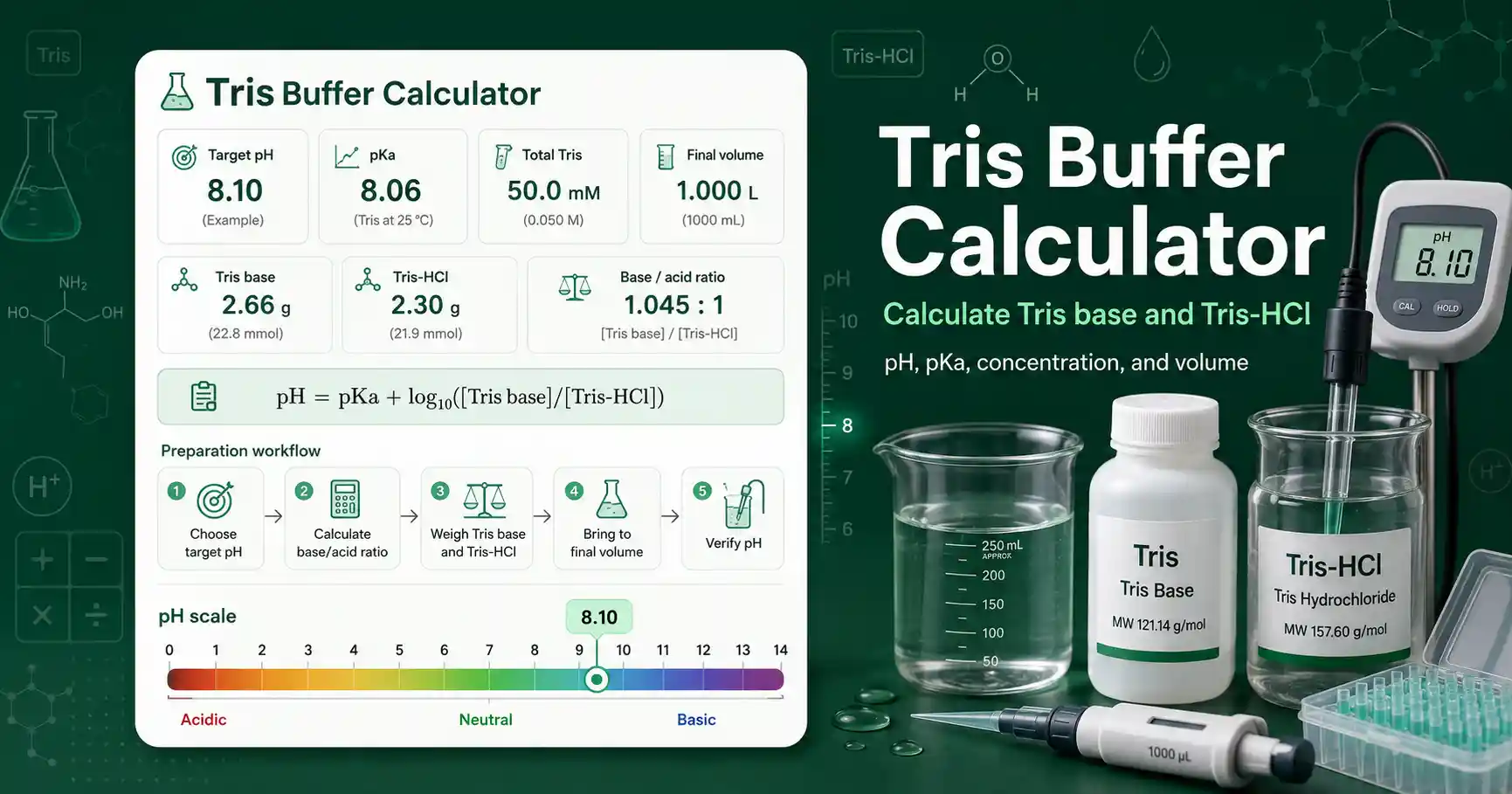
Tris Buffer Calculator for pH and buffer ratio
This Tris Buffer Calculator estimates the amount of Tris base and Tris-HCl needed for a buffer with a chosen pH and total Tris concentration.
The tool uses the Henderson-Hasselbalch equation to split total Tris into its base form and conjugate acid form.
Tris is most useful near its pKa, so a target pH close to 8.06 at 25 °C usually gives stronger buffering behavior.
Students can use the calculator to understand how pH depends on the ratio between a weak base and its protonated form.
Teachers can use it to create quick buffer preparation examples with realistic concentrations and volumes.
Lab workers can use it as a planning aid before checking the final solution with a calibrated pH meter.
Researchers can use it to compare Tris recipes across different pH targets, such as pH 7.5, pH 8.0, and pH 8.5.
For general weak acid and conjugate base mixtures, use the Buffer Preparation Calculator.
For a simple hydrogen ion conversion, use the pH Calculator.
Tris Buffer Calculator formula
The calculation uses pH = pKa + log10([base] / [acid]).
In a Tris system, the base is Tris and the acid form is often represented as Tris-HCl.
The ratio is calculated as [base] / [acid] = 10^(pH − pKa).
After the ratio is known, the calculator divides the total Tris concentration into base moles and acid moles.
It then converts the moles into mass using molecular weights of 121.14 g/mol for Tris base and 157.60 g/mol for Tris-HCl.
The stock volume mode divides the required moles by the stock concentration to estimate how much stock solution to pipette.
A 50 mM Tris buffer means the sum of Tris base and Tris-HCl species is 50 mM before other recipe components are considered.
The final volume should be the volume after all components are dissolved and the solution is brought to mark.
The calculator rounds results for practical lab readability, but it does not imply perfect experimental accuracy.
Chemistry LibreTexts provides a helpful overview of buffer chemistry and acid-base equilibria.
Tris Buffer Calculator result interpretation
A base to acid ratio greater than 1 means the recipe contains more Tris base than Tris-HCl.
A base to acid ratio less than 1 means the recipe contains more protonated Tris-HCl than free Tris base.
When pH equals pKa, the base and acid forms are present at a 1:1 ratio.
A target pH more than one pH unit from the pKa usually gives weaker buffer resistance against added acid or base.
Tris has a strong temperature dependence compared with many buffers, so a recipe calculated at 25 °C may not have the same pH at 4 °C or 37 °C.
Ionic strength, salts, concentrated additives, and electrode calibration can all shift the measured pH.
Always verify critical buffer calculations independently before using them in real experiments.
The calculator is educational and non-clinical, so it should support learning and planning rather than replace protocol validation.
Tris Buffer Calculator worked example
Suppose you need 100 mL of 50 mM Tris buffer at pH 8.00 and you use pKa 8.06.
Given values: pH = 8.00, pKa = 8.06, total Tris = 50 mM, final volume = 100 mL.
Formula: [base] / [acid] = 10^(pH − pKa).
Substitution: [base] / [acid] = 10^(8.00 − 8.06) = 10^−0.06.
Ratio: [base] / [acid] is about 0.871.
Total moles: 0.050 mol/L × 0.100 L = 0.005 mol, or 5 mmol total Tris species.
Result: The recipe needs about 2.33 mmol Tris base and 2.67 mmol Tris-HCl.
Mass estimate: This equals about 282 mg Tris base and 421 mg Tris-HCl.
Interpretation: The slightly lower pH than pKa requires slightly more acid form than base form.
Practical Questions About Tris Buffer Calculator
What pKa should I use for Tris buffer?
Use pKa 8.06 for Tris at about 25 °C unless your protocol gives a different value. Tris pKa changes with temperature, so temperature matters for precise work.
Can this calculator replace pH meter adjustment?
No. It gives a calculated starting recipe, but real buffer pH can shift because of temperature, ionic strength, salts, and measurement conditions.
What does the Tris base to Tris-HCl ratio mean?
The ratio shows how much deprotonated Tris base is present compared with protonated Tris-HCl form at the selected pH and pKa.