
Buffer and molecular biology calculator
TE Buffer Calculator
Calculate Tris and EDTA amounts for TE buffer from final volume, recipe strength, target pH, and optional stock concentrations.
Buffer preparation dashboard
Calculate TE buffer components
Enter a final volume and recipe strength to estimate Tris, EDTA, and optional Tris base to Tris-HCl split for a target pH.
Result
Prepare to 100.0 mL at target pH 8.000.
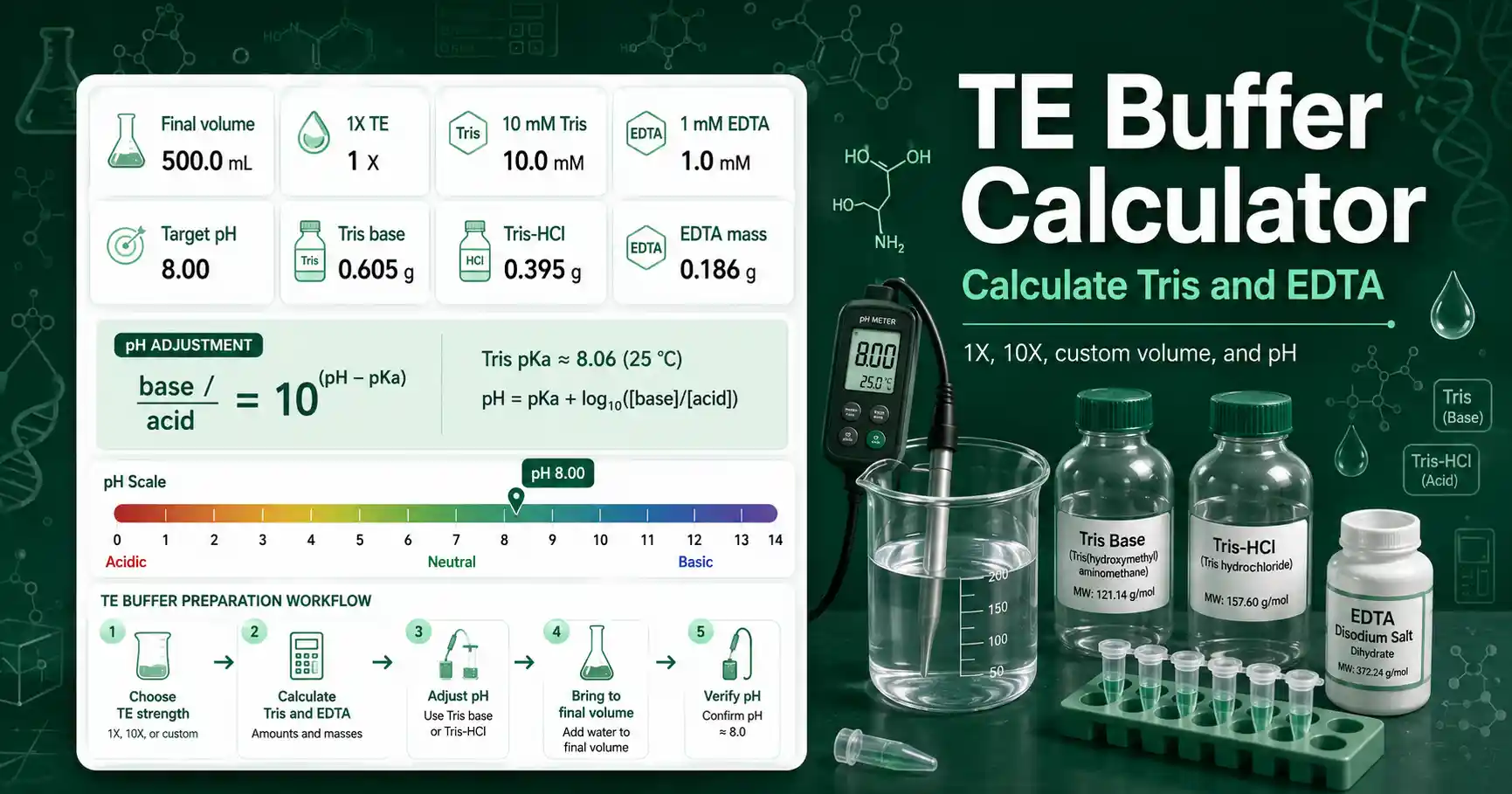
TE Buffer Calculator for Tris and EDTA recipes
This TE Buffer Calculator estimates the Tris and EDTA amounts needed to prepare a selected final volume of TE buffer.
TE buffer is commonly used as a storage and handling buffer for nucleic acid samples in educational and molecular biology settings.
The calculator supports the common 1X recipe of 10 mM Tris and 1 mM EDTA.
It also supports a 10X recipe of 100 mM Tris and 10 mM EDTA when a stronger stock is useful for later dilution.
A custom mode lets you choose any positive Tris concentration and EDTA concentration in millimolar units.
The result shows dry masses for Tris base, Tris-HCl, and the selected EDTA salt form.
The advanced result also estimates stock-solution volumes using the C1V1 = C2V2 dilution relationship.
Use the Tris Buffer Calculator when your main goal is to tune only Tris concentration and pH.
TE Buffer Calculator formula and assumptions
The calculator treats the Tris component as a conjugate acid-base pair made from Tris base and Tris-HCl.
It estimates the Tris base to Tris-HCl ratio from the Henderson-Hasselbalch equation.
The equation is pH = pKa + log10(base / acid).
Rearranging the equation gives base / acid = 10^(pH − pKa).
At pH 8.0 with a Tris pKa of 8.06, the base-to-acid ratio is slightly below 1.
That ratio means the Tris base and Tris-HCl fractions are close, but not exactly equal.
The default Tris pKa is 8.06 at about 25 °C.
Temperature affects Tris pH more than many students expect, so the final pH should be checked under the conditions that matter for the experiment.
EDTA is included as a total concentration calculation, not as a full acid-base speciation model.
For background on buffer calculations, Chemistry LibreTexts explains the Henderson-Hasselbalch approximation and how it connects pH, pKa, acid, and conjugate base.
TE Buffer Calculator results explained
The Tris result gives the total buffer concentration and then splits it into base and acid forms.
The EDTA result gives the mass needed for the selected molecular weight.
Disodium EDTA dihydrate is a common calculation choice, but labels should always be checked before weighing chemicals.
The stock volume result is useful when a lab already has concentrated Tris and EDTA stock solutions.
A stock calculation does not replace final volume adjustment because solids, pH adjustment, and solution mixing can change the working volume.
Bring the solution close to final volume first, adjust pH if needed, and then bring it to the final mark according to your approved lab practice.
Use the Buffer Preparation Calculator when you need a more general acid-base buffer calculation beyond TE.
TE Buffer Calculator worked example
Given values: prepare 100 mL of 1X TE buffer at pH 8.0 using 10 mM Tris and 1 mM EDTA.
Formula for total moles: moles = concentration in mol/L × volume in L.
Substitution for Tris: 0.010 mol/L × 0.100 L = 0.001 mol total Tris.
Substitution for EDTA: 0.001 mol/L × 0.100 L = 0.0001 mol EDTA.
Formula for Tris ratio: base / acid = 10^(pH − pKa).
Substitution for Tris ratio: base / acid = 10^(8.00 − 8.06) = about 0.871.
Result: the calculator assigns about 46.6% of total Tris to Tris base and 53.4% to Tris-HCl.
Result: the EDTA mass is about 37.2 mg when disodium EDTA dihydrate is selected.
Interpretation: the recipe gives a practical 1X TE buffer estimate, but final pH should be verified with a calibrated pH meter.
Practical questions about TE buffer preparation
What is the standard 1X TE buffer recipe?
A common 1X TE buffer recipe contains 10 mM Tris and 1 mM EDTA near pH 8.0.
Can this calculator calculate a 10X TE stock?
Yes. Select 10X TE buffer to calculate 100 mM Tris and 10 mM EDTA for the final volume.
Why does the EDTA salt form matter?
Different EDTA salts have different molecular weights, so the weighed mass changes even when the target EDTA molarity stays the same.
Does this replace checking pH with a meter?
No. The calculator gives a preparation estimate, but final pH should be measured and adjusted when accuracy matters.