
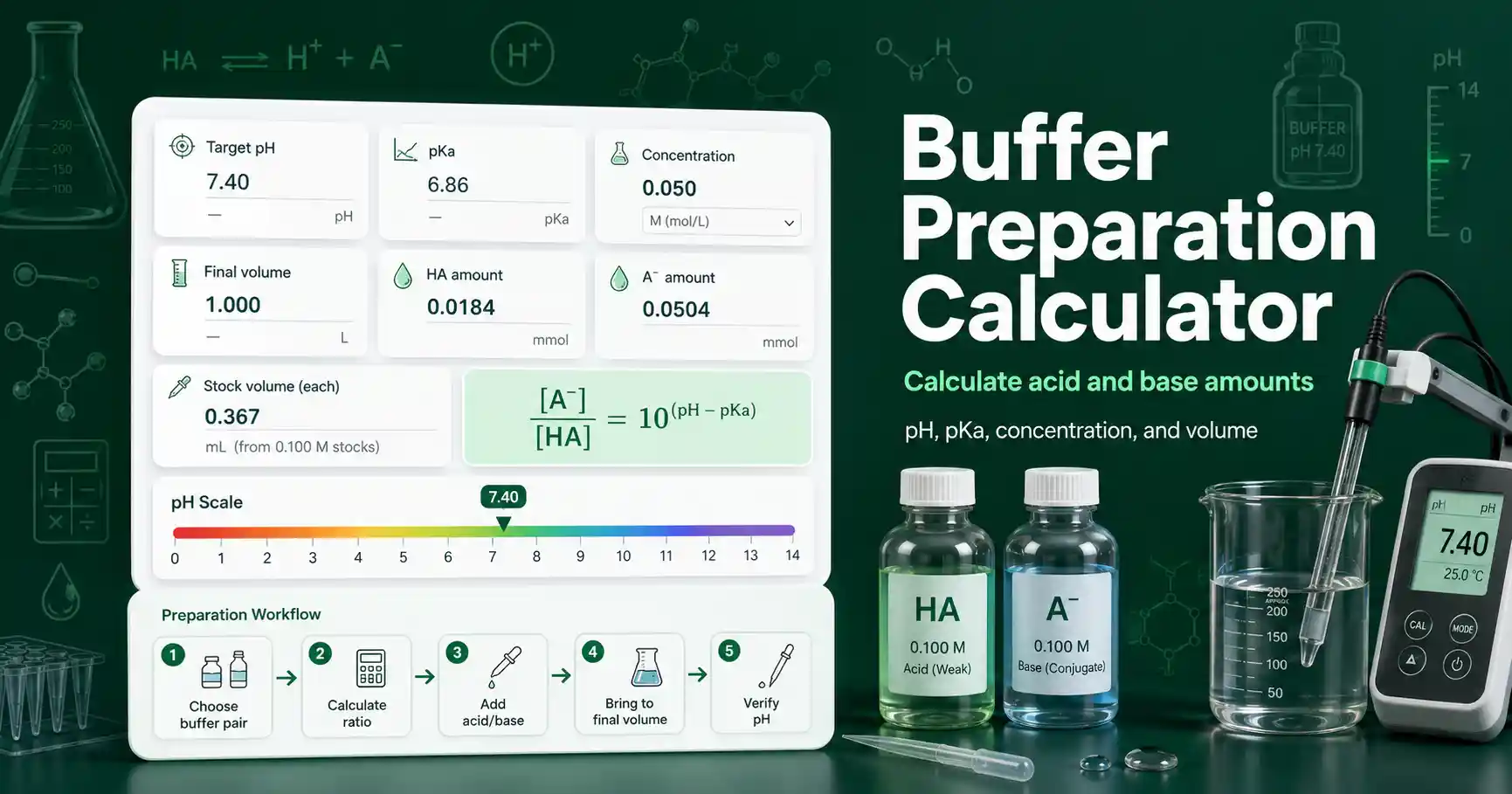
Buffer Preparation Calculator for target pH
The Buffer Preparation Calculator estimates how much weak acid and conjugate base you need for a selected buffer pH.
It uses the target pH, the buffer pKa, the total buffer concentration, and the final solution volume.
The calculator first finds the conjugate base to weak acid ratio from the Henderson-Hasselbalch relationship.
It then splits the total buffer amount into the HA form and the A− form.
This is useful when you want a preparation estimate before making a phosphate, Tris, acetate, or custom buffer.
Students can use the result to connect pH, pKa, and buffer composition in acid-base chemistry problems.
Teachers can use the output to demonstrate why two buffers with the same concentration may need different component ratios.
Lab workers can use the calculator as an educational check before measuring and adjusting a real solution.
Researchers can use it to draft buffer recipes for notes, calculations, and non-clinical educational work.
The tool does not replace a calibrated pH meter because temperature, salt form, hydration state, activity effects, and weighing error can shift the final pH.
For the ratio-only calculation, the method matches the logic used in the Henderson-Hasselbalch Calculator.
For a common neutral biological buffer, the Phosphate Buffer Calculator can provide a more focused workflow.
Buffer Preparation Calculator formula
The main ratio formula is [A−]/[HA] = 10^(pH − pKa).
Here, HA means the weak acid form and A− means the conjugate base form.
The total buffer concentration is treated as [HA] + [A−].
The total moles are calculated as concentration in mol/L multiplied by final volume in liters.
Weak acid moles are calculated as total moles divided by 1 plus the base-to-acid ratio.
Conjugate base moles are calculated as total moles minus weak acid moles.
Advanced mode can convert those moles into stock solution volumes or approximate dry masses when stock concentrations or molecular weights are entered.
A general review of buffer chemistry is available from Chemistry LibreTexts.
Buffer preparation result interpretation
A target pH close to pKa usually gives the strongest practical buffering range for that acid-base pair.
A target pH one unit above pKa requires about ten times more conjugate base than weak acid.
A target pH one unit below pKa requires about ten times more weak acid than conjugate base.
If the target pH is more than two units from pKa, a different buffer system usually makes more sense.
The calculator reports mmol because mmol is convenient for routine lab-scale buffer volumes.
Stock volume results assume the acid and base stocks are already accurately prepared at the entered concentrations.
Dry mass results depend on the exact salt form, hydration state, and formula weight used by the supplier.
Always verify whether your reagent is anhydrous, monohydrate, dihydrate, free acid, or sodium salt before using a mass result.
Rounding matters because a small difference in pH can change the calculated acid-base ratio.
The result is best treated as a starting recipe that should be measured, mixed, and checked carefully.
Verify critical lab calculations independently before using them in real experiments.