
RNA to DNA Converter for sequence work
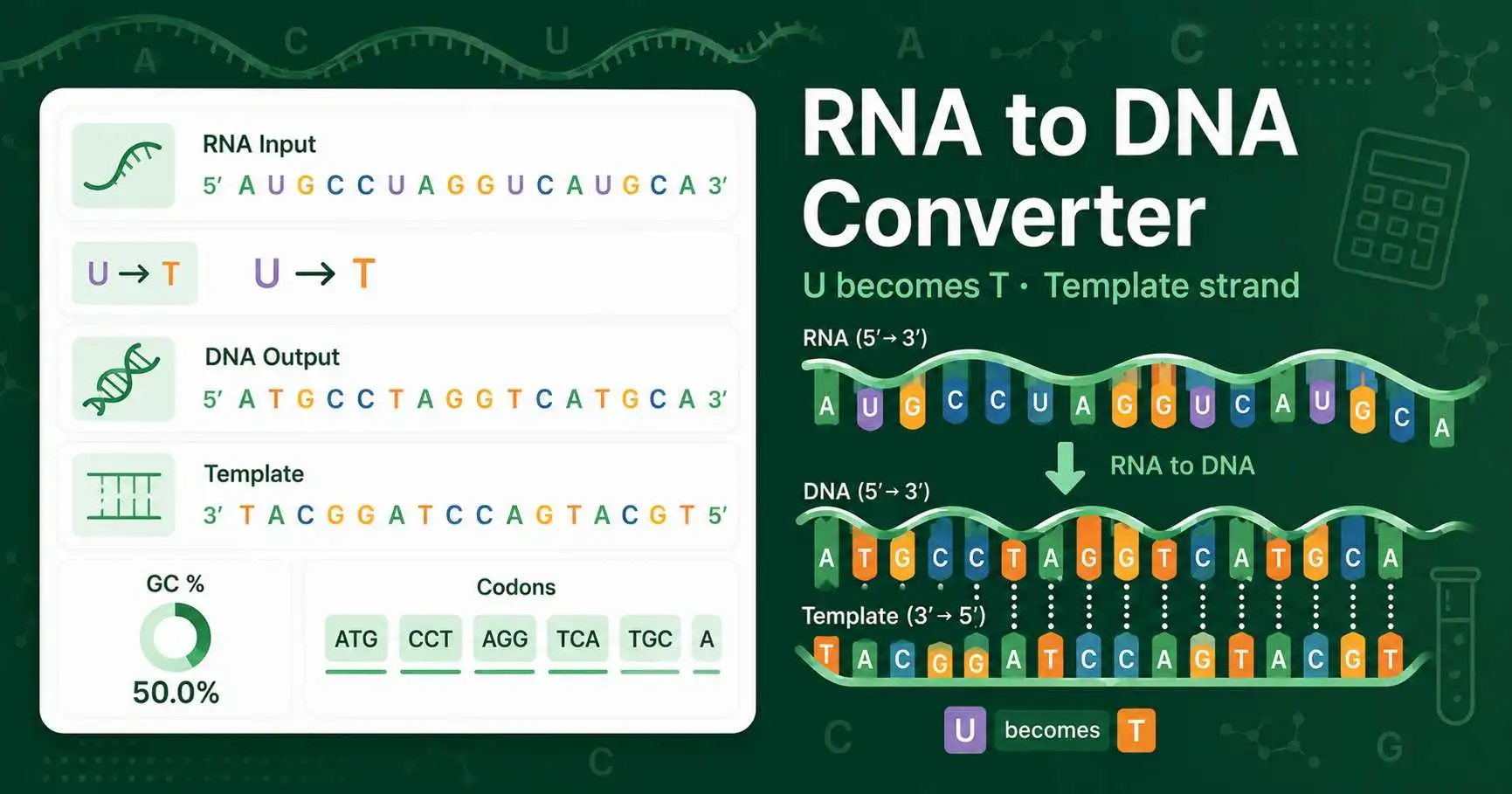
An RNA to DNA Converter changes an RNA nucleotide sequence into a DNA sequence. In the most common coding-strand conversion, the sequence keeps the same 5′ to 3′ order and every uracil base becomes thymine. For example, AUG becomes ATG.
This converter also reports the DNA template complement. That output is useful when you want to understand which DNA strand pairs with the RNA sequence. The result section also shows reverse complement, GC content, AU content, codon count, and base counts.
How to convert RNA sequence to DNA
Paste the RNA sequence into the input box. Use A, C, G, and U letters. The tool ignores FASTA headers, spaces, line breaks, and numbers, so you can paste a sequence from notes or a simple database export.
The DNA coding strand is made by replacing U with T. The sequence direction does not change. The template complement uses base-pairing: A pairs with T, U pairs with A, C pairs with G, and G pairs with C.
RNA to DNA output explained
The DNA coding output is usually the result students need when they ask how to convert mRNA to DNA. It looks like the RNA sequence, but it uses thymine instead of uracil. The DNA template complement is the paired DNA strand, not the same as the coding strand.
The reverse complement is helpful when you need the opposite strand in 5′ to 3′ direction. For primer planning, compare the converted result with a Primer Tm Calculator and check sequence composition with a GC Content Calculator.
Formula used for RNA to DNA conversion
Coding DNA conversion uses a direct letter replacement: U becomes T, while A, C, and G stay the same. GC content is calculated as G plus C divided by total valid bases, multiplied by 100.
Codon count is calculated by dividing the sequence length by three and counting only complete codons. If one or two bases remain, the tool warns that the final codon is incomplete for translation reading-frame work.
When RNA to DNA conversion is useful
Students can use this tool to understand transcription in reverse, coding strands, template strands, and codons. Teachers can use it for practice problems about DNA, RNA, base-pairing, and translation.
Lab workers may use it for quick sequence checks when moving between RNA notation and DNA notation. Before using the result in PCR, cloning, qPCR, or synthesis, verify the strand direction, target region, and experimental purpose.
Important strand direction notes
Most biological sequences are written 5′ to 3′. If you paste an RNA sequence in the wrong direction, the DNA coding output will also be in the wrong direction. Always confirm whether your source sequence is mRNA, pre-mRNA, non-coding RNA, template-related RNA, or a reverse complement sequence.
For background on how DNA information is transcribed into RNA, review the transcription overview from the National Human Genome Research Institute.NHGRI transcription glossary