
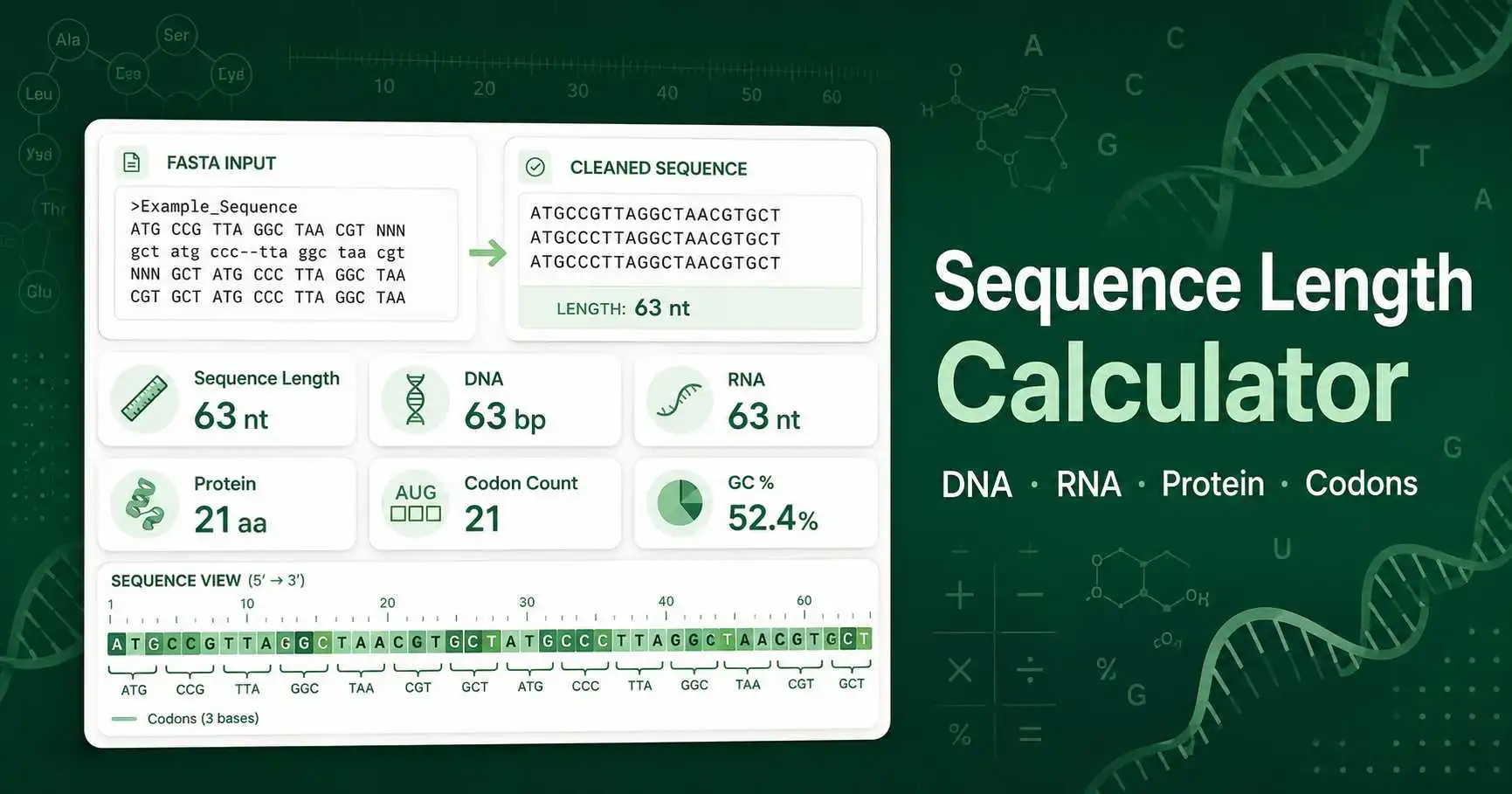
Sequence Length Calculator for DNA, RNA, and protein
A Sequence Length Calculator counts the number of valid symbols in a biological sequence. It helps students and lab workers check DNA length in nucleotides, RNA length in nucleotides, or protein length in amino acid residues.
The tool removes common formatting before it calculates length. It ignores FASTA headers, spaces, line breaks, and numbers. This makes it useful when you paste sequences from worksheets, sequencing files, plasmid maps, primer records, or lab notes.
How the Sequence Length Calculator cleans input
Paste the sequence into the box and choose DNA, RNA, or protein mode. DNA mode accepts A, C, G, T, and common IUPAC DNA ambiguity symbols. RNA mode accepts A, C, G, U, and common RNA ambiguity symbols. Protein mode accepts the standard amino acid letters, stop symbols, and common uncertain residue symbols such as X.
FASTA format often stores a sequence header on a line that starts with a greater-than symbol. This calculator removes that header before counting the sequence. You can review the NCBI guide to FASTA formatting if you need a reference for standard sequence records. NCBI FASTA format
What the sequence length result means
For DNA and RNA, the main result is the number of valid nucleotides. A 900 nucleotide DNA sequence contains 900 bases after cleanup. If the same sequence is coding DNA and starts at the correct reading frame, it can form 300 complete codons.
The calculator also shows leftover bases. A length of 902 nucleotides gives 300 complete codons with 2 leftover bases. That warning matters when you plan translation, ORF checks, cloning inserts, or coding sequence validation.
For protein sequences, the result is the number of amino acid residues. If a pasted protein includes an asterisk, the calculator counts it as a stop symbol and reports it separately. This helps students understand the difference between amino acid length and translated stop notation.
Sequence length, GC content, and base composition
Length alone does not describe a sequence fully. For nucleic acids, this calculator also reports GC content and exact base counts. GC content equals G plus C divided by total valid nucleotide length, then multiplied by 100.
Use the Base Composition Calculator when you need a more detailed base profile. Use the DNA Molecular Weight Calculator when sequence length must be converted into mass, pmol, or copy-number style estimates.
When to use a biological sequence length calculator
Use this tool before PCR primer review, DNA insert checking, RNA transcript review, protein translation checks, sequencing cleanup, and homework calculations. It gives a quick answer when you need to know how many nucleotides or residues are present after formatting is removed.
Teachers can use it to check example sequences before giving class exercises. Students can use it to verify lab report values. Lab workers can use it to confirm sequence records before moving to cloning, primer design, restriction analysis, or molecular weight calculations.
Common sequence length mistakes to avoid
Do not count line numbers from copied sequence files. Do not count FASTA titles as bases. Do not mix T and U unless you understand whether the sequence is DNA, RNA, or a transcript-style conversion. Also check whether ambiguity symbols should be allowed for your assignment or protocol.
For coding sequences, confirm the correct start position and reading frame before interpreting codon count. A sequence can have a valid length and still be in the wrong frame for protein translation.
What to verify before real lab use
Verify the original sequence source, molecule type, strand direction, coding frame, and any ambiguous symbols before using the result in a real protocol. If the result supports cloning, synthesis, sequencing, or protein expression work, compare it with your lab record or validated sequence-analysis software.