
Reverse Complement Generator for DNA and RNA
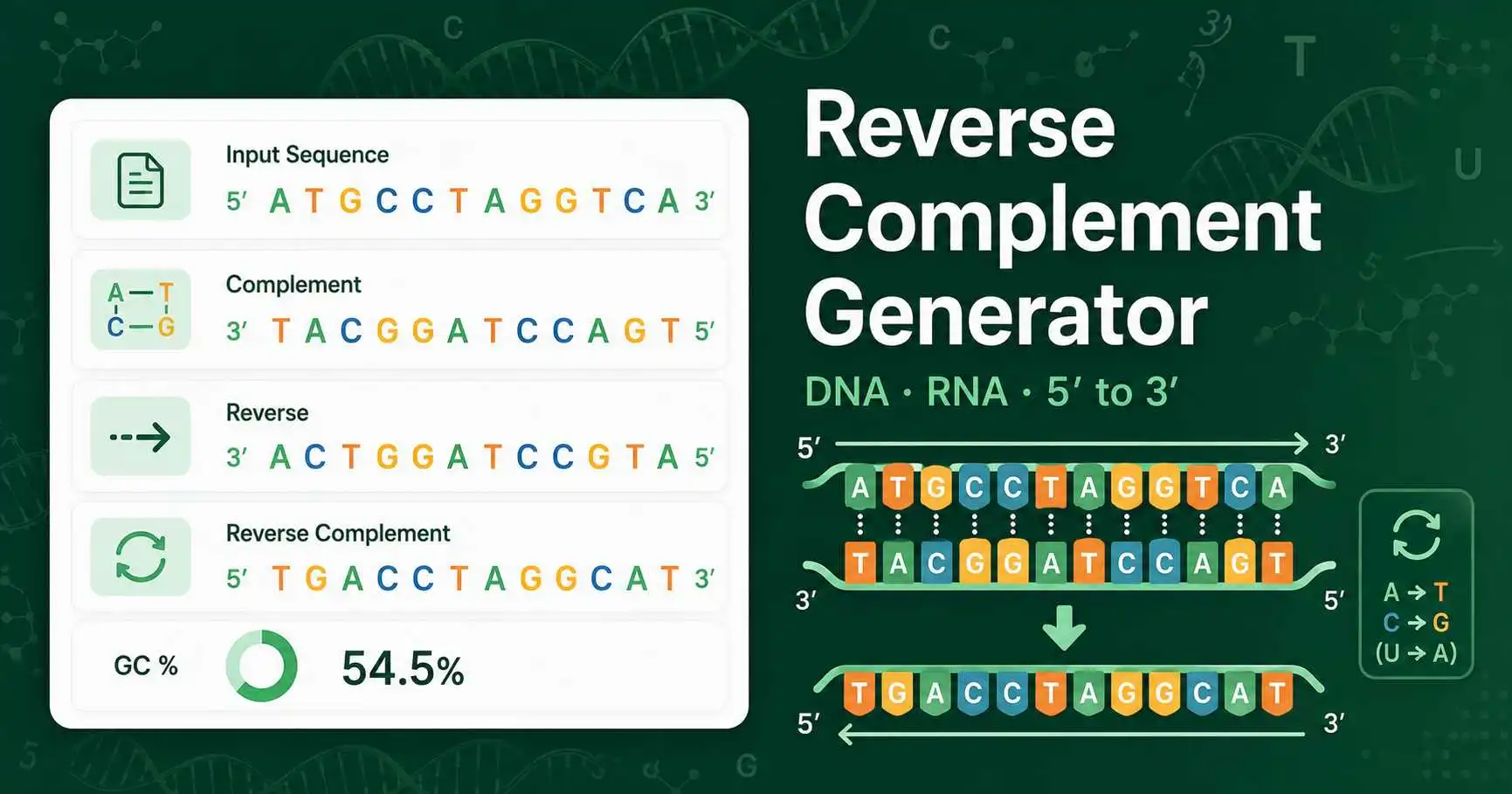
A reverse complement generator converts a nucleotide sequence into the opposite strand sequence written in the correct direction. In DNA, A pairs with T and C pairs with G. In RNA, A pairs with U and C pairs with G. The tool reverses the input sequence and then applies these base-pairing rules.
You can use this page for primers, short synthetic oligos, sequencing reads, restriction site checks, cloning inserts, antisense strand review, and homework problems. It accepts plain sequences and FASTA-style input. It removes spaces, line breaks, and numbers so the output stays clean.
How reverse complement output is calculated
The calculation has two steps. First, the tool makes the complement by replacing each base with its pairing partner. Second, it reverses the complemented sequence so the final output is written 5′ to 3′. This is why a reverse complement is not the same as a simple reversed sequence.
For example, the DNA sequence 5′-ATGC-3′ has the complement TACG. After reversing that complement, the reverse complement is 5′-GCAT-3′. The same logic applies to longer primers and DNA fragments.
Using reverse complements in primer and cloning work
Molecular biology workflows often require strand direction checks. A primer binds to the complementary strand, but the sequence is normally written 5′ to 3′. This tool helps you confirm whether a primer, insert, or target region is shown in the expected orientation.
If you are checking primers, combine this conversion with a primer melting temperature check. If you are reviewing a larger sequence before cloning or annotation, compare the result with the DNA Sequence Analyzer to inspect length, composition, and sequence features.
IUPAC ambiguity codes in reverse complements
This generator supports common IUPAC ambiguity symbols. R changes to Y, Y changes to R, K changes to M, M changes to K, B changes to V, V changes to B, D changes to H, H changes to D, and N remains N. These codes are useful when a sequence position may represent more than one possible nucleotide.
The tool still validates the input. If DNA mode contains U, it asks you to convert or remove it. If RNA mode contains T, it asks you to convert or remove it. This prevents silent mistakes when moving between DNA and RNA notation.
What to check before using the result
Confirm the original strand direction, the molecule type, and whether your sequence uses DNA or RNA bases. Also check whether your source sequence includes adapters, restriction sites, overhangs, or primer tails. These extra regions may be intentional, but they can change how you interpret the output.
For classroom use, this tool shows complement, reverse-only, and reverse-complement outputs side by side. That makes it easier to explain the difference between base pairing and strand orientation. For real lab use, verify critical primer, sequencing, and cloning decisions independently with your protocol or supervisor.
For background on nucleotide base pairing and nucleic acid structure, see the NCBI Bookshelf overview of DNA structure and replication.NCBI Bookshelf DNA structure reference