
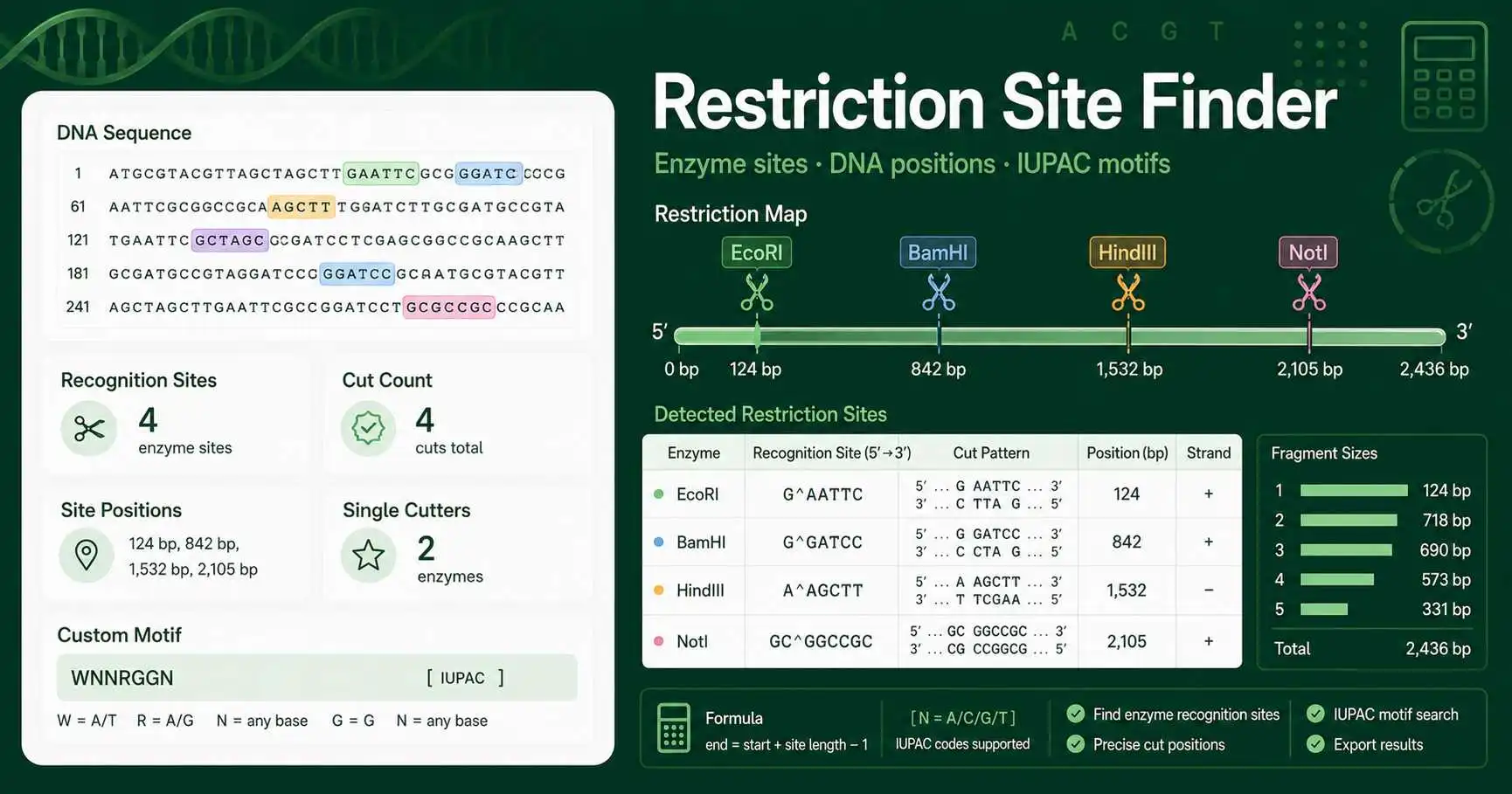
Restriction Site Finder for DNA sequence checks
The Restriction Site Finder scans a DNA sequence for restriction enzyme recognition sites. It helps you see which enzymes cut a plasmid, insert, PCR product, synthetic fragment, or short classroom sequence. The result gives enzyme names, recognition sequences, match positions, strand orientation, and site counts.
Use it when you need a fast answer to questions such as “Does EcoRI cut this sequence?”, “Which enzyme cuts once?”, or “Where is the BamHI site located?” The tool is useful for cloning plans, digest screening, restriction mapping, and molecular biology teaching.
How to use the Restriction Site Finder
Paste a DNA sequence into the tool. FASTA headers, spaces, line breaks, and numbers are removed automatically. Then choose one or more enzymes from the built-in list. You can also enter a custom recognition motif with exact bases or IUPAC ambiguity codes.
The output shows total sites, sequence length, GC content, single cutters, and a table of enzyme counts. The site-position list reports 1-based start and end coordinates, so the first base in your sequence is position 1. This format is easier to compare with plasmid maps and annotated sequence files.
Restriction site formula and matching method
The basic match rule is simple. A recognition site is counted when the DNA sequence contains the enzyme motif. For an exact site such as EcoRI, the tool searches for GAATTC. For a custom motif such as GGNCC, N means A, C, G, or T.
The coordinate formula is: end position = start position + recognition site length − 1. For example, if GAATTC starts at position 12, the end position is 12 + 6 − 1 = 17. The tool also checks reverse-complement orientation for non-palindromic custom motifs when that option is enabled.
Restriction enzymes recognize specific DNA sequences and cut DNA at defined locations. NEB explains that these enzymes identify recognition sequences and create double-stranded breaks that produce sticky or blunt ends. NEB restriction enzyme cloning guide
Worked example: finding EcoRI and BamHI sites
Imagine your sequence contains this region: TTGACGAATTCGATCCGGATCC. EcoRI recognizes GAATTC, and BamHI recognizes GGATCC. If GAATTC begins at position 7, the EcoRI site spans positions 7–12. If GGATCC begins at position 18, the BamHI site spans positions 18–23.
The result tells you that EcoRI cuts once and BamHI cuts once in that short sequence. In cloning, that kind of result may support a simple two-enzyme screening plan. In a full plasmid, you still need to check the complete vector and insert, not only a short copied region.
Use case 1: choose single cutters for plasmid checks
A single cutter appears once in the DNA sequence. Single cutters are useful when you want to linearize a plasmid or confirm that a restriction site is unique. If EcoRI appears once in a plasmid map, an EcoRI digest may produce one linear DNA band close to the plasmid size.
If the same enzyme appears two or more times, it can generate several fragments. That may still be useful, but you should use a fragment-size tool such as the Restriction Digest Predictor to estimate the expected band pattern.
Use case 2: screen insert and vector compatibility
Before cloning, you can scan both the insert and the vector for the same enzyme sites. A useful cloning enzyme should cut at the intended flanking site but should not cut inside an important coding sequence, promoter, tag, or regulatory element.
For example, if your insert contains an internal BamHI site, a BamHI digest may split the insert. In that case, you may choose a different enzyme pair or redesign primers. You can compare enzyme choices with the Double Digest Calculator when planning a two-enzyme reaction.
Custom IUPAC motif search for degenerate sites
Some sequence checks need ambiguous symbols. The custom motif input supports IUPAC DNA codes. R means A or G. Y means C or T. W means A or T. S means G or C. N means any DNA base.
A motif such as GGNCC matches GGACC, GGTCC, GGGCC, and GGCCC. This helps when you search for degenerate restriction-like motifs, engineered adapter sites, primer-added sites, or sequence patterns that allow more than one base at a position.
Common mistakes in restriction site searches
Do not search only the insert if your real digest includes a vector. Check the full plasmid or full PCR product. A hidden internal site can change the expected gel band pattern. Also check both strands when using a non-palindromic custom motif.
Do not assume that finding a recognition site guarantees a successful digest. Enzyme performance depends on buffer, incubation temperature, DNA methylation, enzyme activity, site accessibility, reaction volume, and the number of bases near the DNA end.
What to verify before a real restriction digest
Verify the enzyme name, recognition sequence, cut position, methylation sensitivity, buffer compatibility, star activity risk, incubation temperature, and supplier protocol. For double digests, check whether both enzymes work in the same buffer and whether the total enzyme volume stays within recommended limits.
Treat this calculator as a planning and teaching tool. It gives useful sequence-level guidance, but real lab work still needs protocol review and independent verification of critical cloning calculations.