
What does the Percent Recovery Calculator do?
It calculates how much of an expected amount was recovered as a percentage. It can also calculate spike recovery by comparing unspiked and spiked sample measurements.
Analytical chemistry calculator
Calculate percent recovery from recovered and expected values. Use the spike mode when you need matrix-spike recovery from an unspiked sample, spiked sample, and known spike amount.
Analytical chemistry calculator
Calculate percent recovery from recovered and expected values, or use spike mode to calculate recovery from unspiked and spiked sample measurements.
Use the same measurement dimension for compared values. The tool can convert within mass units or within concentration units, but it does not mix the two.
The percent recovery is 92%. This means the recovered value is 8 percentage points below the expected value.
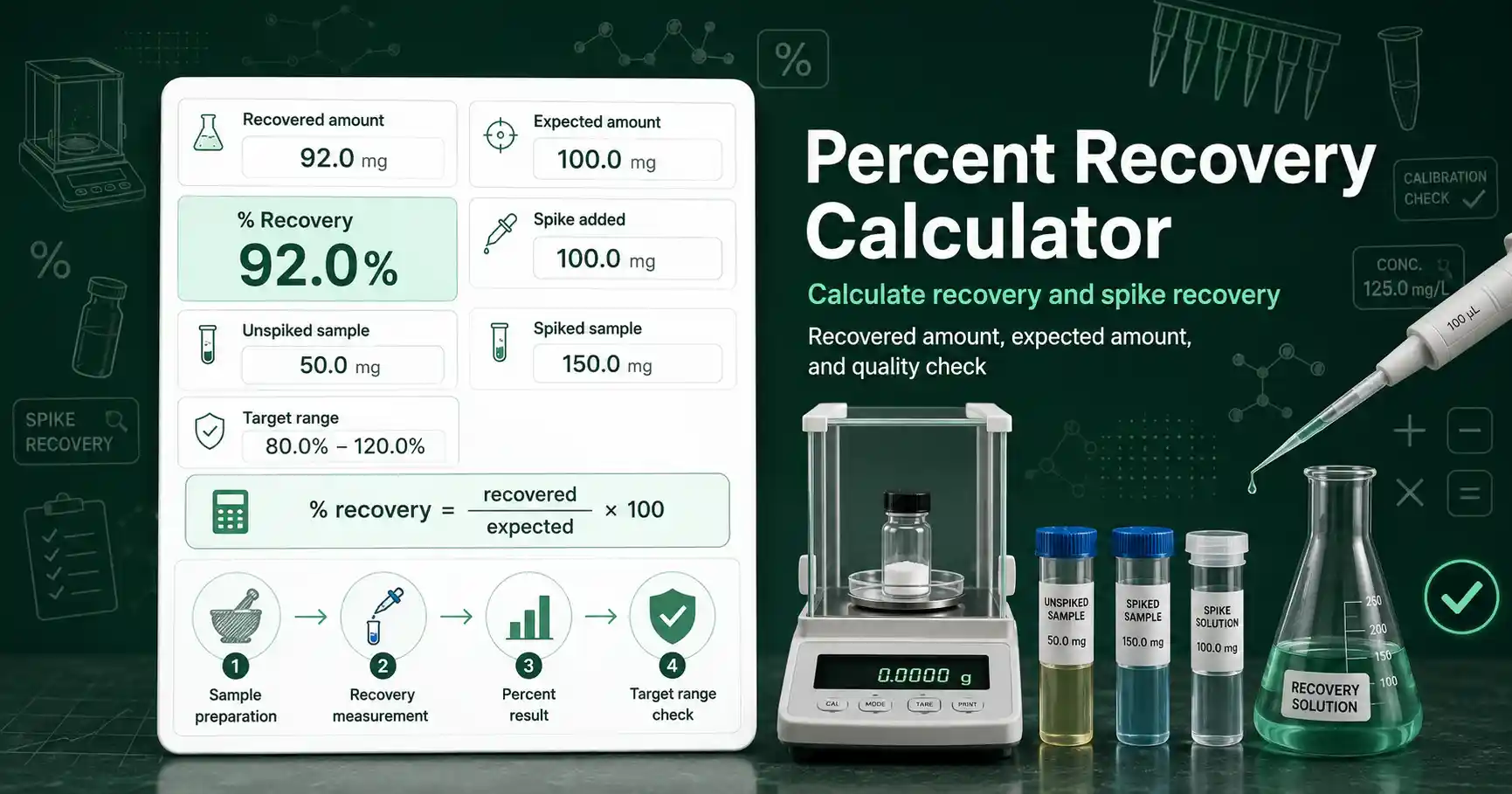
The Percent Recovery Calculator shows how much of an expected amount was actually recovered after a chemistry, biochemistry, purification, extraction, or analytical measurement step.
The basic formula is percent recovery = recovered amount ÷ expected amount × 100.
A result of 100% means the recovered amount equals the expected or starting amount.
A result below 100% means some material, signal, or analyte response was lost relative to the expected value.
A result above 100% means the measured value is higher than expected and should be checked carefully.
The calculator accepts mass units and concentration units, but compared values must use the same measurement dimension.
You can compare grams with milligrams because both are mass units.
You can compare mg/L with µg/mL because both are concentration units.
You should not compare a mass value directly with a concentration value unless you first convert it using the correct final volume.
If you are preparing standards or checking a response curve, the Calibration Curve Calculator can help estimate unknown concentration before you calculate recovery.
If replicate measurements are noisy, the Relative Standard Deviation Calculator can help judge whether the recovery value is precise enough to trust.
Spike recovery is useful when a known amount of analyte is added to a real sample and then measured through the same method.
The spike recovery formula is percent recovery = (spiked sample measurement − unspiked sample measurement) ÷ spike added × 100.
This calculation helps show whether the sample matrix suppresses or increases the measured response.
A low spike recovery can suggest sample loss, extraction inefficiency, matrix suppression, incomplete dissolution, or an instrument response problem.
A high spike recovery can suggest contamination, carryover, matrix enhancement, calibration bias, or an incorrect blank correction.
The calculator lets you set a target recovery range because acceptable recovery depends on the method.
An 80% to 120% target is common in many teaching and screening examples, but it is not universal.
Trace-level work often allows wider recovery limits than high-concentration work because low-level measurements carry more uncertainty.
The Chemistry LibreTexts laboratory material shows percent recovery as a mass recovered divided by original sample mass, expressed as a percentage. Review the LibreTexts recovery calculation example.
A recovery result should always be interpreted with the method, sample type, and measurement uncertainty in mind.
A purification recovery of 75% may be reasonable if the process is selective and some material stays in the mother liquor.
A spike recovery of 75% may be a warning sign if the method requires a tighter quality-control window.
Students can use this calculator to check homework problems involving actual mass, theoretical mass, separated mixture components, or recovered analyte.
Teachers can use it to show why careful weighing, transfer, drying, and blank correction affect the final percentage.
Lab workers can use it for non-clinical recovery checks, extraction exercises, assay training, and quality-control practice calculations.
Researchers can use it during early method development to compare sample preparation conditions.
Rounding matters because a small recovered amount can make a large percentage change when the expected amount is small.
Always keep the original raw values in a notebook or lab report so the recovery calculation can be reviewed later.
Verify critical lab calculations independently before using them in real experiments.
Given values: recovered mass = 0.920 g and expected mass = 1.000 g.
Formula: percent recovery = recovered amount ÷ expected amount × 100.
Substitution: percent recovery = 0.920 ÷ 1.000 × 100.
Result: percent recovery = 92.0%.
Interpretation: the process recovered 92.0% of the expected material, so the loss relative to the expected mass is 8.0 percentage points.
It calculates how much of an expected amount was recovered as a percentage. It can also calculate spike recovery by comparing unspiked and spiked sample measurements.
For basic recovery, it uses percent recovery = recovered amount divided by expected amount, multiplied by 100. For spike recovery, it uses the measured increase after spiking divided by the spike added, multiplied by 100.
Yes. Recovery above 100 percent means the measured or recovered value is higher than the expected value, which may happen because of contamination, matrix effects, weighing error, moisture, calibration bias, or calculation mistakes.
The acceptable range depends on the method and the concentration level. Many teaching examples use 80 to 120 percent as a broad target, but formal analytical methods should follow their own validation criteria.