
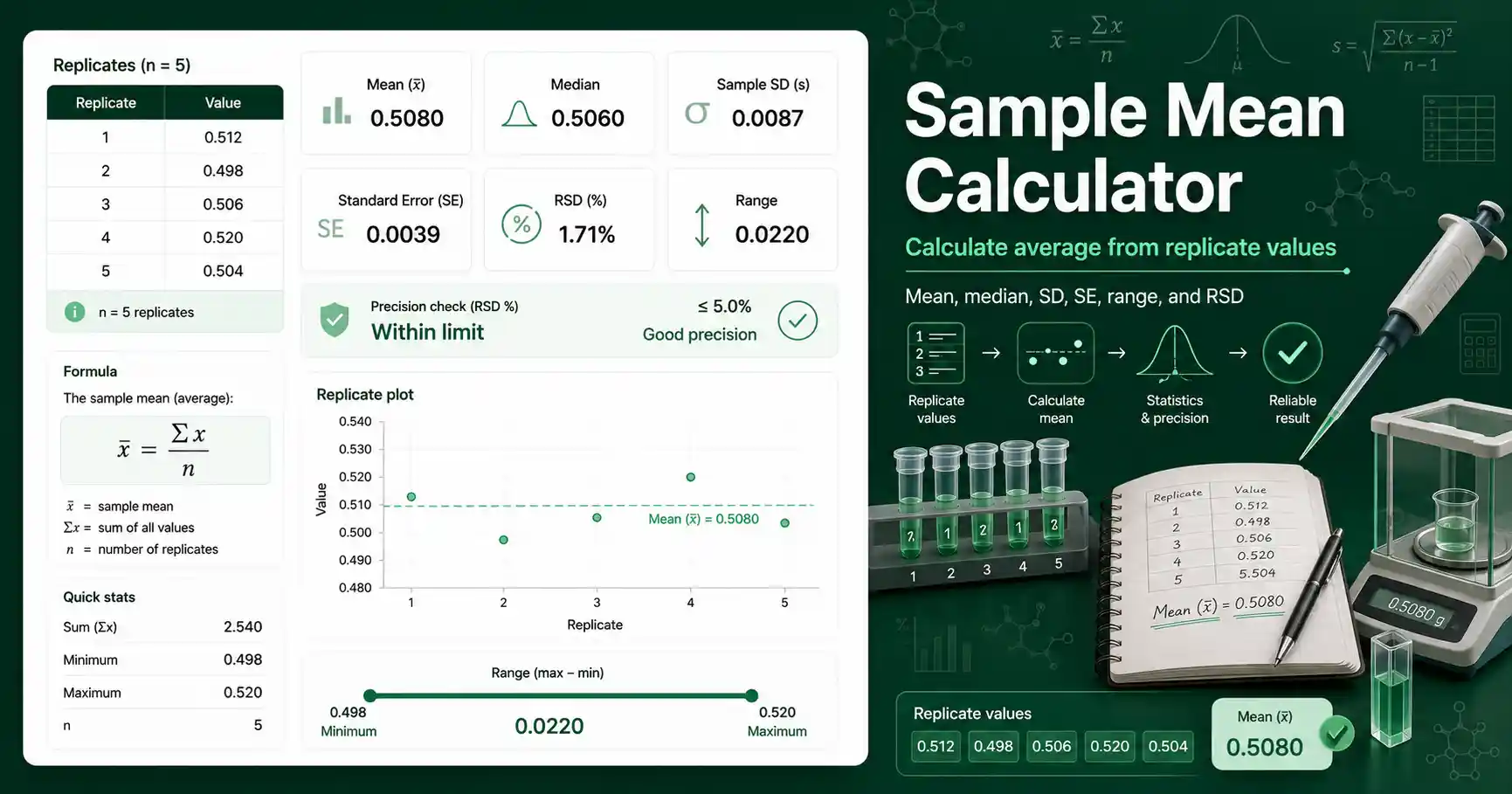
Sample Mean Calculator for replicate values
This Sample Mean Calculator finds the arithmetic mean of a numeric data set. It is useful when you have several replicate measurements and need one representative value. The tool accepts values separated by commas, spaces, semicolons, or line breaks. It works for concentration data, absorbance readings, OD600 values, Ct values, recovery percentages, enzyme rates, and ordinary statistics homework values. The optional unit label appears beside the results, so the output stays clear in lab notes.
The sample mean is the sum of all values divided by the number of values. A data set with values 12.1, 12.4, 12.0, 12.3, and 12.2 has a count of 5. The calculator adds the values first, then divides the sum by 5. It also calculates the median, minimum, maximum, and range so you can see whether the mean represents the data well.
The calculator reports sample standard deviation because most lab replicate sets are samples from a larger measurement process. It also reports population standard deviation for cases where the entered values represent the complete population you want to describe. The standard error estimates how precisely the mean is known from the replicate set. The relative standard deviation, also called coefficient of variation, gives the spread as a percentage of the mean.
Sample Mean Calculator formula and assumptions
The main formula is x̄ = Σx / n. In that formula, x̄ is the sample mean, Σx is the sum of all entered values, and n is the number of values. OpenStax explains the mean as a measure of the center of a data set and shows that it is calculated by adding the data values and dividing by the number of values. OpenStax gives a clear introduction to measures of center.
The tool assumes each entered value is numeric and comparable. Do not mix incompatible units in the same calculation. A list that contains 2.5 mg/mL and 2500 µg/mL without conversion will give a misleading result. Convert all values into the same unit before pasting them. The calculator ignores non-numeric text and tells you which entries were skipped.
The mean is sensitive to outliers. One unusually high or low result can shift the mean more than it shifts the median. Compare the mean with the median when you suspect a pipetting mistake, transcription error, instrument drift, or failed replicate. For deeper precision checks, the Relative Standard Deviation Calculator is useful after you calculate the mean.
Sample Mean Calculator result interpretation
The sample mean gives the central value of your entered measurements. The median gives the middle value after sorting. The range shows the distance from the smallest value to the largest value. Sample standard deviation shows how much individual values spread around the mean. Standard error decreases as the number of consistent replicates increases.
A small RSD suggests that the replicate measurements are close together. A large RSD suggests that the results vary more strongly. The acceptable RSD depends on the method, instrument, concentration range, and teaching or laboratory standard you use. A student may use the output to show the average result in a lab report. A teacher may use it to check homework examples quickly. A lab worker may use it to summarize replicate readings before moving to a calibration curve or quality-control calculation.
Rounding matters because a mean with too many digits can imply false precision. Keep enough decimal places for the method, but avoid reporting more precision than the instrument supports. If the raw readings have one decimal place, reporting the mean to one or two decimal places is usually easier to justify. Verify critical lab calculations independently before using them in real experiments.
Sample Mean Calculator worked example
Given values: 12.1, 12.4, 12.0, 12.3, and 12.2 mg/mL.
Formula: x̄ = Σx / n.
Substitution: x̄ = (12.1 + 12.4 + 12.0 + 12.3 + 12.2) / 5.
Result: x̄ = 61.0 / 5 = 12.2 mg/mL.
Interpretation: The average concentration is 12.2 mg/mL. The values are close to the mean, so the replicate set looks consistent for a simple teaching example.
When to use a sample mean in lab calculations
Use the sample mean when replicate values measure the same sample under the same method. It fits triplicate absorbance readings, repeated concentration measurements, replicate colony counts from comparable plates, and repeated enzyme-rate measurements. It also works for classroom statistics data when the task asks for the arithmetic average. If you need to standardize one value against a mean and standard deviation, use the Z-Score Calculator next.
Do not average values that represent different treatments unless the question asks for a combined group mean. Do not average raw values before correcting obvious unit mismatches. Do not hide failed replicates by deleting them without a documented reason. The calculator helps summarize data, but it does not decide whether a value should be excluded.