
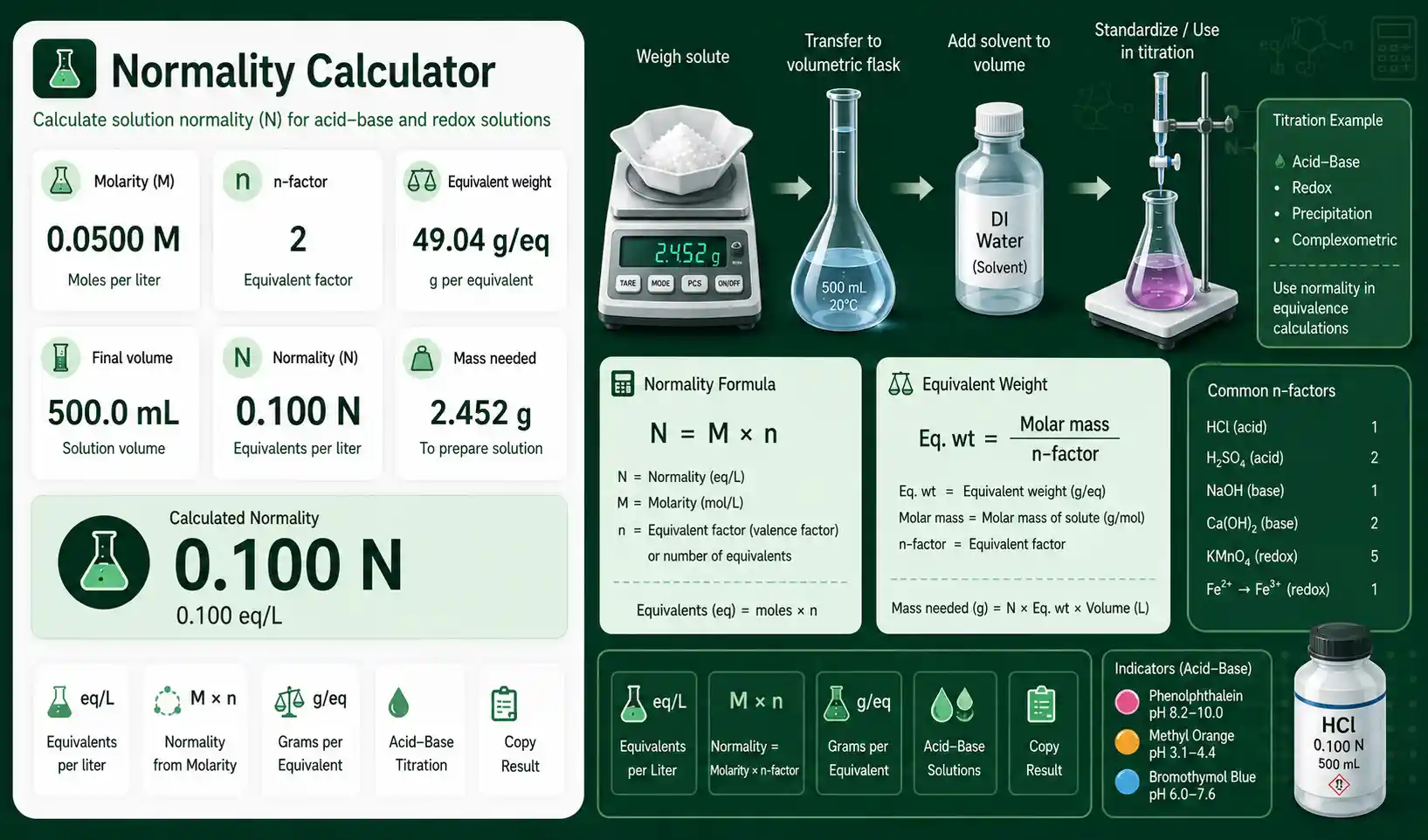
Normality Calculator formula and meaning
Normality measures reactive concentration in equivalents per liter. It is useful when the same molar concentration does not represent the same reacting capacity. The calculator uses normality equals molarity multiplied by the equivalent factor. The equivalent factor is also called the n-factor, valence factor, or reaction factor. A 0.1 M hydrochloric acid solution is 0.1 N because one mole of HCl provides one acidic equivalent. A 0.1 M sulfuric acid solution can be 0.2 N when both acidic protons are neutralized. That difference is why normality is common in titration workflows.
The formula is N = M × n. In this equation, N is normality, M is molarity, and n is the number of equivalents per mole for the reaction being used. You can use the Molarity Calculator first when you need to find mol/L from mass and final volume. Then you can convert molarity to normality with the correct equivalent factor. The tool also calculates equivalent weight when molar mass is available. Equivalent weight equals molar mass divided by the equivalent factor.
Calculate normality from mass and molar mass
The calculator can find normality directly from solute mass. It first converts mass to moles using molar mass. It then multiplies moles by the equivalent factor to obtain equivalents. Finally, it divides equivalents by final volume in liters. This workflow helps when you are checking a prepared reagent bottle, a primary standard, or a titration solution. It also helps students see why the unit N means equivalents per liter rather than moles per liter.
Use the molar mass printed on the reagent label when purity and hydrate form matter. Sodium carbonate, sulfuric acid, and permanganate solutions can require method-specific choices. Normality is reaction-dependent, so the same chemical can have different normality values in different reactions. For general chemistry background on solution concentration units, OpenStax explains concentration in its chemistry text at OpenStax Chemistry 2e. Always match the equivalent factor to the written method, not only to the chemical formula.
Normality Calculator worked example
Suppose you dissolve 4.904 g of H₂SO₄ and dilute the solution to 1.000 L. The molar mass is 98.079 g/mol. The equivalent factor is 2 for complete acid-base neutralization. First calculate moles: 4.904 ÷ 98.079 = 0.0500 mol. Next calculate equivalents: 0.0500 × 2 = 0.100 equivalents. Then divide by volume: 0.100 equivalents ÷ 1.000 L = 0.100 N. The result means the solution has 0.100 acid equivalents per liter for that endpoint.
If the target is 0.100 N H₂SO₄ in 1 L, the mass-needed mode reaches the same answer in reverse. The formula is grams = N × L × molar mass ÷ n. Substitution gives 0.100 × 1.000 × 98.079 ÷ 2 = 4.904 g. This is a calculation aid, not a replacement for your laboratory method. Verify critical lab calculations independently before using them in real experiments.
When normality is useful in the lab
Normality is useful for acid-base titrations because the result tracks proton or hydroxide equivalents. It is useful in redox chemistry because electron transfer can change the reaction factor. It can also appear in precipitation reactions and classical analytical chemistry procedures. Lab workers use it when preparing standards, checking titrant strength, or comparing reagents with different equivalent capacities. Students use it to connect stoichiometry with practical concentration units. Teachers can use this page to show why one liter of 0.1 M acid does not always contain 0.1 equivalents of acid.
Use the Concentration Unit Converter when you need to move between M, mM, µM, ppm, or percent concentration before using normality. Avoid mixing milliliters and liters without conversion. Avoid using a factor of 2 simply because a formula contains the number 2. The factor must come from the actual reaction and endpoint. Do not use normality for biological buffers unless your protocol specifically defines the reacting equivalents. For routine molecular biology dilution work, molarity or mass concentration is usually clearer.