
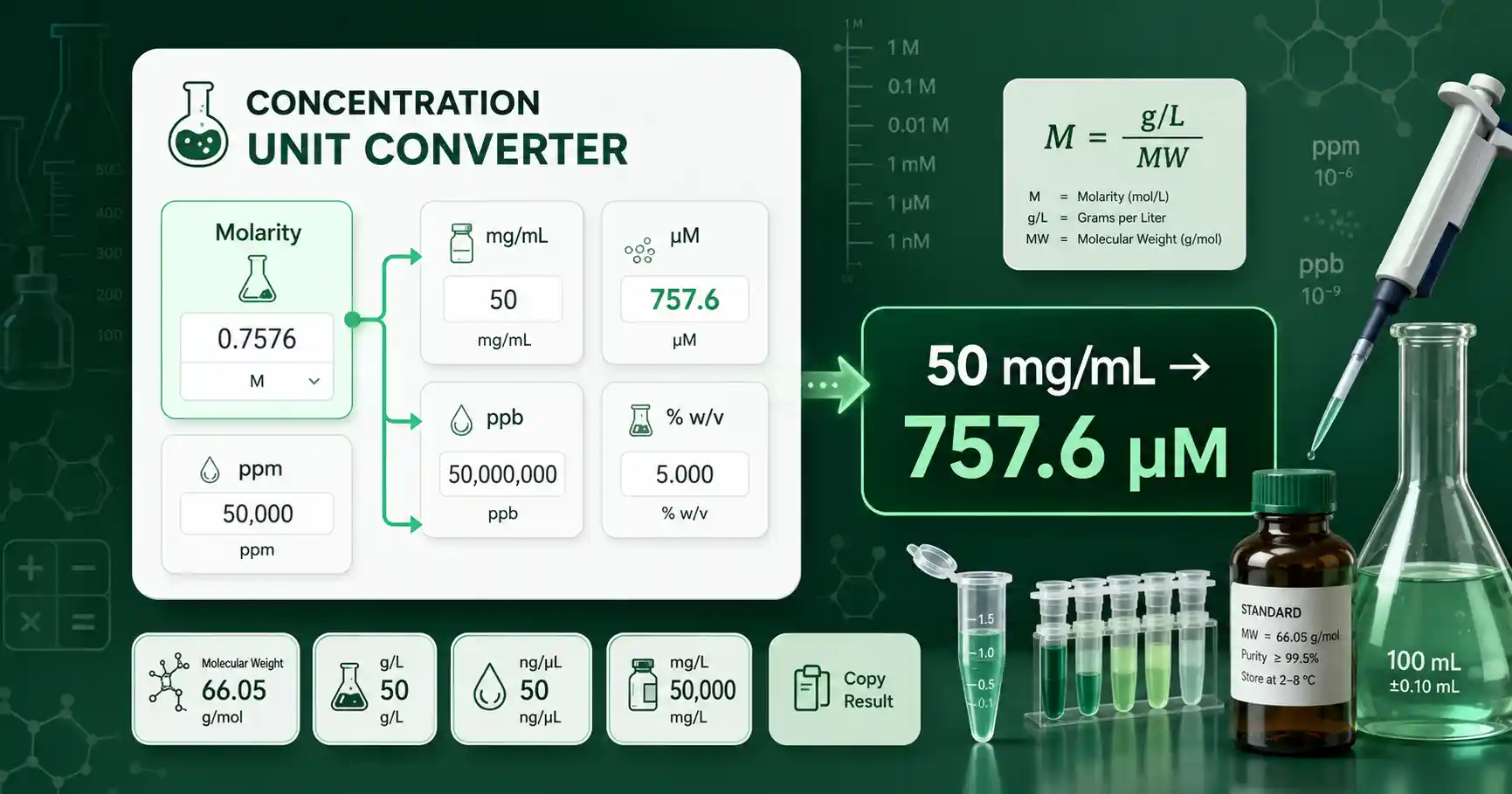
Concentration Unit Converter for common lab units
This concentration unit converter helps you move between units that appear in molecular biology, chemistry, biochemistry, and environmental sample work. It accepts molar units such as M, mM, µM, nM, and pM. It also accepts mass-per-volume units such as g/L, mg/mL, mg/L, µg/mL, ng/µL, µg/L, and ng/mL. The tool also includes ppm, ppb, and percent w/v because these units appear often in reagent labels, stock recipes, and sample reports.
Use it when a protocol gives one unit but your stock tube, datasheet, or assay result uses another unit. Students can use it to understand how concentration scales by powers of ten. Lab workers can use it to check whether a stock concentration matches a working solution target. Researchers can use it to translate protein, oligo, drug, salt, dye, and standard concentrations before planning a dilution.
Convert molarity, mass concentration, ppm, and ppb
Molar concentration describes moles of solute per liter of solution. Mass concentration describes grams, milligrams, micrograms, or nanograms of solute per volume. The converter can move freely inside the molar unit family without molecular weight. It can also move freely inside the mass-per-volume family without molecular weight. A molecular weight is required only when the calculation crosses from molar concentration to mass concentration or from mass concentration to molarity.
For example, mM to µM is a simple scale conversion. One mM equals 1000 µM. One mg/mL equals one g/L. One µg/mL equals one mg/L. One ng/µL also equals one µg/mL, which is a useful shortcut for DNA, RNA, and protein sample labels.
The ppm and ppb options use the common dilute aqueous approximation. In water-like dilute samples, 1 ppm is approximately 1 mg/L and 1 ppb is approximately 1 µg/L. This is a practical laboratory convention, but it depends on density and matrix. For formal chemistry definitions of concentration units, see the OpenStax overview of solution concentration units.
Concentration Unit Converter formula
The main molar-to-mass equation is g/L = M × molecular weight. The reverse equation is M = g/L ÷ molecular weight. These equations work because molecular weight has units of grams per mole. The calculator first normalizes the starting value into either mol/L or g/L, then reports the matching target units.
Percent w/v means grams of solute per 100 mL final solution. A 1% w/v solution equals 1 g per 100 mL, which equals 10 g/L. A 5% w/v solution equals 50 g/L. If molecular weight is supplied, the tool can also express that percent solution as molarity.
Concentration conversion worked example
Suppose a protein stock is labeled as 50 mg/mL, and the protein molecular weight is 66,000 g/mol. First convert 50 mg/mL to 50 g/L because 1 mg/mL equals 1 g/L. Then use M = g/L ÷ molecular weight. Substitution gives M = 50 ÷ 66,000 = 0.0007576 M. That equals 0.7576 mM or 757.6 µM.
The result means the 50 mg/mL stock contains about 758 micromoles of protein molecules per liter if the molecular weight is 66 kDa. This value helps when you need a molar dose rather than a mass dose. It also helps when comparing proteins of different sizes, because the same mg/mL value does not always mean the same molecule count.
When to use this lab concentration converter
Use the tool when a supplier gives concentration in mg/mL but a protocol asks for µM. Use it when a water sample report gives ppm and you need mg/L or ppb. Use it when a reagent recipe gives percent w/v and you want g/L. Use it when a standard curve requires ng/mL but your stock is labeled as µg/mL.
The converter is also useful before using a Molarity Calculator for reagent preparation. It pairs well with a ppm conversion workflow when trace concentration values must be compared across reports. It can reduce manual mistakes caused by micro, milli, nano, and pico prefixes.
Common concentration conversion mistakes to avoid
Do not convert mg/mL to µM without molecular weight. Do not assume ppm equals mg/L in every solvent. Do not treat % w/v and % v/v as the same unit. Do not enter molecular weight in kDa unless you convert it to g/mol first. A protein listed as 66 kDa should be entered as 66,000 g/mol. A small molecule listed as 180.16 g/mol should be entered as 180.16.
Also check whether a protocol describes final concentration or stock concentration. Final concentration is the concentration after all dilution steps. Stock concentration is the concentration in the source tube or bottle. Verify critical lab calculations independently before using them in real experiments.