
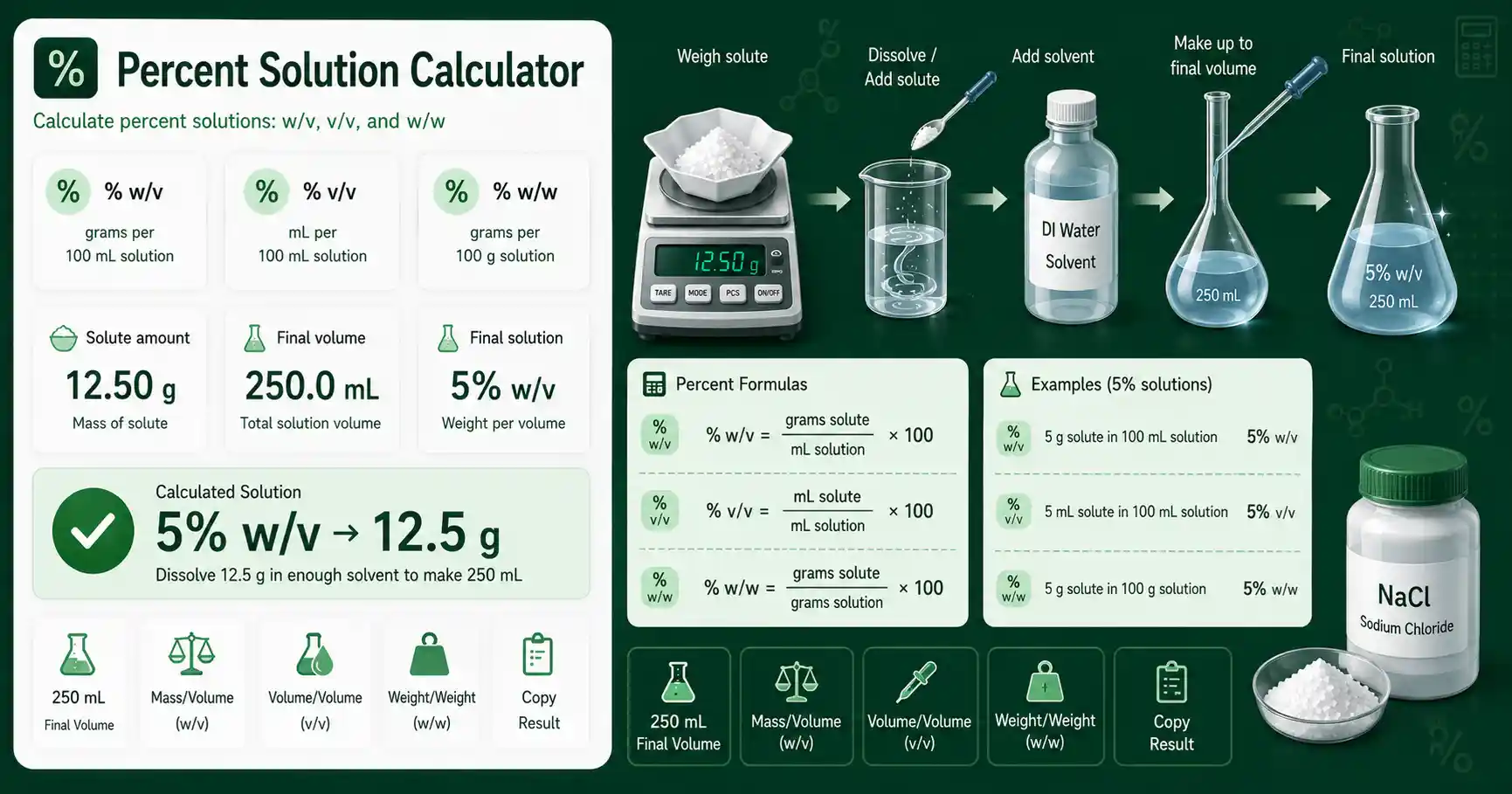
Percent Solution Calculator for w/v, v/v, and w/w
This Percent Solution Calculator helps you prepare solutions written as percent concentration. It handles mass by volume, volume by volume, and mass by mass notation. A % w/v solution uses solute mass and final solution volume. A % v/v solution uses liquid component volume and final mixture volume. A % w/w solution uses solute mass and final solution mass.
The calculator can solve for the solute amount, the final solution amount, or the percent concentration. This makes it useful when a protocol gives a target percent but not the exact mass to weigh. It also helps when you already prepared a mixture and need to calculate the actual percent. Students can use it to check homework steps. Lab workers can use it to reduce manual calculation errors before preparing reagents.
Percent Solution Calculator formula and assumptions
The calculator uses the common chemistry definitions for percent solution concentration. OpenStax describes mass percentage, volume percentage, and mass-volume percentage as common concentration units for solutions in chemistry and laboratory work. OpenStax Chemistry 2e
For % w/v, the equation is grams of solute divided by milliliters of solution, multiplied by 100. For % v/v, the equation is milliliters of liquid component divided by milliliters of final mixture, multiplied by 100. For % w/w, the equation is grams of solute divided by grams of final solution, multiplied by 100. The tool converts mg, g, kg, µL, mL, and L to the base units before it calculates. It assumes that the final volume or final mass refers to the finished solution, not only the amount of solvent added.
This distinction matters in the lab. To make a 5% w/v NaCl solution, you do not add 5 g NaCl to 100 mL water. You dissolve 5 g NaCl and then bring the final solution volume to 100 mL. The final volume includes the solute and solvent together. For precise analytical work, use a volumetric flask or a validated protocol.
Percent Solution Calculator worked example
Suppose you need 250 mL of a 5% w/v glucose solution. The given values are 5% w/v and 250 mL final solution. The formula rearranges to grams of solute = percent × final volume ÷ 100. Substitution gives grams = 5 × 250 ÷ 100. The result is 12.5 g glucose.
The interpretation is simple. Weigh 12.5 g glucose, dissolve it in less than 250 mL solvent, and bring the final volume to 250 mL. That gives 5 g per 100 mL. The calculator reports the same result and reminds you that the final amount means final solution volume. You can use the Molarity Calculator when the protocol uses mol/L instead of percent concentration.
How to prepare percent solutions in the lab
For % w/v solutions, enter the target percent and final volume. The result gives the solute mass to weigh. Dissolve the solute first, then adjust to the final mark. This workflow is common for salts, stains, agarose, sucrose, detergents, and many routine buffers.
For % v/v mixtures, enter the target percent and final volume. The result gives the liquid component volume. Add that component, then add diluent to the final volume. This workflow is common for ethanol, methanol, acetic acid, glycerol, and other liquid reagents.
For % w/w preparations, enter the target percent and final solution mass. The result gives the solute mass. The remaining mass is usually the solvent or mixture base. This workflow is useful when volume changes after mixing or when density makes volume-based preparation less accurate.
Common percent solution mistakes to avoid
Do not mix up % w/v with % w/w. A 10% w/v solution means 10 g per 100 mL, while a 10% w/w solution means 10 g per 100 g. These are not always equal because solution density can change the relationship between mass and volume. Do not treat the solvent amount as the final solution amount unless the protocol says so. Do not use percent concentration for clinical or hazardous preparation without checking the official protocol.
Watch your units before you weigh or pipette. A result of 0.5 g equals 500 mg. A result of 0.25 mL equals 250 µL. The calculator shows practical units, but you should still check the scale and pipette range. For very concentrated solutions, solubility may prevent the solute from dissolving completely. For very dilute solutions, a serial dilution may be more accurate than weighing a tiny mass directly.
When percent concentration is useful
Percent solutions are common in teaching labs because the notation is easy to read. They are also common in wet-lab protocols because many reagents are prepared by mass or volume rather than moles. A 1% agarose gel, a 70% ethanol disinfectant mixture, a 4% paraformaldehyde solution, and a 0.1% detergent wash are all percent-style examples. The calculator helps translate those short protocol lines into measured amounts.
The tool also connects percent notation to other concentration workflows. If you need ppm, ppb, molarity, or unit conversion, use a separate concentration tool because percent concentration does not always preserve molecular information. For broader conversions, the Concentration Unit Converter can help compare common laboratory units.