
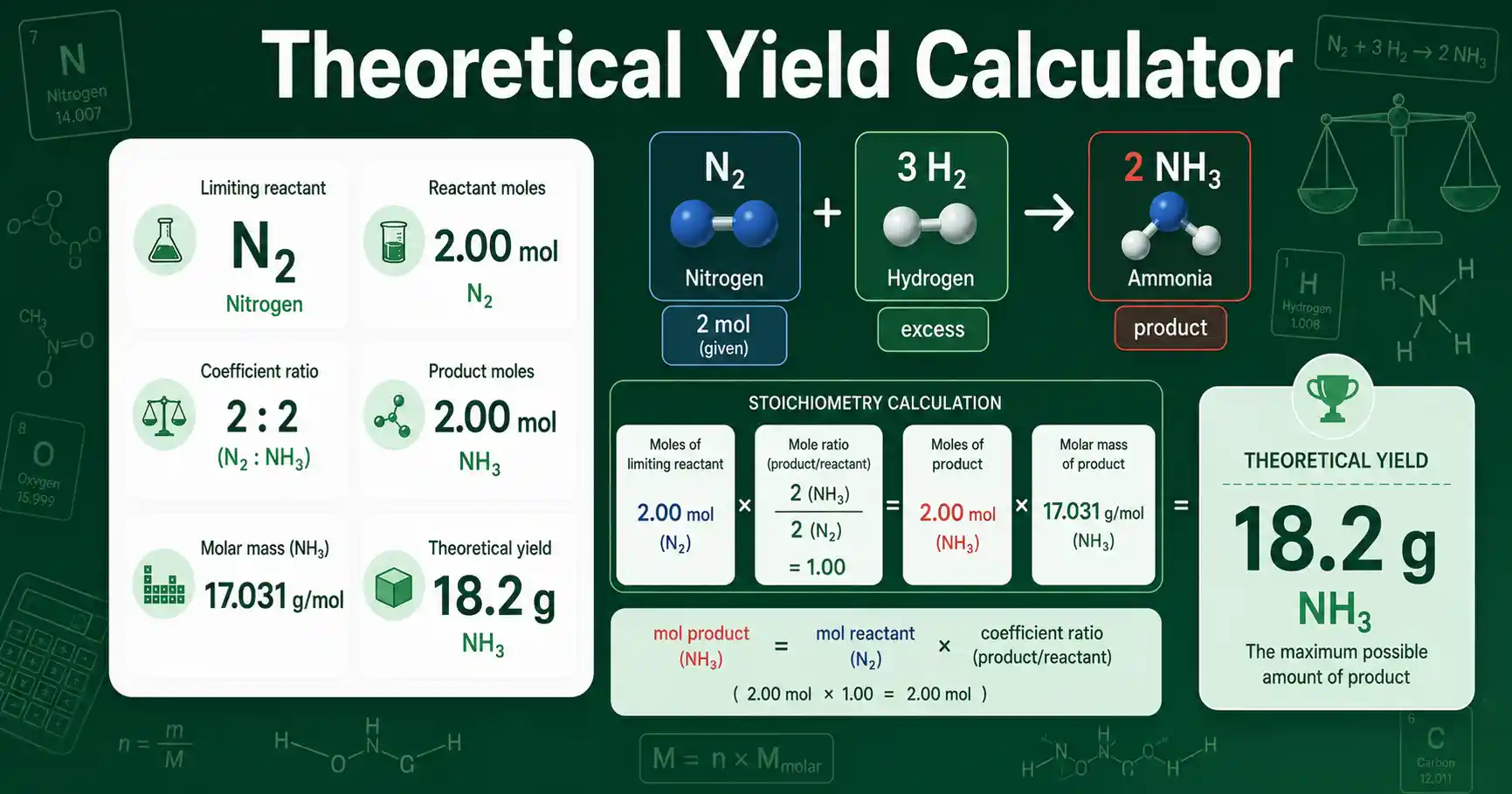
Theoretical Yield Calculator for stoichiometry
This Theoretical Yield Calculator finds the maximum amount of product that a balanced chemical reaction can make from a limiting reactant. Theoretical yield is an ideal value. It assumes the limiting reactant reacts completely and that the reaction follows the written stoichiometric equation.
The calculator is useful when a problem gives the limiting reactant amount and asks for product mass. It also helps after you have already used a Limiting Reagent Calculator to decide which reactant runs out first. Once the limiting reactant is known, theoretical yield becomes a direct mole-ratio conversion.
Students can use the tool to check homework steps. Teachers can use it to demonstrate why balanced coefficients matter. Lab workers and researchers can use it as a quick educational stoichiometry check before documenting a reaction calculation. It does not replace a full reaction design review, safety assessment, or independent verification.
The result may be shown in grams, moles, milligrams, and kilograms. The gram result depends on the product molar mass. The mole result depends only on the limiting reactant moles and the coefficient ratio in the balanced equation.
How to use Theoretical Yield Calculator correctly
Start with a balanced chemical equation. Identify the limiting reactant before using this tool. Enter the limiting reactant name or formula, its coefficient, its amount, and its unit. If the amount is entered in grams, enter the limiting reactant molar mass in g/mol so the calculator can convert mass to moles.
Enter the product name, product coefficient, and product molar mass. The product coefficient is the number written before the product in the balanced equation. For N2 + 3H2 → 2NH3, the product coefficient for ammonia is 2.
Use Advanced mode when a sample purity value is provided. A 95% pure limiting reactant means only 95% of the entered material counts as available reactant. Advanced mode can also compare an actual yield against the theoretical yield, but the dedicated Percent Yield Calculator is better when percent yield is the main task.
Keep units consistent. Molar mass must be entered in grams per mole. Product mass is reported in grams from product moles multiplied by product molar mass. If your class requires significant figures, round the final reported answer based on the least precise measurement in the problem.
Theoretical Yield Calculator formula and assumptions
The calculator first converts the limiting reactant to moles. If the reactant amount is already in moles, that value is used directly. If the reactant amount is in grams, moles equal grams divided by molar mass.
Theoretical product mass equals theoretical product moles multiplied by product molar mass. This is why the same mole-ratio answer can become different gram values for different products. The product coefficient and limiting reactant coefficient must come from the balanced equation, not from the unbalanced formula skeleton.
The method assumes complete conversion of the limiting reactant to the chosen product. It does not account for equilibrium, side reactions, incomplete mixing, volatility, transfer losses, purification losses, or decomposition. It also assumes the product formula and molar mass are correct.
OpenStax Chemistry explains reaction yields by connecting limiting reactants, theoretical yield, and percent yield. This calculator follows that educational stoichiometry approach and keeps the mole conversion visible so users can check each step. Verify critical lab calculations independently before using them in real experiments.
Theoretical Yield Calculator worked example
Consider the balanced reaction N2 + 3H2 → 2NH3. Given values are limiting reactant N2 = 15.0 g, molar mass of N2 = 28.014 g/mol, coefficient of N2 = 1, coefficient of NH3 = 2, and molar mass of NH3 = 17.031 g/mol.
First convert nitrogen mass to moles. N2 moles = 15.0 g ÷ 28.014 g/mol = 0.535 mol. Then use the coefficient ratio to find ammonia moles. NH3 moles = 0.535 × 2 ÷ 1 = 1.07 mol.
Convert the product moles to product mass. NH3 mass = 1.07 mol × 17.031 g/mol = 18.2 g. The theoretical yield is about 18.2 g NH3 under ideal stoichiometric conditions.
The interpretation is straightforward. If nitrogen is the limiting reactant, 15.0 g of nitrogen can make no more than about 18.2 g of ammonia in this ideal calculation. A real experiment can produce less than this value, but it should not produce more unless the inputs, units, purity, or product identity need review.
Theoretical Yield Calculator results explained
The theoretical yield in grams is the main product mass result. It tells the maximum mass predicted by the balanced equation. The theoretical yield in moles is also useful because many stoichiometry problems move from moles of reactant to moles of product before converting to grams.
A larger reactant amount gives a larger theoretical yield only when the same reactant remains limiting. If a different reactant becomes limiting, the theoretical yield must be recalculated from that reactant. This is why limiting reagent identification comes before theoretical yield in multi-reactant problems.
The stoichiometric factor tells how many moles of product form per mole of limiting reactant. A factor of 2 means one mole of limiting reactant can form two moles of product. A factor of 0.5 means two moles of limiting reactant are needed for one mole of product.
The optional percent yield preview compares actual yield with the theoretical yield. A value below 100% is common in real experiments. A value above 100% usually means the product may be wet, impure, contaminated, incorrectly weighed, or calculated with the wrong theoretical yield.
Theoretical Yield Calculator mistakes to avoid
Do not use an unbalanced equation. The coefficient ratio controls the calculation, so an unbalanced equation gives a wrong yield. Do not compare grams directly when converting reactant to product. Stoichiometry uses moles because coefficients describe particle ratios.
Do not enter product molar mass for the reactant molar mass field. Reactant molar mass is used only to convert the limiting reactant amount to moles. Product molar mass is used later to convert product moles to grams.
Do not use percent yield as purity. Purity corrects how much limiting reactant is available before the reaction. Percent yield compares actual product against theoretical product after the reaction. These values answer different questions.
Do not over-round intermediate values when solving by hand. Keep extra digits through the mole-ratio step, then round the final product mass. The calculator shows practical precision, but your class or lab report may require a specific significant-figure rule.
Theoretical Yield Calculator use cases in chemistry
A student can use the calculator to check a textbook stoichiometry problem after identifying the limiting reactant. The visible steps help show how grams become moles, how coefficients create the product mole ratio, and how product molar mass gives the final gram yield.
A teacher can use the calculator during a lesson on reaction yields. Changing the product coefficient or limiting reactant coefficient instantly shows how the balanced equation changes product yield. This makes mole ratios easier to explain than a static worksheet alone.
A lab worker can use the tool to prepare an educational calculation record for non-clinical chemistry training. A researcher can use it for a quick first-pass stoichiometric check before reviewing the full reaction plan, reagent purity, hazards, and experimental constraints.
Student questions about theoretical yield
What is theoretical yield?
Theoretical yield is the maximum amount of product predicted by stoichiometry from the limiting reactant and the balanced equation. It is an ideal value, not a measured lab value.
Do I need the limiting reactant first?
Yes. The theoretical yield calculator assumes you already know which reactant limits the reaction. If the wrong reactant is used, the product yield will be wrong even if the arithmetic is correct.
Why is actual yield not the same as theoretical yield?
Actual yield is measured after a real reaction. It may be lower because of incomplete conversion, side reactions, transfer loss, purification loss, evaporation, or measurement uncertainty.
External source: OpenStax Chemistry 2e section on reaction yields.