
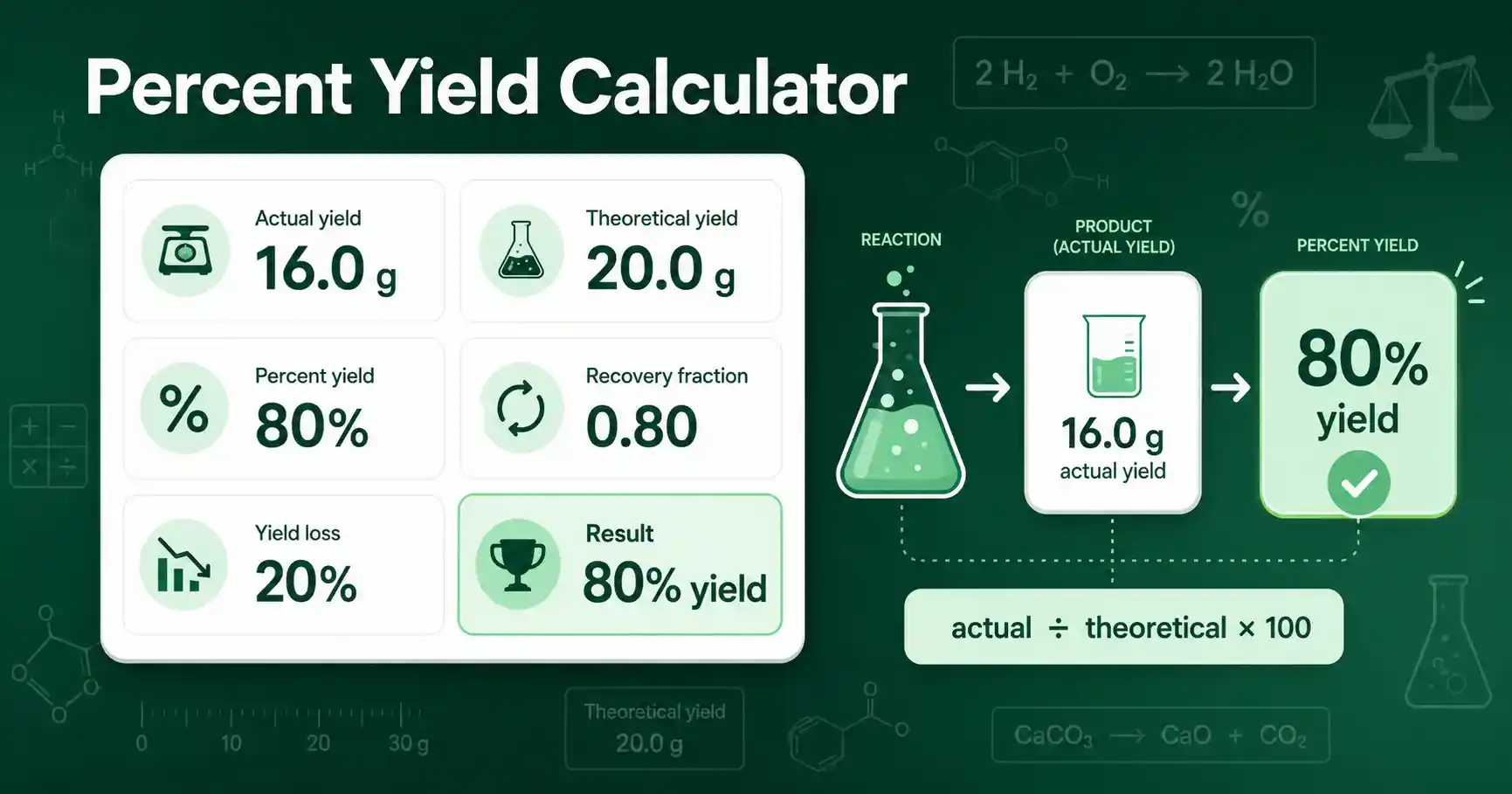
Percent Yield Calculator for actual and theoretical yield
The Percent Yield Calculator finds how much product you recovered compared with the maximum amount predicted by stoichiometry. It uses actual yield, theoretical yield, and consistent mass units to calculate a percentage.
Students use this calculator after solving a balanced chemical equation and identifying the product amount that should form. Teachers can use it to demonstrate why a real reaction rarely gives the full theoretical amount.
Lab workers and researchers can use the result as a quick recovery check after synthesis, purification, crystallization, drying, or sample transfer. The calculation is educational and non-clinical, so critical experimental decisions should still be verified independently.
A percent yield below 100% means the recovered amount is lower than the predicted maximum. A value above 100% often signals water, solvent, salts, impurities, or a unit mismatch rather than extra product.
How to use Percent Yield Calculator correctly
Enter the actual yield as the product amount you measured after the reaction or isolation step. This value might be the dry mass of crystals, a purified product fraction, or a recovered sample mass.
Enter the theoretical yield as the maximum product amount predicted from the limiting reagent and balanced equation. If you still need that value, use a Theoretical Yield Calculator before calculating percent yield.
Select the correct unit for each value. The calculator accepts µg, mg, g, and kg, then converts both amounts to grams internally before dividing them.
The actual and theoretical amounts must describe the same product. Do not compare an impure wet product mass with a pure theoretical product mass unless you clearly state that assumption in your report.
Percent Yield Calculator formula and assumptions
The formula is percent yield = actual yield ÷ theoretical yield × 100. The numerator is the amount recovered in the real experiment, and the denominator is the calculated maximum amount.
The calculator assumes the theoretical yield is already correct. That means the balanced equation, molar mass, limiting reagent, and mole ratio must be checked before this step.
The calculator also assumes both values refer to the same substance and compatible measurement type. A mass-based percent yield should compare mass with mass, not mass with moles.
For a broader chemistry explanation of percent yield and reaction yield, see the educational overview from Chemistry LibreTexts.
Percent Yield Calculator worked example
Given: actual yield = 3.2 g and theoretical yield = 4.0 g. These two values use the same unit, so no unit conversion is needed before the percentage calculation.
Formula: percent yield = actual yield ÷ theoretical yield × 100. Substitution: 3.2 g ÷ 4.0 g × 100 = 80%.
Result: percent yield = 80%. Interpretation: the reaction recovered 80% of the maximum predicted product mass.
The missing 20% may reflect incomplete reaction, product left behind during transfer, side products, filtration loss, evaporation loss, or purification loss. The calculator does not identify the cause, but it gives a clear value to report and discuss.
Percent Yield Calculator results explained
A low percent yield can show that the reaction did not go to completion, the product was lost during workup, or the product was not fully recovered. In teaching labs, low yield is common because small handling losses matter more at small scale.
A moderate percent yield shows that product formed but some expected amount was lost or never produced. This range can still be useful when the product identity and purity are supported by other evidence.
A high percent yield close to 100% suggests strong recovery, but it still needs a purity check. A wet or contaminated product can look like a high-yield product when measured only by mass.
A result above 100% should be treated as a warning. Recheck drying, weighing, unit conversion, theoretical yield, and product identity before writing the final value in a report.
Percent Yield Calculator mistakes to avoid
Do not use the mass of a crude mixture as the actual yield unless the assignment asks for crude percent yield. Crude product can contain solvent, unreacted reagent, drying agent, or impurities.
Do not use the starting reactant mass as the theoretical yield. Theoretical yield describes the product amount predicted from stoichiometry, not the mass of material added to the flask.
Do not mix units without conversion. For example, 750 mg actual yield and 1.0 g theoretical yield gives 75%, not 750%.
Do not round too early. Keep enough digits through the stoichiometry step, then round the final percent yield based on your course or lab report rules.
Percent Yield Calculator use cases in lab work
In a student synthesis lab, the calculator helps turn a measured product mass into a clear recovery percentage. The result can be used in the discussion section to compare technique, drying quality, and reaction completion.
In a chemistry homework problem, the calculator helps check the final step after finding the limiting reagent and theoretical product mass. If the limiting reagent is still unknown, a Limiting Reagent Calculator can support the earlier stoichiometry step.
In a purification workflow, percent yield can compare material before and after crystallization, chromatography, precipitation, or filtration. The value helps users see how much material was retained through the process.
In a teaching setting, percent yield is a useful bridge between ideal chemical equations and real experimental outcomes. It shows why balanced equations predict maximum amounts, not guaranteed recovered masses.
Student questions about Percent Yield Calculator
What does percent yield mean?
Percent yield compares the actual recovered product amount with the theoretical product amount predicted by stoichiometry. It tells you how efficiently the expected product was obtained.
Can percent yield be above 100 percent?
Yes, the calculation can show a value above 100%, but the result usually points to wet product, impurities, incomplete drying, contamination, weighing error, or an incorrect theoretical yield.
Do actual yield and theoretical yield need the same unit?
They must describe the same type of amount. This calculator converts mass units such as µg, mg, g, and kg, but it cannot make an invalid comparison between different substances or different measurement types.