
Biochemistry calculator
Substrate Concentration Calculator
Calculate substrate concentration from enzyme initial rate, Km, and Vmax using the Michaelis-Menten equation. You can also estimate the initial rate for a known substrate concentration.
Michaelis-Menten calculator
Calculate substrate concentration from rate
Solve for substrate concentration when you know the initial rate, Km, and Vmax, or predict the rate from a substrate level.
Required substrate concentration
Verify critical lab calculations independently before using them in real experiments.
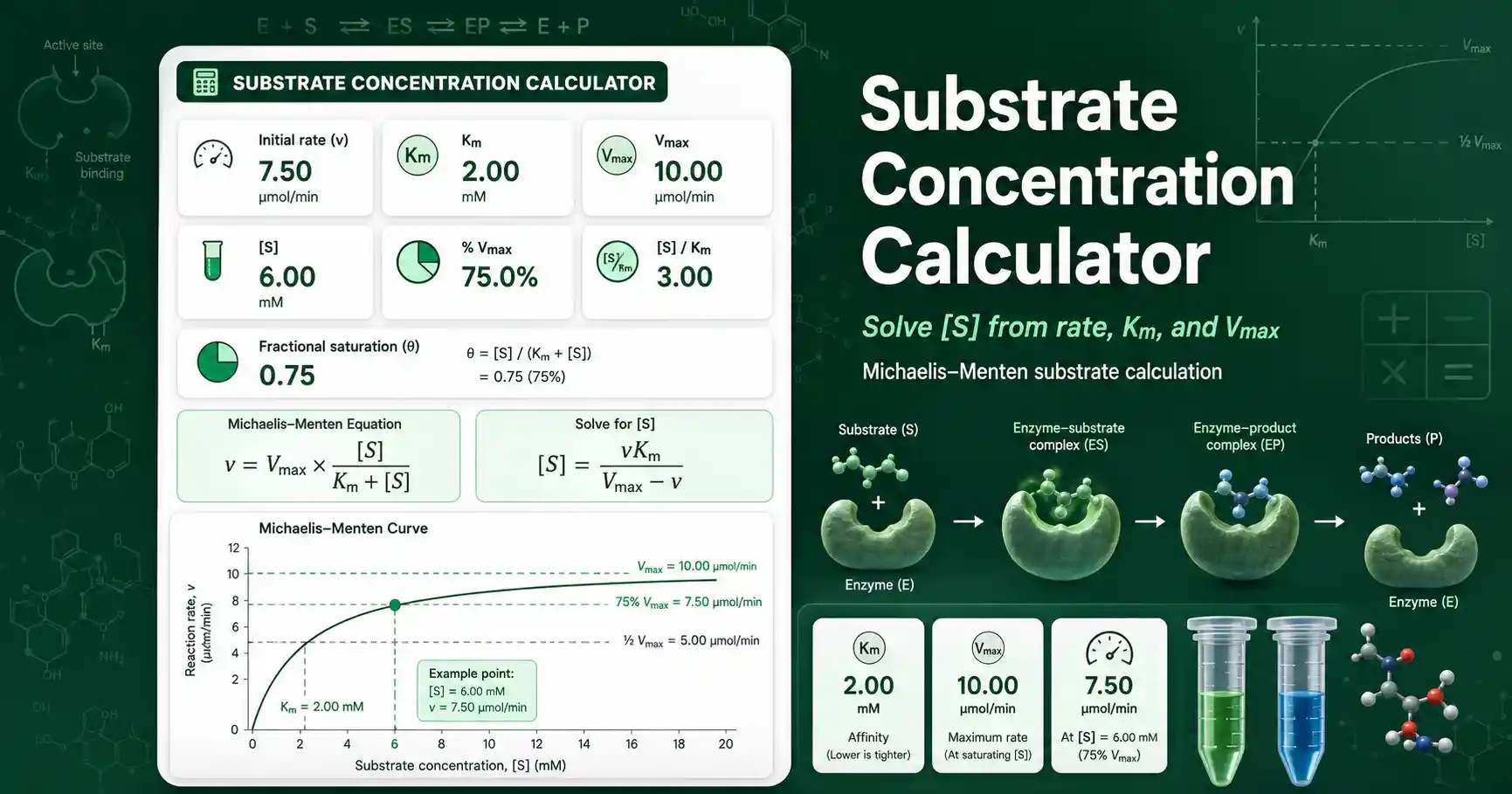
Substrate Concentration Calculator for enzyme assays
The Substrate Concentration Calculator uses Michaelis-Menten kinetics to connect substrate concentration, enzyme rate, Km, and Vmax. It is useful when you measured an initial rate and want to estimate the substrate concentration that would produce that rate. It is also useful when you know a substrate concentration and want to predict the expected reaction rate. Students can use it to check enzyme kinetics homework. Teachers can use it to show how Km changes the shape of a rate curve. Lab workers can use it as a quick calculation aid while reviewing assay conditions. Researchers can use it to sanity-check kinetic assumptions before a more complete model fit.
The calculator assumes a simple one-substrate Michaelis-Menten model. The enzyme reaction should be measured under initial-rate conditions. Product inhibition, substrate inhibition, allosteric effects, enzyme instability, and mixed inhibitor behavior are not included. The result is most reliable when Km and Vmax came from a good kinetic fit. If you need to estimate both constants from substrate-rate data, use the Km and Vmax Calculator before using this page.
The core formula is v = Vmax × [S] / (Km + [S]). When the calculator solves for substrate concentration, it rearranges the equation to [S] = vKm / (Vmax − v). This rearranged form explains why the initial rate must be lower than Vmax. As v gets very close to Vmax, the denominator becomes very small. That makes the substrate concentration very large and very sensitive to small measurement errors.
Substrate concentration from Km and Vmax
Km and substrate concentration must use the same concentration unit. You can enter values in nM, µM, mM, or M. The calculator converts the concentration internally, then reports the answer in the selected unit. Initial rate and Vmax must also use the same rate unit. The rate unit can be µM/min, µmol/min, absorbance units per minute, or another consistent label. The calculation only compares v with Vmax, so the numerical units must match exactly.
The result also shows percent Vmax, fractional saturation, and the [S]/Km ratio. A substrate concentration equal to Km gives 50% of Vmax. A substrate concentration much lower than Km gives a rate that is strongly substrate-dependent. A substrate concentration much higher than Km moves the enzyme toward saturation. These values help you interpret whether the enzyme assay is operating in a low-substrate, mid-range, or near-saturation region. For a broader rate calculation workflow, the Enzyme Kinetics Calculator can calculate related Michaelis-Menten outputs.
Michaelis-Menten kinetics is a standard model for many introductory enzyme calculations, and Chemistry LibreTexts gives a helpful background on the relationship between substrate concentration and initial velocity in Michaelis-Menten kinetics. This calculator keeps the model practical. It does not claim that every enzyme follows the model perfectly. Real enzyme systems can deviate when the assay conditions do not match the assumptions.
Substrate Concentration Calculator worked example
Given values: Initial rate v = 75 µM/min, Vmax = 100 µM/min, and Km = 40 µM.
Formula: [S] = vKm / (Vmax − v).
Substitution: [S] = 75 × 40 / (100 − 75).
Result: [S] = 3000 / 25 = 120 µM.
Interpretation: The substrate concentration is three times Km, so the predicted rate is 75% of Vmax under this model.
This answer is reasonable because a substrate concentration above Km should give a rate above half of Vmax. The value is not extremely high, so the estimate is not in the most unstable near-Vmax region. If the measured rate were 98 µM/min with the same Vmax, the required substrate concentration would become much larger. That kind of result should be checked carefully because small rate errors near Vmax can change the calculated substrate concentration a lot.
How to interpret substrate concentration results
A calculated [S]/Km value below 1 means the assay is below the half-saturation point. A value near 1 means the substrate concentration is close to Km. A value above 1 means the substrate concentration is above Km. A very high [S]/Km value means the enzyme is near saturation. Near saturation, adding more substrate produces only a small increase in initial rate. This is why many teaching examples use rates such as 25%, 50%, or 75% of Vmax instead of rates extremely close to Vmax.
Rounding matters because enzyme kinetic constants often come from fitted experimental data. Reporting too many digits can suggest false precision. For most classroom and early analysis work, three to four significant figures are enough. Use the same unit system across the calculation. Confirm that Km and [S] refer to molar concentration, not mass concentration. Confirm that Vmax and v describe the same assay volume, enzyme amount, wavelength method, or product-rate basis.
Student Questions About Substrate Concentration
What does the Substrate Concentration Calculator solve?
It solves substrate concentration from initial rate, Km, and Vmax using the rearranged Michaelis-Menten equation. It can also predict the initial rate from a known substrate concentration.
Why must the rate be lower than Vmax?
The Michaelis-Menten model approaches Vmax as substrate concentration becomes very large. A rate equal to Vmax would require infinite substrate, so a finite answer exists only when v is lower than Vmax.
Which units should I use for Km and substrate concentration?
Use the same concentration unit for Km and substrate concentration. A Km of 40 µM must be compared with substrate concentration in µM unless you convert both values first.
Can I use this calculator for inhibited enzyme reactions?
Use it only as a simple educational estimate for inhibited reactions. Inhibition changes the apparent Km, apparent Vmax, or both, so inhibitor experiments need a model that matches the inhibition type.