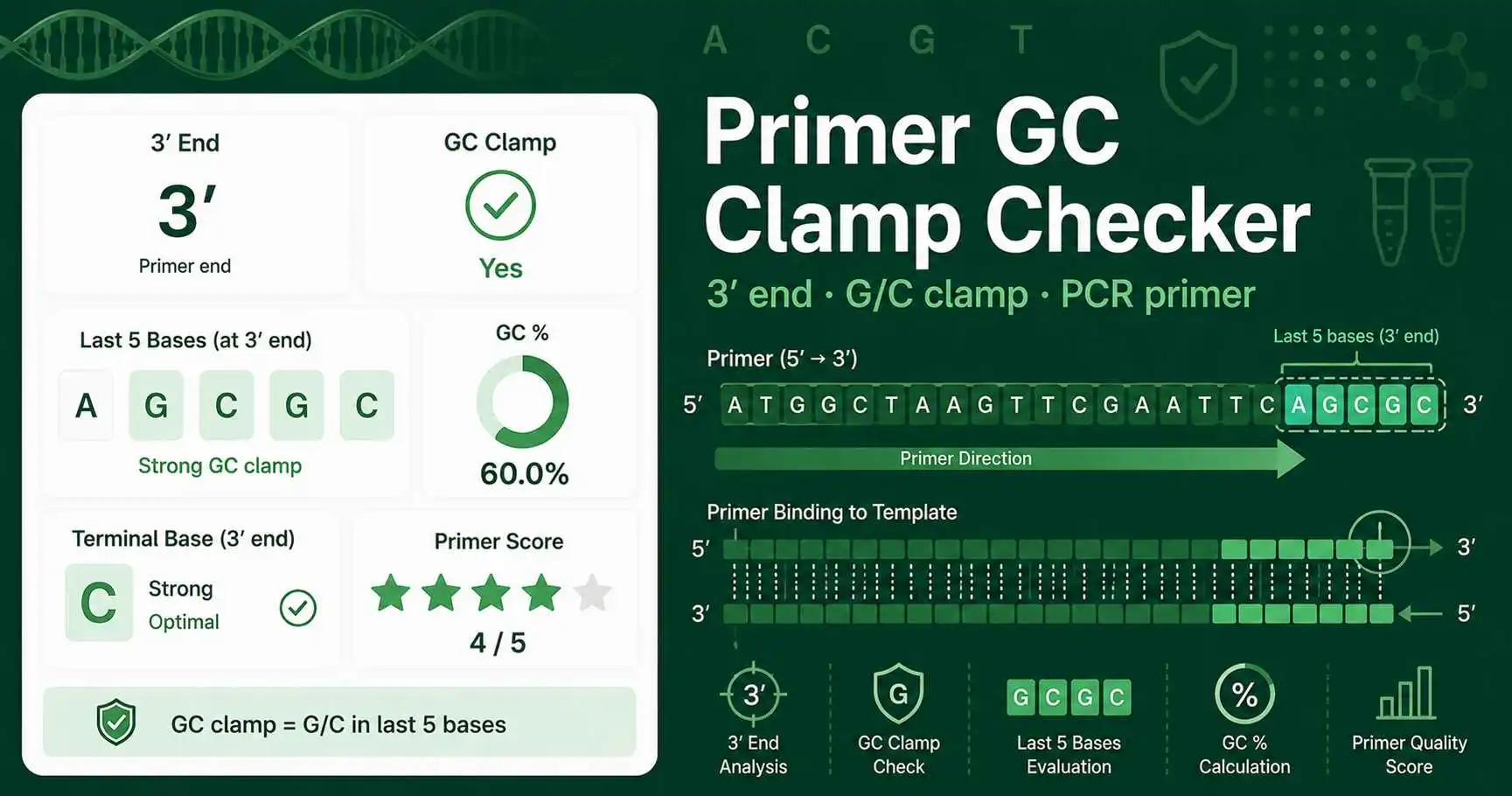
Primer GC Clamp Checker for PCR primer ends
The Primer GC Clamp Checker reviews the last five bases at the 3′ end of a DNA primer. That end matters because DNA polymerase extends from the primer 3′ hydroxyl group. A stable 3′ end can support primer binding during PCR, qPCR, cloning PCR, colony PCR, and Sanger sequencing PCR.
The tool checks whether the terminal base is G or C, counts G and C bases in the last five positions, calculates the primer GC percentage, estimates Wallace Tm, and warns about long base runs. It accepts one primer or a forward and reverse primer pair.
How to use Primer GC Clamp Checker
Paste the primer sequence in 5′ to 3′ direction. Use only A, C, G, and T. The calculator removes spaces, line breaks, numbers, and FASTA headers before analysis. You can enter only a forward primer or enter both forward and reverse primers for pair screening.
Read the result from the 3′ end card first. A practical beginner-level target is one to three G or C bases in the last five positions, with the terminal base ending in G or C. The full score also considers primer length, total GC content, and homopolymer runs.
Primer GC clamp formula and scoring logic
The main clamp count is simple:
GC clamp count = number of G and C bases in the last five bases at the 3′ end.
The total primer GC percentage uses this equation:
GC % = (G + C) ÷ total primer length × 100.
The tool also shows a quick Wallace Tm estimate:
Tm = 2(A + T) + 4(G + C).
These values support quick screening. They do not replace a full primer design workflow. Thermodynamic primer tools may use salt, magnesium, primer concentration, mismatch, and nearest-neighbor calculations.
Worked example for primer GC clamp checking
Suppose your primer is 5′-ATGCGTACGTTAGCGTACGC-3′. The last five bases are TACGC. This 3′ end contains three G/C bases: C, G, and C. The terminal base is C, so the primer has a clear GC clamp.
The same sequence has 11 G/C bases in 20 total bases. Its GC percentage is 11 ÷ 20 × 100 = 55%. That value sits inside the common 40–60% design range for many routine PCR primers. The Wallace estimate is 2(A+T) + 4(G+C), so this primer gives an estimated Tm of 62°C.
Practical use case 1: screening a PCR primer pair
A lab worker may design a forward and reverse primer for a 350 bp PCR product. Before ordering the pair, they can paste both primers into this checker. The result shows whether both 3′ ends have a reasonable G/C balance.
If the forward primer has a good clamp but the reverse primer ends in A or T with no G/C bases near the 3′ end, the pair may need redesign. The next step is to compare primer Tm with the Primer Tm Calculator and then check primer-dimer risk.
Practical use case 2: avoiding an over-strong 3′ end
A student may think that more G and C bases always make a primer better. That is not true. A 3′ end such as GCGGC has five G/C bases in the last five positions. It may bind strongly, but it can also raise the chance of non-specific binding or primer-dimer formation.
The checker marks very GC-rich 3′ ends as risky. In that case, review nearby target positions and look for a primer with a more balanced final five bases. You can then use the Primer Dimer Checker to review self-binding and pair-binding signals.
Good Primer GC Clamp Checker result ranges
For many routine PCR primer designs, a good starting point is a primer length of about 18–30 nucleotides, total GC content around 40–60%, and one to three G/C bases in the last five positions. A terminal G or C is often useful because it strengthens the 3′ end.
Avoid treating these values as absolute rules. Some assays work with weaker clamps. Some GC-rich targets require special optimization. A qPCR assay may need stricter checks than a classroom PCR exercise.
Common mistakes when checking a primer GC clamp
Do not paste the reverse primer in the wrong direction. Orderable primers are written 5′ to 3′, and this tool reads the final base as the 3′ terminal base. If you paste a sequence backward, the clamp result will describe the wrong end.
Do not judge a primer by the GC clamp alone. A primer also needs target specificity, compatible Tm, balanced base composition, no strong hairpin, low primer-dimer risk, and the correct amplicon location. Always verify critical PCR calculations independently before ordering primers or preparing real experiments.
Trusted primer design guidance
Thermo Fisher primer design guidance describes a GC clamp as a 3′ end ending in G or C, suggests a common 40–60% primer GC content range, and cautions against too many repeated G or C bases near the 3′ end.Thermo Fisher oligo design tips