
Chemistry and buffer math
Osmolarity Calculator for Lab Solutions
Use this osmolarity calculator to estimate total osmolarity from solute concentration, dissociation particle factor, and osmotic coefficient. It is useful for PBS-style buffers, teaching examples, cell culture solution checks, and general lab solution calculations.
Lab solution calculator
Calculate total osmolarity
Add each solute, enter its concentration, set the number of particles it forms, and estimate the total osmolarity in mOsm/L.
Solute inputs
Use mol/L, millimol/L, or micromol/L. The particle factor is the van't Hoff factor.
Osmolarity result
Contribution by solute
This falls near the range often seen for physiological aqueous solutions.
Verify critical lab calculations independently before using them in real experiments.
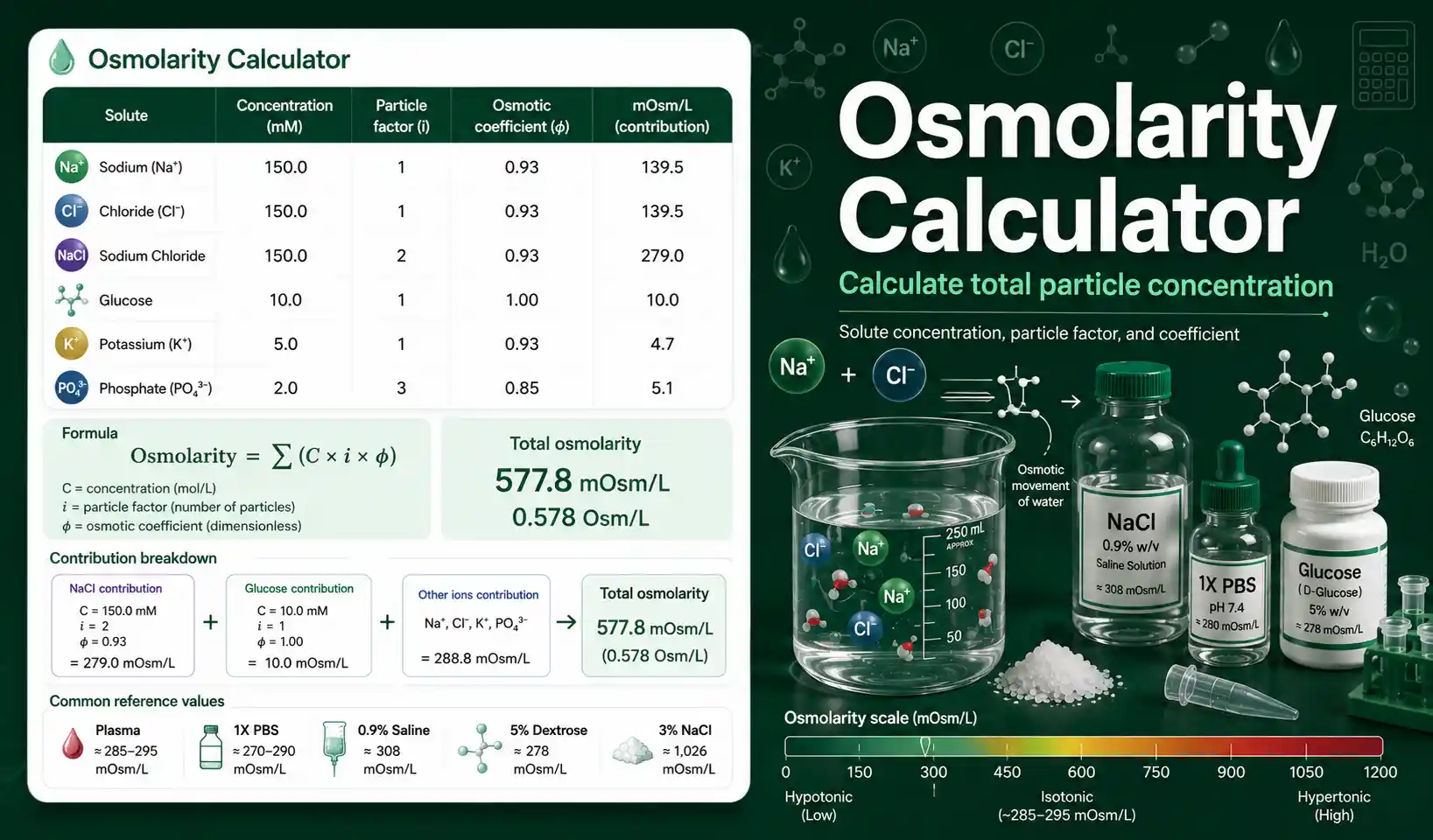
Osmolarity Calculator formula for aqueous solutions
Osmolarity describes the concentration of osmotically active particles in a solution. It is commonly reported as osmoles per liter or milliosmoles per liter. The calculator uses the relationship osmolarity equals the sum of concentration multiplied by particle factor and osmotic coefficient. The particle factor is often called the van't Hoff factor. A non-electrolyte such as glucose usually has a particle factor of 1. Sodium chloride is often approximated with a particle factor of 2 because it forms sodium and chloride ions. Calcium chloride is often approximated with a particle factor of 3 because it can form one calcium ion and two chloride ions. The osmotic coefficient adjusts the ideal particle count when a real solution behaves less ideally.
The basic formula is Σ(C × i × φ), where C is molarity in mol/L, i is the particle factor, and φ is the osmotic coefficient. The final mOsm/L result equals Osm/L multiplied by 1000. This tool accepts M, mM, and µM input units. It converts every concentration to mol/L before calculating the contribution. A 154 mM NaCl solution with an ideal particle factor of 2 contributes about 308 mOsm/L. A 5.5 mM glucose solution contributes about 5.5 mOsm/L because glucose remains one dissolved particle. For more background on osmotic pressure and osmotic concentration, see the educational overview from Chemistry LibreTexts.
How to calculate osmolarity from molarity
Start with the actual molar concentration of each solute. Choose the particle factor that matches the expected dissolved form. Use 1 for molecules that do not dissociate. Use 2 for ideal one-to-one salts such as NaCl. Use 3 for ideal salts that form three ions, such as CaCl2. Then apply an osmotic coefficient if your class, protocol, or reference table gives one. If no coefficient is known, φ = 1 gives an ideal estimate. This ideal estimate is useful for homework and early buffer planning. It may not match an osmometer reading for concentrated salts.
Osmolarity differs from ionic strength. Osmolarity counts particles that affect water movement. Ionic strength weights ions by charge squared and describes electrostatic screening. A solution can have a similar osmolarity but a different ionic strength if the ion charges differ. Osmolarity also differs from simple molarity because salts can create more than one particle per formula unit. This is why unit choice matters. Entering 154 mM as 154 M would create a result that is one thousand times too high. Entering 154 µM as 154 mM would create the same kind of unit error.
Osmolarity Calculator result interpretation
The result card reports total osmolarity in mOsm/L and Osm/L. The contribution list shows how much each solute adds to the total. This makes it easier to find the component that dominates the calculation. Salts often dominate because dissociation increases the particle count. Neutral compounds can still matter when their concentration is high. A typical biological buffer may sit around a few hundred mOsm/L, depending on the recipe. A very high value should prompt a unit check, a stock concentration check, and a particle factor check. Rounding to one or two decimal places is usually enough for teaching and planning. More precision does not guarantee more accuracy when real solution behavior is non-ideal.
You can use the calculator while building a buffer recipe in the PBS Preparation Calculator. Students can use it to learn why 100 mM glucose and 100 mM NaCl do not have the same osmolarity. Teachers can use it to demonstrate the effect of dissociation. Lab workers can use it as a quick planning check before preparing a non-clinical research solution. Researchers can compare candidate buffer compositions before confirming a final recipe with the proper method for their system. The calculator does not replace direct osmometer measurement. It also does not judge whether a solution is safe or suitable for cells, animals, patients, or clinical use.
Osmolarity Calculator worked example
Given values: NaCl concentration = 154 mM, particle factor = 2, osmotic coefficient = 1. Glucose concentration = 5.5 mM, particle factor = 1, osmotic coefficient = 1.
Formula: total osmolarity = Σ(C × i × φ).
Substitution: NaCl contribution = 154 × 2 × 1 = 308 mOsm/L. Glucose contribution = 5.5 × 1 × 1 = 5.5 mOsm/L.
Result: total osmolarity = 308 + 5.5 = 313.5 mOsm/L.
Interpretation: The solution has an ideal calculated osmolarity of 313.5 mOsm/L. The true measured value may differ if ion interactions reduce ideal behavior.
Practical Questions About Osmolarity Calculator
What does an osmolarity calculator measure?
An osmolarity calculator estimates the number of osmotically active particles in one liter of solution. It uses solute concentration, particle factor, and osmotic coefficient.
Why does NaCl use a particle factor of 2?
Sodium chloride ideally separates into sodium and chloride ions in water, so each formula unit can contribute about two particles. Real solutions may need a coefficient below 1.
Is osmolarity the same as molarity?
Osmolarity is not the same as molarity. Molarity counts solute formula units, while osmolarity counts the effective particles that influence osmotic behavior.
What should I verify before using the result?
Verify the solute identity, hydration state, concentration unit, particle factor, and osmotic coefficient. Confirm critical lab calculations independently before using them in real experiments.