
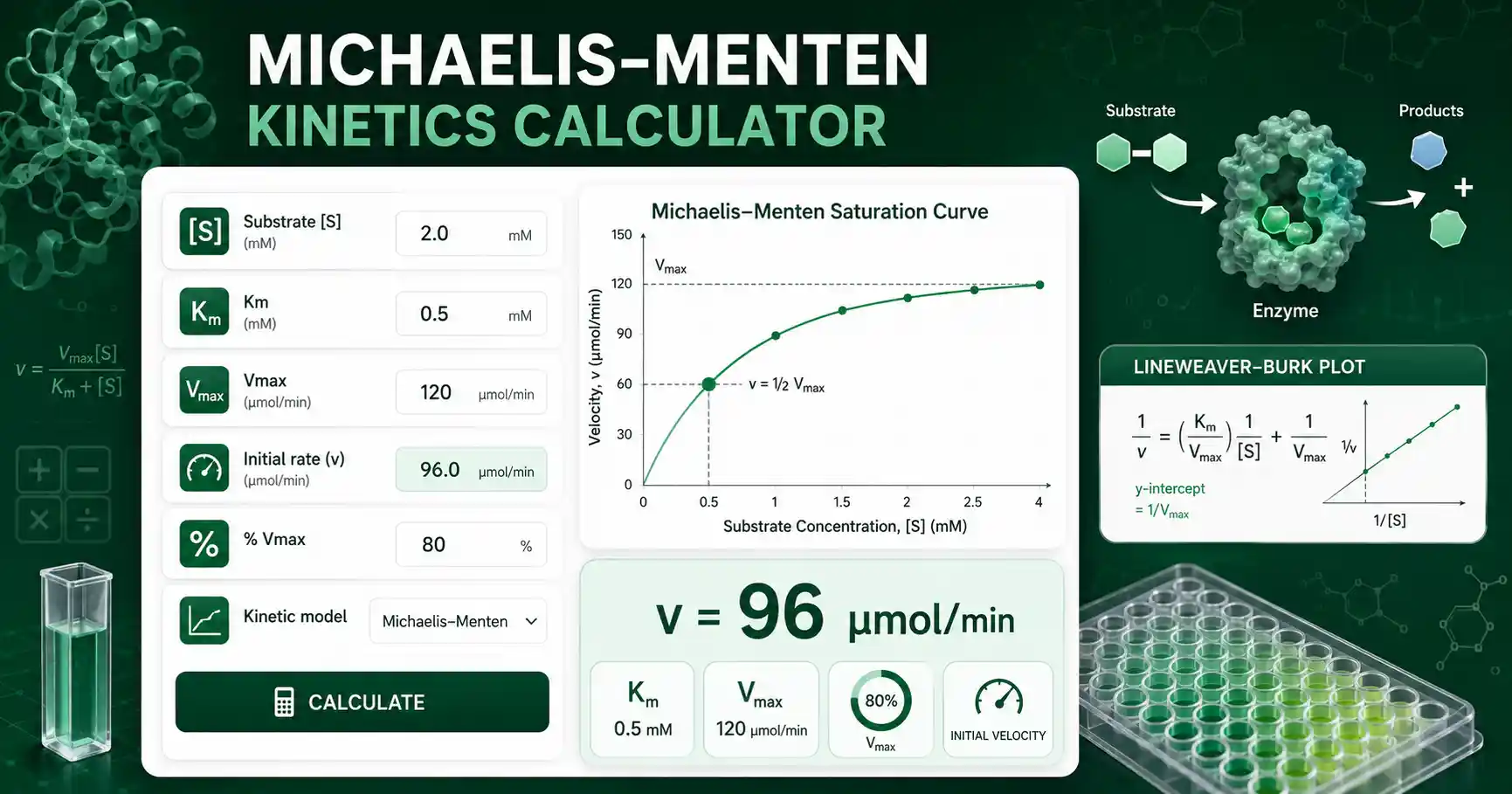
Michaelis-Menten Calculator for enzyme kinetics
This Michaelis-Menten Calculator estimates the initial rate of an enzyme-catalyzed reaction.
It uses substrate concentration, Km, and Vmax to calculate velocity.
The tool also works in reverse when you need to solve Vmax, Km, or substrate concentration from a measured initial rate.
Students can use it to understand the shape of enzyme saturation curves.
Lab workers can use it to check whether an assay substrate concentration is near Km or safely above Km.
Researchers can use it as a quick planning calculator before building a full enzyme kinetics experiment.
The calculator handles nM, µM, mM, and M for substrate and Km inputs.
The rate unit label is flexible because Vmax and velocity keep the same unit.
Michaelis-Menten equation used by the calculator
The calculator uses v = Vmax × [S] ÷ (Km + [S]).
In this equation, v is the initial reaction velocity.
Vmax is the maximum velocity expected when the enzyme is saturated with substrate.
Km is the substrate concentration that gives half of Vmax in the simple one-substrate model.
The substrate concentration and Km must describe the same chemical species and should use the same effective concentration scale.
The calculator converts concentration units internally so a value in mM can be compared with a value in µM.
A helpful introduction to enzymes and reaction rates is available from OpenStax Biology 2e.
Use initial rates, not late endpoint rates, because the Michaelis-Menten equation assumes the early linear part of the reaction.
Do not use this simple model when strong cooperativity, substrate inhibition, allosteric regulation, or multiple substrates control the reaction.
Michaelis-Menten Calculator worked example
Suppose an enzyme has a Vmax of 120 µmol/min.
The Km is 0.5 mM.
The substrate concentration is 2.0 mM.
The formula is v = Vmax × [S] ÷ (Km + [S]).
Substitution gives v = 120 × 2.0 ÷ (0.5 + 2.0).
The calculated rate is 96 µmol/min.
This rate is 80% of Vmax because 96 ÷ 120 equals 0.8.
The interpretation is that the enzyme is close to saturation but has not fully reached Vmax.
If [S] were equal to 0.5 mM, the expected rate would be 60 µmol/min, which is half of Vmax.
How to interpret Km, Vmax, and rate results
A low Km often means the enzyme reaches half-maximal velocity at a low substrate concentration.
A high Km means more substrate is needed to reach the same fraction of Vmax.
Km is not always a direct binding affinity, especially when catalytic steps affect the reaction mechanism.
Vmax depends on enzyme amount, enzyme quality, temperature, pH, cofactors, and assay setup.
The same enzyme can show different apparent Km and Vmax values under different buffer conditions.
When [S] is much lower than Km, the rate changes almost linearly with substrate concentration.
When [S] is much higher than Km, the rate approaches Vmax and adding more substrate gives only a small increase.
Use the Enzyme Activity Calculator when you need to convert product formation or absorbance slope into enzyme units before fitting kinetics.
Michaelis-Menten lab use and assay planning
The calculator helps choose substrate concentrations for kinetic assays.
A good experiment usually measures rates below Km, near Km, and above Km.
Substrate points around 0.25× Km, 0.5× Km, 1× Km, 2× Km, 5× Km, and 10× Km often give a useful first spread.
The substrate response preview in the tool shows how rate changes across multiples of Km.
Use blank-corrected and background-corrected initial rates when estimating kinetic constants.
Repeat measurements help reveal pipetting error, unstable enzyme, substrate depletion, and nonlinear progress curves.
For purification work, combine kinetic measurements with the Specific Activity Calculator to compare U/mg across fractions.
Always record assay temperature, pH, substrate identity, enzyme amount, incubation time, and detection method with the calculated result.
Common Michaelis-Menten calculation mistakes
Do not mix total reaction time with initial velocity unless the reaction stays linear during that time.
Do not compare Km values from different pH or temperature conditions without noting those conditions.
Do not solve substrate concentration from a rate that is equal to or greater than Vmax.
Do not treat a single calculated point as a fitted kinetic constant.
Do not use endpoint absorbance directly if the assay requires slope-based initial velocity.
Do not ignore inhibitor, activator, detergent, salt, metal ion, or cofactor effects.
Do not overinterpret Lineweaver-Burk helper values because double-reciprocal plots can exaggerate low-substrate error.
For publication-quality kinetics, fit the original velocity data by nonlinear regression whenever possible.
Related tools
Practical Questions About Michaelis-Menten Kinetics
What does a Michaelis-Menten Calculator calculate?
It calculates the initial enzyme reaction rate from Vmax, Km, and substrate concentration.
What happens when substrate concentration equals Km?
The reaction rate equals half of Vmax in the basic Michaelis-Menten model.
Can I solve Vmax from one measured rate?
Yes, the calculator can rearrange the equation, but one point is only a rough check and not a fitted kinetic constant.
Can I use this tool for inhibited reactions?
You can use it for simple checks, but inhibitor studies need a model that matches the inhibition type and experimental design.
What should I verify before real lab use?
Verify substrate units, enzyme rate units, blank correction, linear time range, and assay conditions before using the result in a real experiment.