
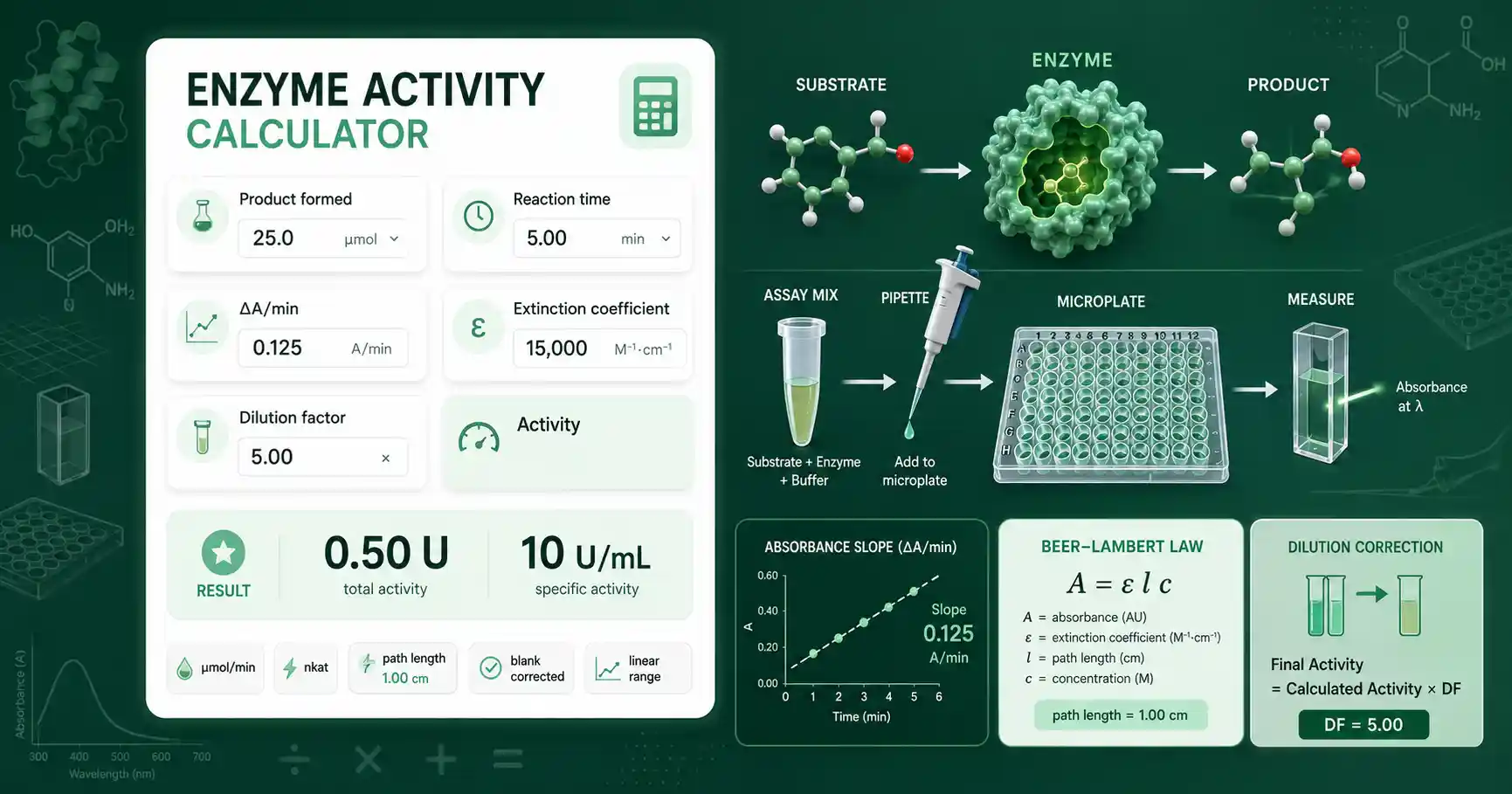
Enzyme Activity Calculator for assay results
This Enzyme Activity Calculator converts raw assay measurements into enzyme units.
It supports two common lab workflows.
You can calculate activity from the amount of product formed over a measured time.
You can also calculate activity from a blank-corrected absorbance slope when an extinction coefficient is known.
The main result is enzyme activity in units, where 1 U means 1 µmol of product formed per minute under the assay conditions.
The calculator also reports U/mL, which is often the most useful value for comparing enzyme stocks.
It includes nkat because some protocols and enzyme datasheets use SI enzyme activity units.
Enzyme activity formula used by the calculator
For a direct product assay, the calculator uses activity = product formed ÷ reaction time.
If the product amount is entered in nmol, the tool converts it to µmol before calculating units.
If the product amount is entered in mmol, the tool converts it to µmol in the opposite direction.
The activity concentration is calculated as total activity ÷ enzyme sample volume in mL.
The dilution factor multiplies the activity concentration when the measured sample was diluted before the assay.
For absorbance assays, the tool uses the Beer-Lambert relationship with ΔA/min, reaction volume, molar extinction coefficient, and path length.
A clear introduction to enzyme behavior and catalysis is available from OpenStax Biology 2e.
Use the same extinction coefficient unit expected by the formula, usually M⁻¹ cm⁻¹.
Use the actual optical path length when a microplate path-length correction is available.
Enzyme Activity Calculator worked example
Suppose an assay forms 2.5 µmol of product in 5 minutes.
The enzyme sample volume added to the reaction is 50 µL.
No dilution was made, so the dilution factor is 1.
The total activity is 2.5 µmol ÷ 5 min = 0.5 U.
The sample volume is 50 µL, which equals 0.05 mL.
The activity concentration is 0.5 U ÷ 0.05 mL = 10 U/mL.
This means each milliliter of the enzyme stock contains enough enzyme to form about 10 µmol of product per minute under the same assay conditions.
If that sample had been diluted 10-fold before measurement, the original stock activity would be 100 U/mL.
How to interpret enzyme activity results
A higher U/mL value means the enzyme preparation has more catalytic activity per unit volume.
It does not always mean the enzyme protein is purer.
Specific activity requires protein concentration as well as enzyme activity.
Use the Specific Activity Calculator when you need U/mg protein.
Use the Protein Concentration Calculator when you need to estimate the protein amount before calculating purity or enrichment.
Activity depends strongly on pH, temperature, substrate concentration, cofactors, salt, inhibitors, and assay timing.
Always compare activities only when samples were measured under the same assay conditions.
The initial linear reaction range is the best part of the assay for activity calculation.
Common enzyme assay mistakes to avoid
Do not use endpoint absorbance values as ΔA/min unless you divide by the measured linear time interval.
Do not mix µL and mL without converting the enzyme sample volume correctly.
Do not forget the dilution factor when the enzyme stock was diluted before measurement.
Do not use a calibration curve outside its reliable range.
Do not calculate activity from a reaction that has already reached substrate depletion or product inhibition.
Do not report activity without stating the assay temperature and pH when the number will be compared later.
Replicates help reveal pipetting error, timing variation, and nonlinear assay behavior.
Blank correction matters because background absorbance can create a false activity estimate.
Lab uses for enzyme activity calculation
Students can use the calculator to learn the relationship between product formation, time, and enzyme units.
Teaching labs can use it to check manual calculations from enzyme kinetics exercises.
Research labs can use it for quick stock activity estimates before setting up reactions.
Quality-control workflows can use U/mL to compare different enzyme lots or storage conditions.
Protein purification workflows can track enzyme activity across lysate, flow-through, wash, and elution fractions.
The calculator helps reduce transcription errors when converting nmol to µmol or µL to mL.
It also helps keep the assumptions visible next to the result.
Verify critical lab calculations independently before using them in real experiments.
Related tools for enzyme and protein work
Practical Questions About Enzyme Activity
What is one enzyme unit?
One enzyme unit is the amount of enzyme that forms 1 µmol of product per minute under the stated assay conditions.
Can I use absorbance per minute?
Yes. Use absorbance-rate mode when you know ΔA/min, extinction coefficient, path length, and reaction volume.
Why does dilution factor matter?
Dilution factor restores the calculated activity back to the concentration of the original enzyme stock.
Does the calculator prove my enzyme is pure?
No. Enzyme activity measures catalytic rate under assay conditions, while purity needs protein concentration, gel analysis, or other evidence.
When should I repeat the assay?
Repeat the assay when the blank is high, the slope is nonlinear, replicates disagree, or the result falls outside the standard curve range.