
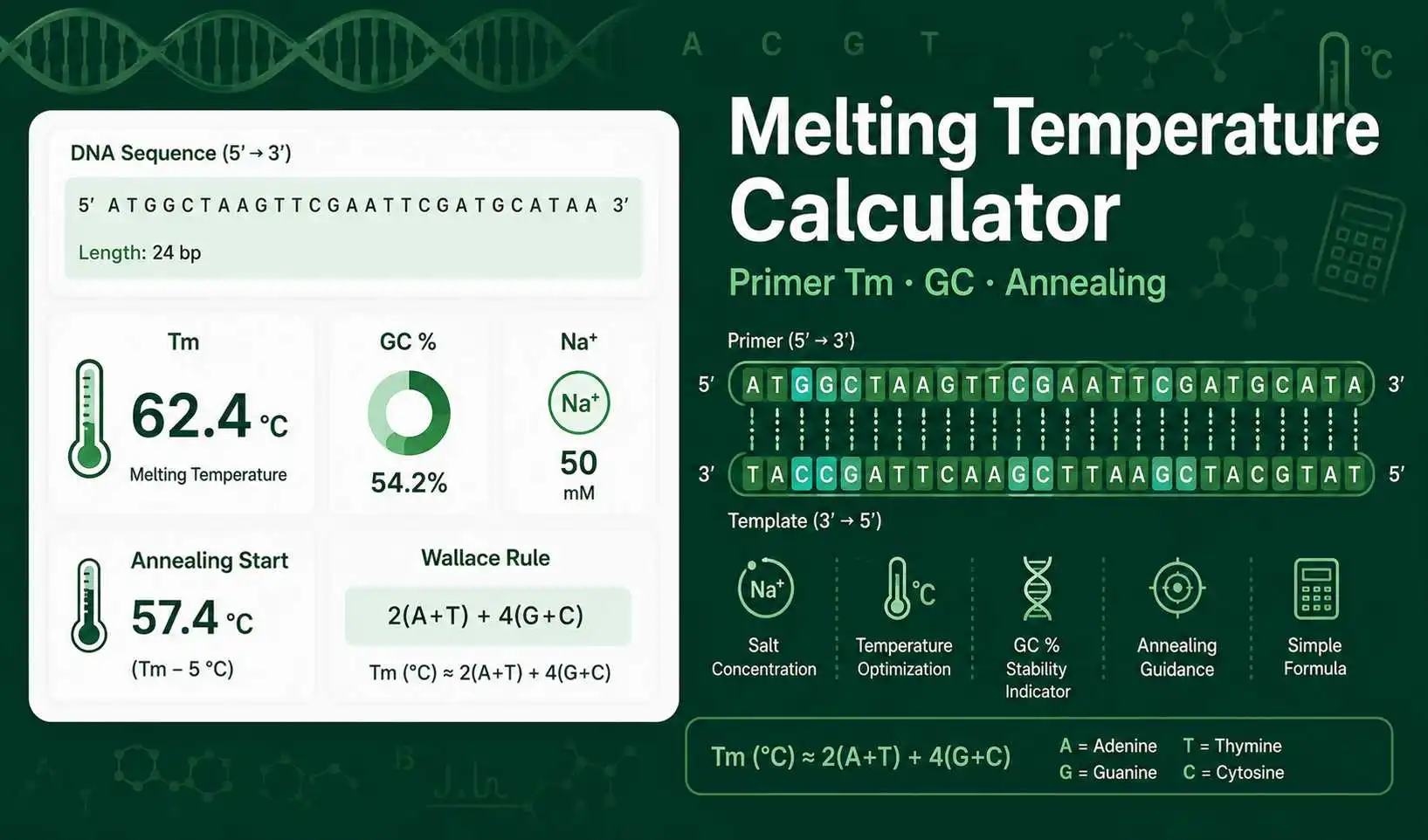
Melting Temperature Calculator for DNA primers
A melting temperature calculator estimates the Tm of a DNA primer or short oligo. Tm is the temperature where about half of the primer is hybridized to its complementary strand and half is unbound. In PCR, this value helps you choose a sensible annealing temperature.
This calculator reads a DNA sequence, removes spaces and FASTA headers, counts A, C, G, and T bases, calculates GC content, and reports two Tm estimates. It also gives a rough annealing starting point by subtracting 5°C from the reported Tm.
How to use the DNA melting temperature calculator
Paste the primer sequence in 5′ to 3′ direction. Use only A, C, G, and T bases. Set the monovalent salt concentration if you want the salt-adjusted estimate to reflect a different Na⁺ assumption. The default value is 50 mM because it is a common educational starting point for PCR-style calculations.
Read the reported Tm first. Then check the GC content, primer length, Wallace Tm, salt-adjusted Tm, and warnings. A sequence with balanced GC content, a practical length, and a Tm near your target range is usually easier to optimize than an extreme primer.
Melting temperature formulas used here
For short oligos, the calculator uses the Wallace rule. The equation is: Tm = 2 × (A + T) + 4 × (G + C). This simple formula works best as a quick classroom or beginner estimate for short DNA sequences.
For longer oligos, the calculator also reports a salt-adjusted estimate: Tm = 81.5 + 16.6 × log10([Na⁺]) + 0.41 × GC% − 675 ÷ length. In this equation, [Na⁺] is entered as molar concentration, GC% is the percentage of G and C bases, and length is the number of nucleotides.
A professional primer design workflow may use nearest-neighbor thermodynamics, magnesium correction, primer concentration, buffer chemistry, and polymerase-specific settings. For comparison, the NEB Tm Calculator is designed to estimate Tm and annealing conditions for NEB PCR products.NEB Tm Calculator
Worked example for primer Tm calculation
Suppose your primer is ATGCGTACGTTAGCGTACGA. It has 20 nucleotides. The sequence contains 5 A bases, 4 T bases, 5 G bases, and 6 C bases. GC count is 11, so GC content is 11 ÷ 20 × 100 = 55%.
The Wallace estimate is 2 × (A + T) + 4 × (G + C). That becomes 2 × 9 + 4 × 11 = 62°C. With 50 mM Na⁺, the salt-adjusted estimate is lower because the formula also includes sequence length and salt concentration. The best value to use depends on the calculation method required by your lab protocol.
Use case 1: choosing a PCR annealing temperature
In routine PCR, researchers often begin with an annealing temperature a few degrees below primer Tm. If your primer Tm is 62°C, a first trial near 57°C may be reasonable. If amplification is weak or nonspecific, a gradient PCR can test several annealing temperatures in one run.
This tool calculates only one sequence at a time. For a primer pair, calculate the forward primer and reverse primer separately. Then compare the two Tm values. A large difference between primer Tm values can make PCR optimization harder.
Use case 2: checking GC-rich or AT-rich oligos
GC-rich primers usually have higher Tm because G-C base pairs have three hydrogen bonds. AT-rich primers usually have lower Tm because A-T base pairs have two hydrogen bonds. This is why two primers of the same length can have different melting temperatures.
If GC content is below 40%, the primer may bind weakly. If GC content is above 60%, the primer may form stable secondary structures or need a higher denaturation and annealing setup. Use this page with theGC Content Calculator when you want a focused base-composition check.
Melting temperature result interpretation
Many PCR primers fall near 18–25 nucleotides, 40–60% GC content, and a Tm near 55–65°C. These values are practical guidelines, not strict rules. A primer outside these ranges may still work if the target, polymerase, buffer, and cycling conditions support it.
Low Tm can cause weak binding. Very high Tm can require harsher annealing conditions and may suggest GC-rich sequence behavior. If you are designing an assay, compare this result with a dedicatedPrimer Tm Calculator and verify the full primer pair before ordering.
Common mistakes in primer Tm calculation
Do not paste RNA bases into this DNA calculator. U bases should be converted to T first. Do not include primer labels, restriction sites written as text, modification notes, or ambiguity codes unless you plan to remove or resolve them before calculation.
Do not treat Tm as the same thing as annealing temperature. Tm describes duplex stability under an assumed condition. Annealing temperature is a PCR cycling setting. It depends on both primers, template, polymerase, buffer, and the target amplicon.
What to verify before using Tm in the lab
Check the sequence direction, primer specificity, expected amplicon size, primer-dimer risk, hairpin risk, polymerase instructions, magnesium concentration, and cycling protocol. For high-value work, confirm primer behavior with a supplier tool or a validated primer design platform.
Students can use this calculator to learn why GC content affects melting temperature. Lab workers can use it for quick screening before deeper primer design checks. Researchers can use it as an early planning step, not as the final authority for experimental conditions.