
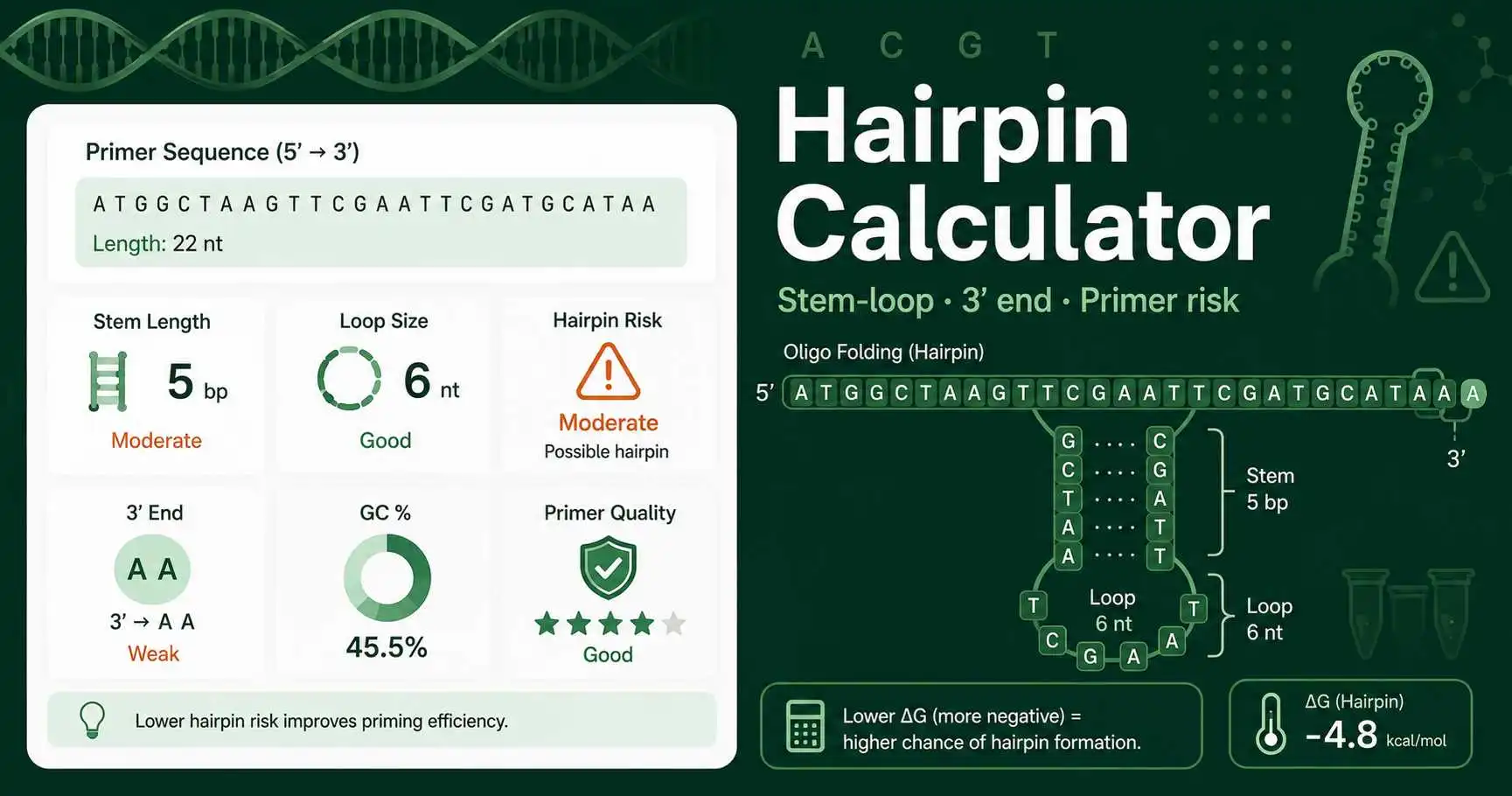
Hairpin Calculator for oligo secondary structure
A Hairpin Calculator checks whether a short DNA or RNA oligo can fold back on itself. This folding happens when one part of the sequence is complementary to another part of the same sequence. The paired region forms a stem. The unpaired region between the arms forms a loop.
This page gives a fast educational screen for primer hairpins. It reports the best exact inverted-repeat hit, stem length, loop length, GC content, 3′ end involvement, and a simple risk level. It helps students, teachers, and lab workers understand why a primer may need redesign before PCR, qPCR, cloning, or sequencing.
How the Hairpin Calculator works
Paste a DNA or RNA sequence into the tool. Choose the sequence type. The calculator removes FASTA headers, spaces, line breaks, and numbers. It then scans the cleaned sequence for inverted repeats that can pair as a stem-loop.
The tool uses Watson-Crick base pairing. In DNA, A pairs with T and C pairs with G. In RNA, A pairs with U and C pairs with G. A longer stem, a GC-rich stem, and a structure near the 3′ end increase the warning level.
Hairpin stem-loop formula used by the tool
The calculator uses a simple exact-match rule. It searches for this pattern inside the oligo:
left arm + loop + reverse complement of left arm
A practical score is then estimated from stem length, GC pairs, and 3′ involvement:
score = stem length × 2 + GC pairs in the stem + 3′ end bonus
This score is not a thermodynamic value. It is not ΔG. It is a quick screening score that helps you spot sequences that deserve more careful review.
Worked example for primer hairpin checking
Suppose a student enters the DNA primer AGCTGATCGTACGATCAGCT. The beginning AGCT can pair with the ending AGCT when the right side folds back as a reverse-complement arm. The loop sits between the two arms.
In this case, the calculator detects a possible stem of 4 base pairs. It also checks whether the structure reaches the 3′ end. If the 3′ end is involved, the warning becomes more important because PCR primers extend from the 3′ end.
Use case 1: screening PCR primers before ordering
Before ordering primers, paste each primer into the checker. A low-risk result means the tool did not find a strong exact-match hairpin. A moderate or high-risk result means you should review the primer position, especially if the predicted stem is long or GC-rich.
This is useful with the Primer Dimer Checker because a primer can fail from self-folding, primer-primer binding, or both. Checking both problems gives a better early primer screen.
Use case 2: teaching DNA base pairing and primer design
Teachers can use this calculator to show how complementary bases create secondary structure. Students can paste different sequences and compare how stem length, loop length, and GC content change the result.
The visual stem-loop output makes the concept easier to understand than a plain sequence. It also connects base pairing rules to practical PCR design.
How to interpret Hairpin Calculator results
Low risk means the exact-match scan did not find a strong hairpin at the selected settings. Moderate risk means the oligo has a possible stem-loop that deserves review. High risk means the detected structure is stronger, longer, or closer to the 3′ end.
GC-rich stems matter because G-C pairs have three hydrogen bonds and often stabilize secondary structure more than A-T or A-U pairs. Long GC-rich stems can make primers less available for target binding.
Common mistakes when checking primer hairpins
Do not paste a DNA sequence while RNA mode is selected. DNA mode accepts T. RNA mode accepts U. Also check that your primer is written 5′ to 3′, because the 3′ end warning depends on direction.
Do not treat this result as a final ordering decision. This calculator does not include salt concentration, magnesium concentration, primer concentration, mismatched pairing, or full nearest-neighbor thermodynamics. For detailed primer work, compare results with an oligo analysis tool such as IDT OligoAnalyzer.
Hairpin Calculator versus Primer Tm Calculator
A hairpin checker looks for self-folding. A Primer Tm Calculator estimates the temperature where a primer binds and melts from its target. Both checks matter because a primer can have a good Tm but still fold into a hairpin.
Use hairpin screening for secondary structure. Use Tm and GC checks for binding strength. Use product-size and specificity checks before real PCR or qPCR work.
What to verify before using the primer in a lab
Verify target specificity, primer direction, expected amplicon size, Tm compatibility, GC content, primer-dimer risk, and hairpin ΔG with a validated tool. Also follow your polymerase protocol and your lab’s ordering requirements.
This tool is best for fast learning and early screening. For critical experiments, verify the final primer design independently before ordering or preparing reactions.