
Microbiology growth math
Doubling Time Calculator
Calculate doubling time from an initial value, a final value, and an elapsed time. The calculator also reports fold change, generations, and specific growth rate.
Calculate doubling time from two measurements
Enter an initial value, a final value, and the elapsed time. Use OD600, CFU/mL, cell count, or another positive proportional growth measurement.
Doubling time output
The od600 increased 8-fold over 3 hours. Under an exponential-growth assumption, one doubling took about 1 h.
Verify critical lab calculations independently before using them in real experiments.
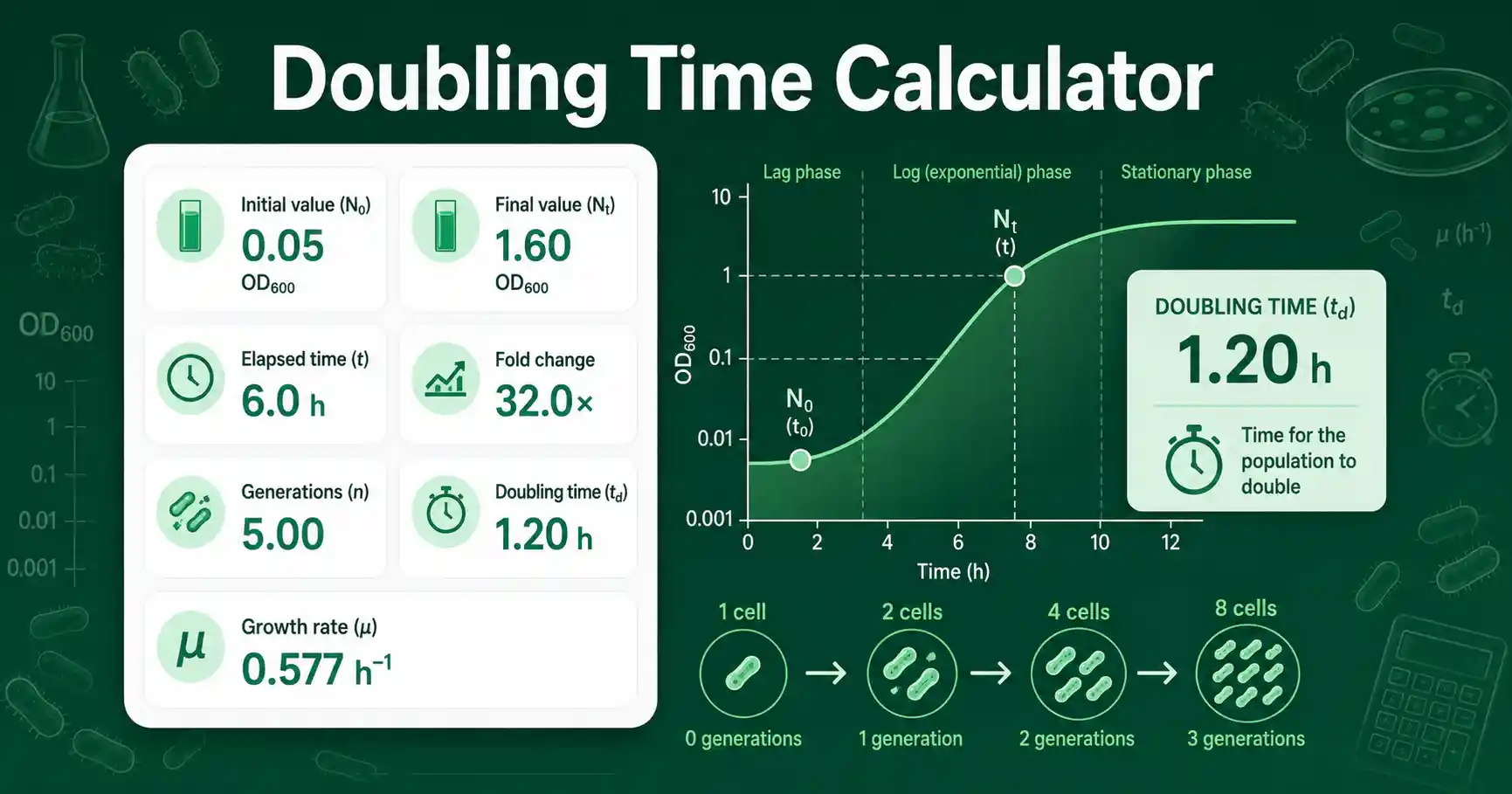
Doubling Time Calculator for microbial growth data
This Doubling Time Calculator estimates how long a growing population takes to double. It works with any positive measurement that is proportional to population size. Common inputs include OD600, CFU/mL, direct cell counts, and relative growth signals. The calculator is useful when students or lab workers have two growth measurements and need a clear exponential-growth summary.
Doubling time is often called generation time in microbiology. OpenStax describes generation time as the time required for a bacterial population to double, and it explains that log-phase growth is exponential rather than linear. You can review that background in the OpenStax section on how microbes grow. This page keeps the calculation educational and non-clinical.
How to use Doubling Time Calculator correctly
Enter the first measurement as the initial value. Enter the later measurement as the final value. Then enter the elapsed time between the two readings. The units of the initial and final measurements must match because the calculator uses their ratio.
A starting OD600 of 0.08 and an ending OD600 of 0.64 can be used directly because both values are OD600 readings. A starting density of 2.0 × 10⁵ CFU/mL and an ending density of 1.6 × 10⁶ CFU/mL can also be used directly because both values share the same unit. Do not mix OD600 with CFU/mL in the same calculation. Use the Bacterial Growth Rate Calculator when you want a broader growth-rate workflow with more interpretation.
Doubling Time Calculator formula and assumptions
The calculator first finds the fold change by dividing the final value by the initial value. It then calculates the number of generations as log₂(final ÷ initial). The doubling time equals elapsed time divided by the number of generations. The specific growth rate μ equals ln(final ÷ initial) divided by elapsed time.
Generations: n = log₂(Nₜ ÷ N₀)
Doubling time: g = t ÷ n
Specific growth rate: μ = ln(Nₜ ÷ N₀) ÷ t
These equations assume exponential growth across the interval being analyzed. The assumption is strongest during log phase. It is weaker during lag phase, stationary phase, or when the measurement is outside its linear range. If your values are very large or very small, the Scientific Notation Calculator can help format them clearly for reports.
Doubling Time Calculator worked example
Given values: Initial OD600 = 0.08, final OD600 = 0.64, elapsed time = 3 hours.
Formula: generations = log₂(Nₜ ÷ N₀), then doubling time = elapsed time ÷ generations.
Substitution: Nₜ ÷ N₀ = 0.64 ÷ 0.08 = 8. Then log₂(8) = 3 generations.
Result: doubling time = 3 hours ÷ 3 generations = 1 hour per doubling.
Interpretation: the proportional growth signal doubled about once every hour under the measurement conditions used.
Doubling Time Calculator results explained
A short doubling time means the measured population increased quickly. A long doubling time means the population increased more slowly. A one-hour doubling time means one two-fold increase occurred every hour under the chosen conditions. A 30-minute doubling time means two doublings can occur in one hour if the same rate continues.
The reported growth rate μ is shown per hour so users can compare different time inputs on one scale. A positive μ means growth occurred. A μ near zero means little net change occurred. A negative μ means the final measurement is lower than the initial measurement, so the sample did not show positive exponential growth.
Doubling Time Calculator mistakes to avoid
Do not enter zero, negative, or blank values because logarithms require positive measurements. Do not use a time interval of zero because growth rate depends on time. Do not calculate doubling time across a long interval that includes lag phase and stationary phase unless you clearly state that it is an average. Do not treat OD600 as exact cell number unless you have a calibration curve for the organism and instrument.
Rounding matters because small differences can change the final time when the fold change is small. Keep enough significant figures during the calculation, then round the final answer to a practical level. A result such as 62.4 minutes is usually more useful than reporting many extra decimals. Verify critical lab calculations independently before using them in real experiments.
Doubling Time Calculator use cases in lab work
Students can use the calculator to solve exponential growth problems from microbiology worksheets. Teachers can use it to demonstrate why log-phase growth appears linear on a semilog plot. Lab workers can compare two growth conditions by entering matched time intervals and reading the doubling time. Researchers can summarize pilot growth data before deciding whether more detailed curve fitting is needed.
The calculator also helps users compare OD600 readings, CFU/mL estimates, or direct counts when the same measurement method is used at both time points. It should not replace a full growth-curve model when many time points are available. It gives a clean two-point estimate that is easy to place in homework, teaching notes, and basic lab records.
Student questions about Doubling Time Calculator
Can I calculate doubling time from OD600 values?
Yes. OD600 can be used when the readings are proportional to cell density and are taken within a useful measuring range.
Why is doubling time not defined when the final value is lower?
A positive doubling time describes exponential increase. If the final value is lower than the initial value, the sample declined rather than doubled.
What is the difference between growth rate and doubling time?
Growth rate describes the exponential rate of increase per unit time. Doubling time converts that rate into the time needed for one two-fold increase.