
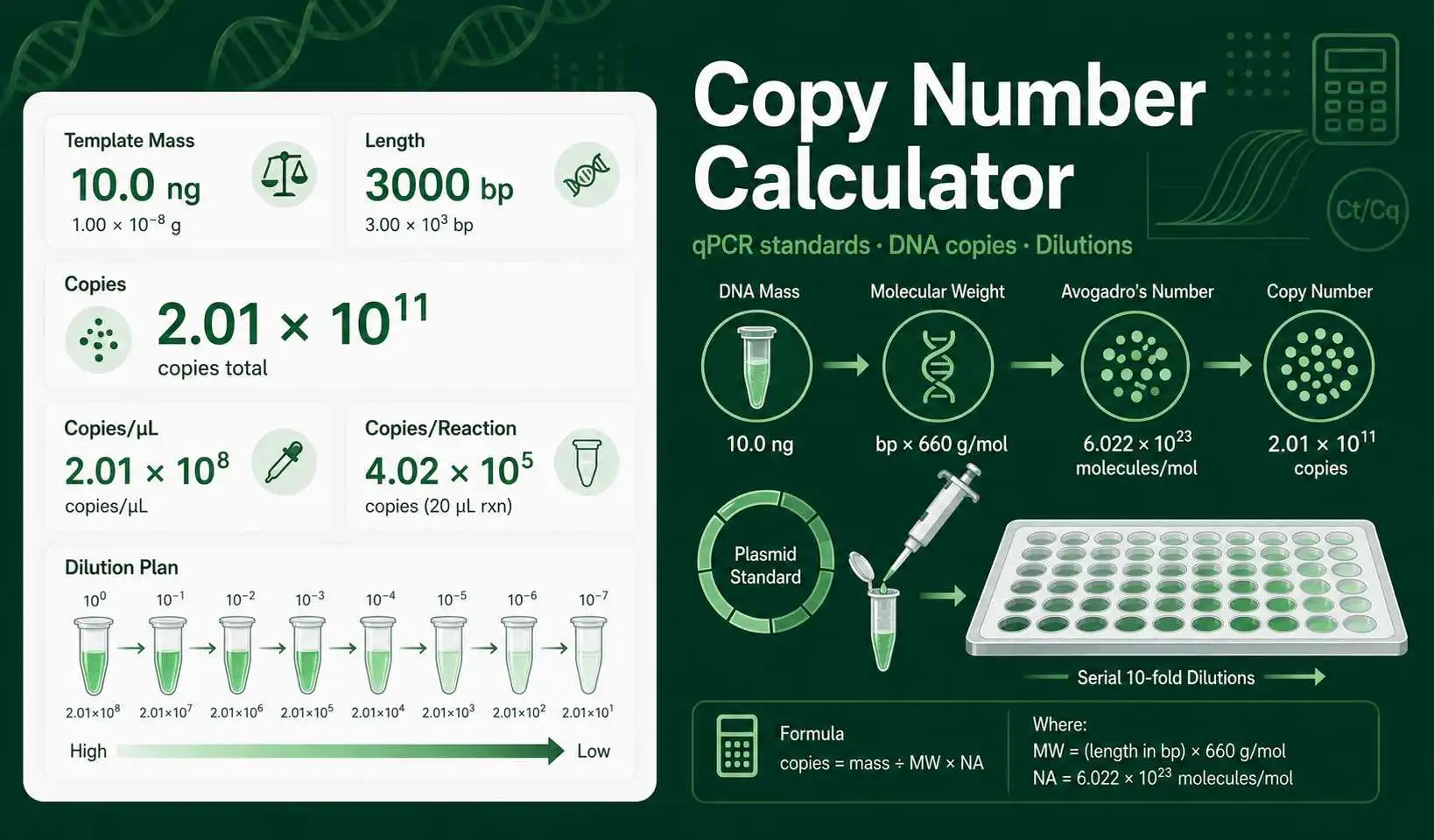
Copy Number Calculator for qPCR standards
This Copy Number Calculator estimates how many DNA or RNA molecules are present in a measured amount of template. It is useful when you prepare qPCR standards, plasmid standards, synthetic gene fragments, PCR amplicons, RNA controls, or teaching examples about molecule number.
The tool answers a practical lab question: “If I have this much DNA at this length, how many copies do I have?” It also converts the stock into copies per microliter and copies per qPCR reaction.
Copy number formula used by the calculator
The calculator first estimates molecular weight from template length. For double-stranded DNA, it uses about 660 g/mol per base pair. For single-stranded DNA, it uses about 330 g/mol per nucleotide. For single-stranded RNA, it uses about 340 g/mol per nucleotide.
The main equation is: copies = mass in grams ÷ molecular weight in g/mol × 6.022 × 10²³. Copies per microliter = total copies ÷ stock volume in microliters. Copies per reaction = copies per microliter × template volume per reaction.
Absolute qPCR often uses standards of known quantity to build a standard curve and estimate unknown sample quantity. For background on real-time PCR copy estimation, see this NCBI-hosted article on a real-time PCR method for genome copy estimation.
Worked example for DNA copy number
Suppose you have 10 ng of a 3,000 bp double-stranded plasmid fragment in 100 µL. The approximate molecular weight is 3,000 × 660 = 1,980,000 g/mol. The mass in grams is 10 × 10⁻⁹ g.
Moles = 10 × 10⁻⁹ ÷ 1,980,000 = 5.05 × 10⁻¹⁵ mol. Total copies = 5.05 × 10⁻¹⁵ × 6.022 × 10²³ = about 3.04 × 10⁹ copies. If the stock volume is 100 µL, the stock has about 3.04 × 10⁷ copies/µL.
If you add 2 µL of this stock to one qPCR reaction, the reaction receives about 6.08 × 10⁷ copies. That is high for many standard-curve plans, so you may prepare serial dilutions before loading the qPCR plate.
Use case 1: preparing a qPCR standard curve
A qPCR standard curve needs known copy numbers across a dilution series. You can enter the mass and length of a purified plasmid standard, then use copies per microliter to plan 10-fold dilutions. This helps you prepare standards such as 10⁶, 10⁵, 10⁴, 10³, and 10² copies per reaction.
After you run the standard curve, use a Standard Curve Calculator to check slope, R², and linear range. A good copy number plan still needs clean pipetting, mixed standards, and consistent template volume.
Use case 2: checking template input per reaction
Copy number also helps you decide whether a sample has too little or too much template. Very low copy input can increase replicate scatter. Very high copy input can saturate the assay, shift Ct values, or force extra dilution.
For qPCR assay quality, compare copy number planning with qPCR efficiency, Ct replicate spread, melt curve behavior, and no-template controls. Copy number is only one part of assay interpretation.
Practical copy number problem
Imagine you want 10,000 copies per qPCR reaction, and your current stock has 1,000,000 copies/µL. If you add 2 µL template per reaction, the undiluted reaction receives 2,000,000 copies. You need 10,000 copies, so the reaction input must be 200 times lower.
A 1:200 dilution would bring 2 µL of template close to 10,000 copies per reaction. In real lab work, you may make this as two easier steps, such as 1:20 followed by 1:10, to reduce pipetting error.
Common mistakes in DNA copy number calculation
The most common mistake is using the wrong length. If you measured the mass of a full plasmid, use full plasmid length. If you measured a purified PCR product, use amplicon length. These choices can change the calculated copy number by orders of magnitude.
Another common mistake is mixing ng, pg, and µg. Always check the mass unit before reading the result. Also verify concentration with a suitable method, because contaminants, RNA carryover, salts, and low-volume measurement error can affect the mass estimate.
How students and lab workers can use the result
Students can use the calculator to connect molecular weight, Avogadro's number, and qPCR standard curves. It makes abstract mole calculations easier because it turns mass into molecule count.
Lab workers can use it for routine planning before setting up absolute qPCR, digital PCR controls, plasmid standards, synthetic DNA standards, or template dilution checks. Always verify critical calculations independently before preparing final standards.