
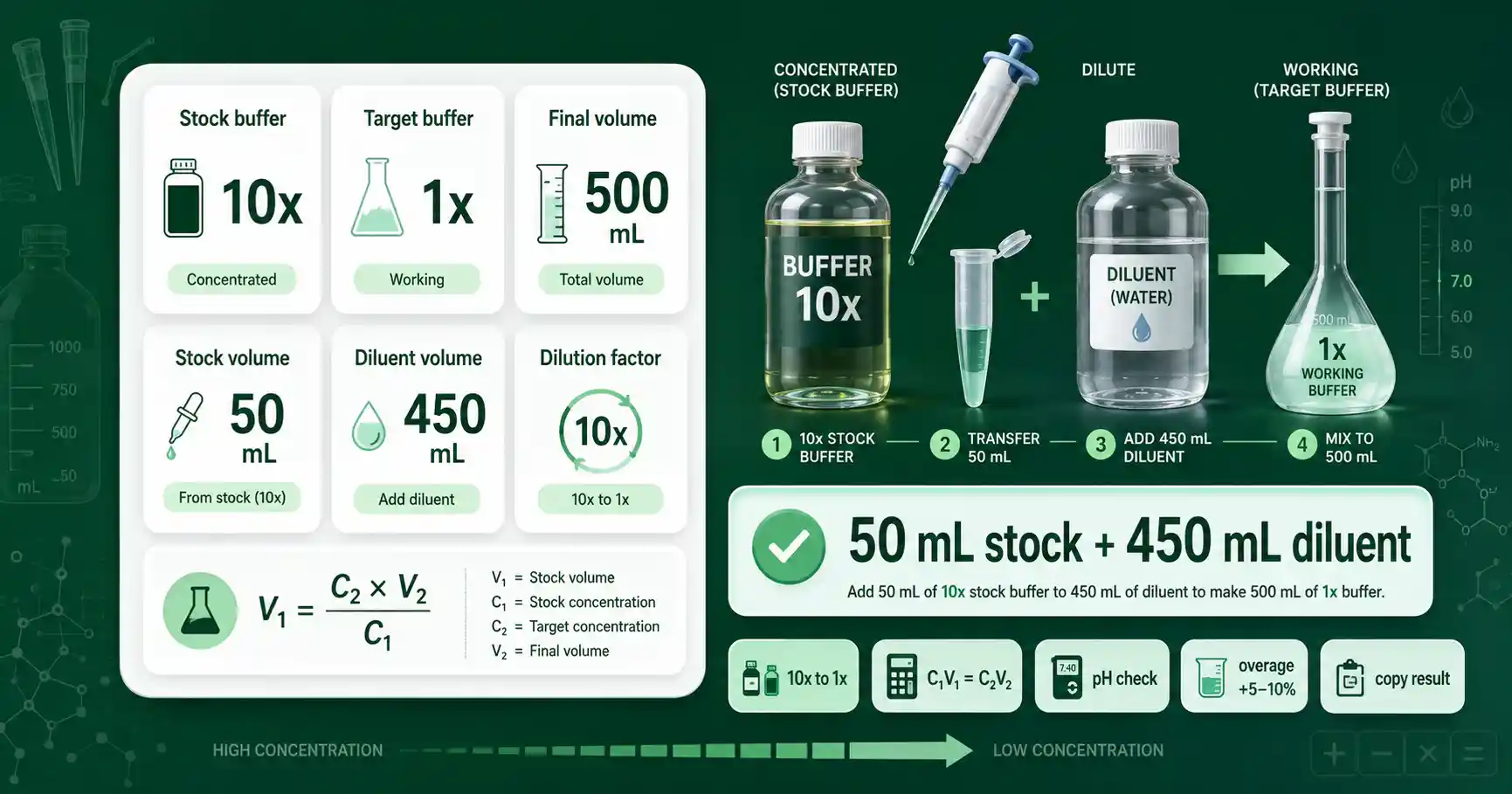
Buffer Dilution Calculator for working buffers
This Buffer Dilution Calculator helps you prepare a working buffer from a concentrated stock. It is useful when a protocol asks for 1x PBS, 1x TAE, 1x TBE, 50 mM Tris buffer, or another diluted laboratory buffer. The tool calculates the volume of stock buffer to pipette and the volume of water or diluent to add. It also reports the dilution factor, prepared volume, and working strength compared with the stock.
The calculator uses the standard dilution equation C1V1 = C2V2. C1 is the stock buffer concentration. C2 is the desired working buffer concentration. V2 is the final working volume. V1 is the stock volume that must be added to the final preparation.
Students can use the tool to understand how stock concentration and final volume control dilution. Lab workers can use it to avoid manual volume errors during routine buffer preparation. Researchers can use it to scale a small buffer recipe to a larger batch with an overage allowance.
Buffer dilution formula used by the calculator
The main formula is V1 = C2 × V2 ÷ C1. If you dilute 10x buffer to 1x buffer, the dilution factor is 10. That means one part stock buffer is mixed with nine parts diluent to make ten total parts. If you prepare 500 mL of 1x buffer from a 10x stock, the stock volume is 50 mL and the diluent volume is 450 mL.
The tool accepts concentration values as x, M, mM, or µM. Stock and target concentration should use the same unit in one calculation. A 10x to 1x dilution and a 500 mM to 50 mM dilution both represent a ten-fold dilution. The unit changes the label, but the ratio controls the stock volume.
Volume can be entered in µL, mL, or L. The result automatically displays readable units. This helps when you prepare small molecular biology reactions, medium-scale wash buffers, or liter-scale electrophoresis buffers.
Buffer Dilution Calculator worked example
Suppose you need 500 mL of 1x PBS from a 10x PBS stock. The given values are C1 = 10x, C2 = 1x, and V2 = 500 mL. Substitute the values into the formula: V1 = 1 × 500 ÷ 10. The stock volume is 50 mL.
The diluent volume is final volume minus stock volume. That means 500 mL − 50 mL = 450 mL. You would mix 50 mL of 10x PBS with 450 mL of water to prepare 500 mL of 1x PBS. If you add 10% overage, the calculator prepares 550 mL instead, so it gives 55 mL stock and 495 mL diluent.
This result means the final buffer has one tenth of the stock concentration. The acid-base ratio of a true buffer system may remain similar after dilution, but the total buffer capacity drops because fewer buffer components are present per liter. That is why a very dilute buffer may resist pH change less effectively.
How to interpret buffer dilution results
The stock volume tells you the amount of concentrated buffer to add first. The diluent volume tells you how much water, solvent, or compatible buffer base to add. The prepared volume includes overage when you enter an overage percentage. Overage is helpful when some liquid remains in tips, tubes, reservoirs, or membrane trays.
The dilution factor tells you how many times the stock is diluted. A dilution factor of 20 means the working buffer is one twentieth of the stock concentration. The working strength percentage shows the same relationship in another way. A 1x solution made from a 10x stock is 10% of the stock strength.
The advanced pKa check helps you think about buffer range. A buffer usually works best near its pKa because both acid and conjugate base are present in useful amounts. OpenStax explains buffer behavior and the Henderson-Hasselbalch relationship in its Chemistry 2e buffer section. Use a calibrated pH meter if the final pH matters for enzyme activity, protein stability, electrophoresis, or cell culture.
Common buffer dilution mistakes to avoid
Do not enter a target concentration that is higher than the stock concentration. Dilution can only lower concentration. Do not mix concentration units accidentally, such as entering a stock in mM and a target in µM while reading both as the same unit. Convert units first or keep both values in the same unit.
Do not assume dilution always leaves pH exactly unchanged. Dilution can change ionic strength, activity coefficients, carbon dioxide exposure, and electrode readings. Temperature also affects pH readings. For critical buffers, prepare close to the desired volume, mix well, check pH, adjust if your protocol allows it, and then bring to final volume.
Do not use tap water or an incompatible diluent unless your protocol says so. Many molecular biology buffers need nuclease-free water, deionized water, or a defined solvent. Some commercial buffer concentrates contain salts, detergents, or preservatives, so the final composition depends on the manufacturer recipe.
When this lab buffer calculator is useful
Use the calculator before making wash buffer for western blotting, running buffer for electrophoresis, phosphate-buffered saline for routine work, or Tris-based buffers for molecular biology. It also helps when you need to prepare a smaller aliquot from a large stock bottle. If your workflow is a simple concentration dilution rather than a buffer-specific task, the Solution Dilution Calculator gives a similar stock-to-working calculation. For a direct equation-focused layout, the C1V1 C2V2 Calculator is useful.
The tool helps students see why a 10x stock does not mean adding 10 mL to any final volume. The final volume controls the amount of stock. It helps lab workers make repeatable buffer preparations because the result can be copied into a notebook or protocol. It helps teachers create dilution examples that connect concentration, volume, and dilution factor.
Verify critical lab calculations independently before using them in real experiments. Check the buffer label, expiration date, storage condition, and protocol concentration. If the buffer contains hazardous chemicals, follow your institution's safety procedures and waste rules.