
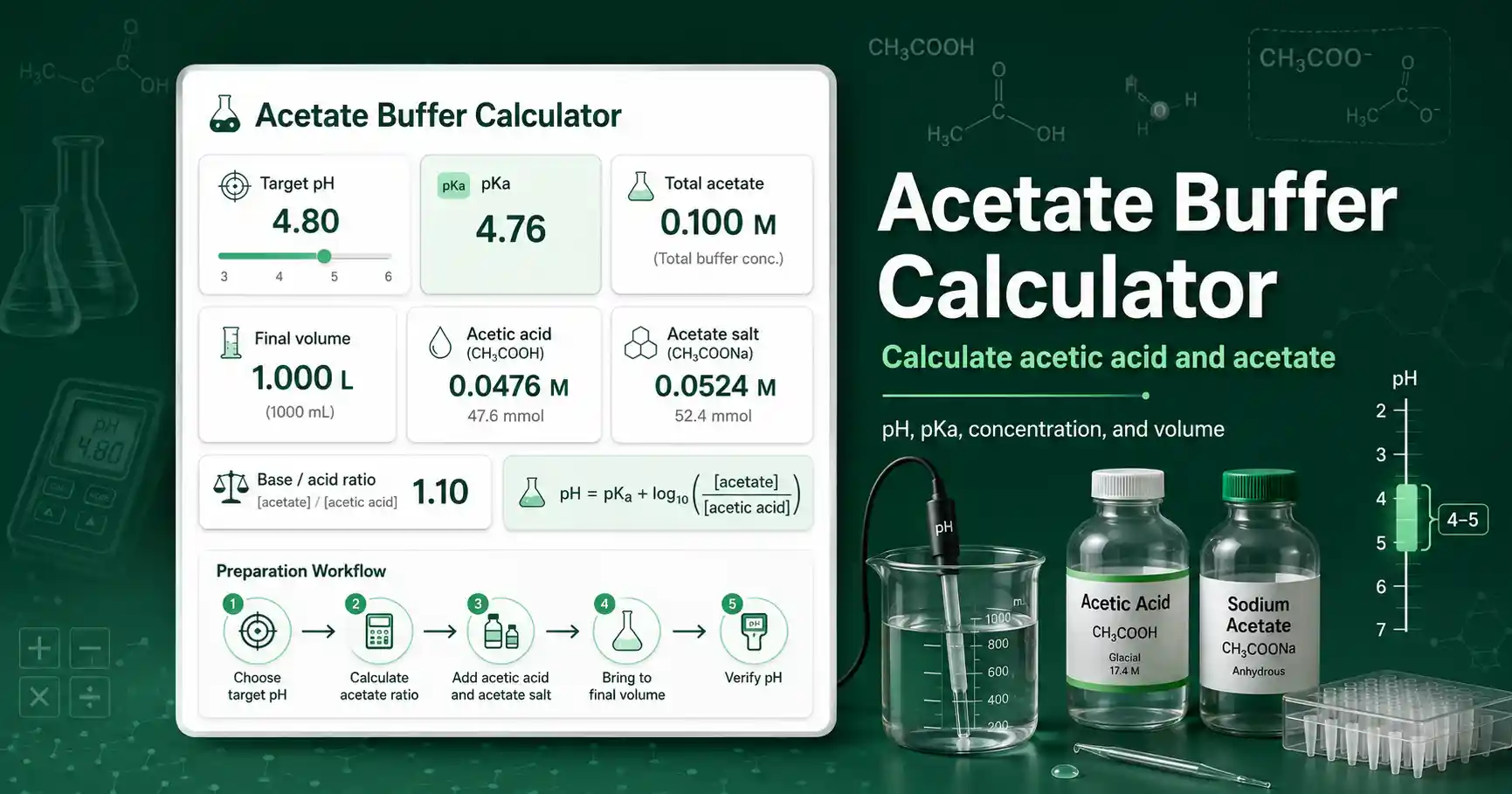
Acetate Buffer Calculator for pH and concentration
This Acetate Buffer Calculator estimates how much acetic acid and acetate you need for a selected target pH. It uses the acetic acid and acetate conjugate pair, often written as CH3COOH and CH3COO-. The calculator uses total acetate concentration as the combined concentration of both buffer forms. A 100 mM acetate buffer therefore means the acetic acid plus acetate species add up to 100 mM before any final pH adjustment.
Students can use the result to understand why a buffer contains both a weak acid and its conjugate base. Teachers can use the tool to demonstrate how changing pH changes the base-to-acid ratio. Lab workers can use it as a quick recipe check before preparing a non-clinical acetate buffer. Researchers can use it to compare acetate salt forms and stock solution options during early calculation planning.
The calculator is most useful near the acetic acid pKa. The default pKa is 4.76, which is a common value for acetic acid near room temperature. Buffer capacity is strongest when the target pH is close to the pKa. A target pH around 4.75 gives nearly equal acetic acid and acetate amounts. A target pH above the pKa needs more acetate. A target pH below the pKa needs more acetic acid.
Acetate buffer formula used by the calculator
The calculation uses the Henderson-Hasselbalch equation. The equation relates pH, pKa, and the concentration ratio between acetate and acetic acid. For a deeper equation-only check, the Henderson-Hasselbalch Calculator can calculate the ratio without preparing a full recipe.
The calculator rearranges the equation to get the ratio [acetate] / [acetic acid] = 10^(pH - pKa). It then splits the total acetate moles into acid and base forms. The total moles come from concentration multiplied by final volume. If you enter 100 mM and 500 mL, the total acetate amount is 50 mmol. The ratio decides how many of those 50 mmol are assigned to acetic acid and how many are assigned to acetate.
This page treats activities as concentrations. That assumption works well for many classroom calculations and quick planning estimates. It may not fully describe high ionic strength solutions, mixed solvents, or temperature-shifted systems. For critical experiments, check the pKa at your working temperature and verify the final pH after mixing. Chemistry LibreTexts gives a useful background explanation of the Henderson-Hasselbalch approximation and its assumptions.
How to use the Acetate Buffer Calculator
Start with the target pH because the target pH controls the acetate-to-acetic-acid ratio. Keep the pKa at 4.76 unless you have a temperature-specific value from a reliable source. Enter the total acetate concentration in mM or M. Enter the final volume in mL or L. Choose Basic mode for a fast estimate using glacial acetic acid and anhydrous sodium acetate. Choose Advanced mode when you want to use acetic acid stock solution, acetate stock solution, sodium acetate trihydrate, or potassium acetate.
The result shows the base-to-acid ratio first because it explains the chemistry behind the recipe. The acetic acid amount is the HA component. The acetate amount is the A- component. The preparation estimate converts those moles into a practical liquid volume or salt mass. The final instruction says to bring the mixture to final volume because buffer recipes are normally made by mixing components first and then diluting to the selected final volume.
Unit choice changes the result. A 100 mM buffer is ten times more dilute than a 1 M buffer. A 500 mL volume contains half the amount required for a 1 L volume at the same concentration. The calculator keeps these conversions internal so the displayed recipe remains easy to read. Rounding is sensible for planning, but it is not a replacement for calibrated instruments or a laboratory balance with known precision.
Acetate buffer assumptions and practical limits
The calculator assumes ideal behavior and complete mixing. It assumes that total acetate concentration is the sum of acetic acid and acetate. It does not correct for ionic strength, activity coefficients, temperature-dependent pKa shifts, or volume contraction after mixing. It estimates glacial acetic acid as 17.46 M. It uses common molar masses for acetate salts, including anhydrous sodium acetate, sodium acetate trihydrate, and potassium acetate.
Acetate buffers are often useful in acidic pH ranges. They are not a good choice when the target pH is far from the pKa. If the calculator warns that the target pH is outside pKa ± 1, the buffer may resist pH change poorly. In that case, consider another buffer system with a pKa closer to the target pH. For a broader weak acid workflow, the Buffer Preparation Calculator can help compare other buffer pairs.
Always check whether the selected salt form matches the bottle label. Sodium acetate trihydrate weighs more per mole than anhydrous sodium acetate because it contains water of crystallization. Using the wrong molar mass can shift the acetate amount noticeably. Always prepare buffers with appropriate safety procedures, labeled containers, and calibrated pH equipment. Verify critical lab calculations independently before using them in real experiments.