
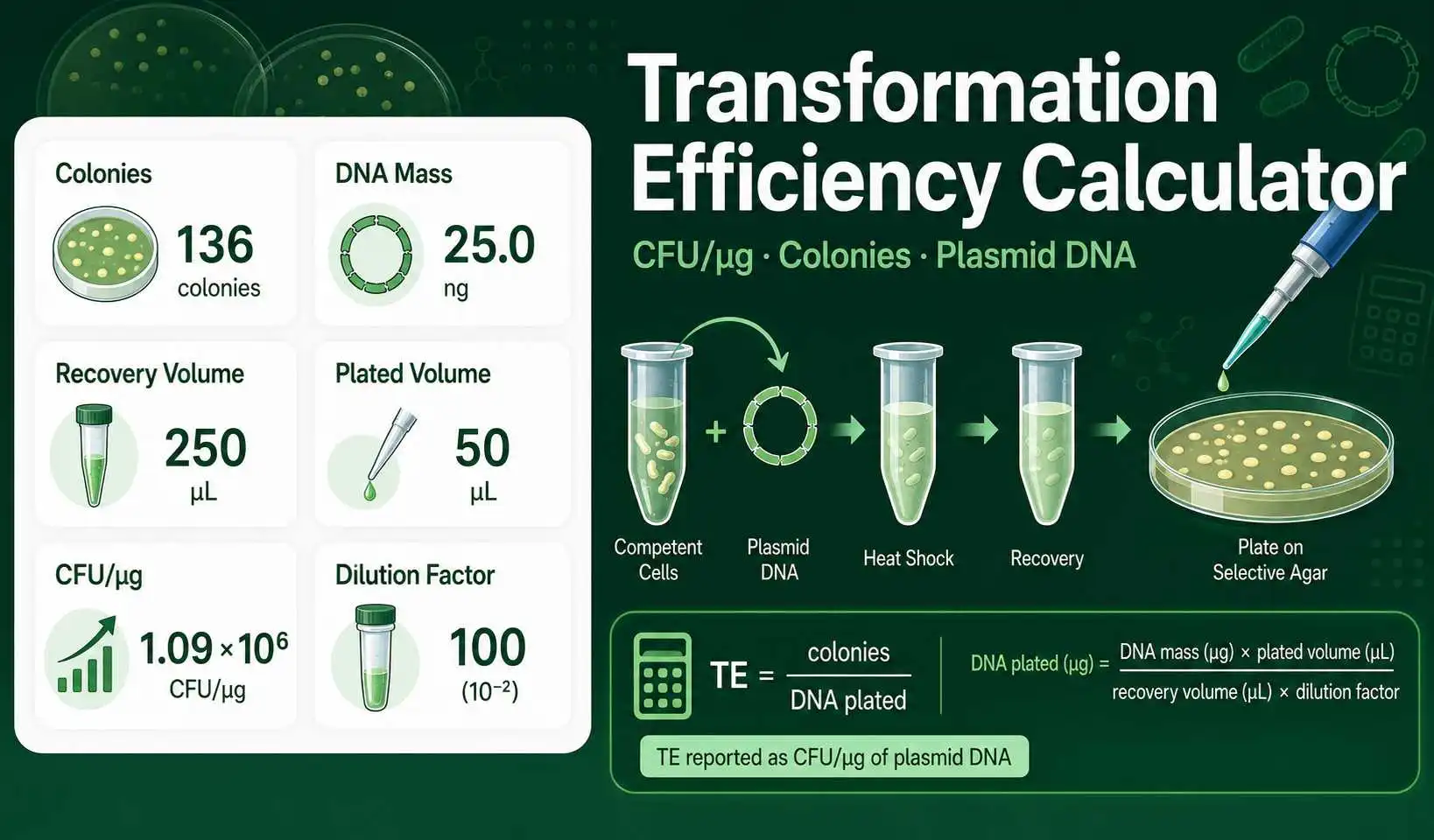
Transformation Efficiency Calculator for CFU per microgram
A Transformation Efficiency Calculator estimates how effectively competent bacterial cells take up plasmid DNA. It reports the result as colony-forming units per microgram of DNA, usually written as CFU/µg. This value helps you compare competent cell batches, control transformations, ligation reactions, and cloning workflows.
The calculator uses the colonies you counted on an antibiotic plate and corrects the number for DNA amount, total recovery volume, plated volume, and dilution. This matters because the plate usually represents only part of the recovered transformation mixture.
Transformation efficiency formula used by the calculator
The core idea is simple. Count colonies, estimate how much DNA those colonies represent, and scale the result to one microgram of DNA.
TE = colonies × total recovery volume × dilution factor ÷ (plated volume × DNA in µg)
The tool also calculates DNA represented on the counted plate. If you transformed 0.05 ng DNA, recovered to 1000 µL, and plated 100 µL, the counted plate represents 10% of the transformation mix. That means the plate represents 0.005 ng DNA.
NEB gives the same basic transformation efficiency relationship as colonies divided by micrograms of DNA and dilution. This calculator expands that idea so students and lab workers can enter plated volume and recovery volume directly.NEB transformation efficiency calculation
Worked example: calculate bacterial transformation efficiency
Suppose you transformed 0.05 ng of control plasmid DNA into competent E. coli. After recovery, the total volume was 1000 µL. You plated 100 µL and counted 250 colonies the next day. No extra dilution was used, so the dilution factor is 1.
First convert DNA to micrograms. 0.05 ng equals 0.00005 µg. Next calculate the plated fraction: 100 µL ÷ 1000 µL = 0.1. The DNA represented on the plate is 0.00005 µg × 0.1 = 0.000005 µg.
TE = 250 ÷ 0.000005 = 50,000,000 CFU/µg = 5 × 10⁷ CFU/µg
This value suggests a useful competent-cell preparation for many routine cloning tasks. It does not prove that every ligation will work. Insert size, vector quality, antibiotic selection, recovery medium, and cell handling still affect colony number.
When to use transformation efficiency in cloning
Use this calculator after a control transformation with known plasmid DNA. A control plate tells you whether competent cells, antibiotic plates, heat shock or electroporation, recovery medium, and incubation conditions are working as expected.
You can also use it after ligation, Gibson Assembly, Golden Gate Assembly, or plasmid rescue experiments. For ligation plates, the number is not a pure competent-cell efficiency value because the reaction mixture contains assembled and unassembled DNA. Still, it helps you compare plates across experiments and troubleshoot poor colony recovery.
If your cloning setup also needs insert and vector planning, calculate the reaction first with the Ligation Calculator. If you need copies, fmol, or molecular weight from a plasmid length, use the Plasmid Size Calculator.
Practical use case 1: checking competent cell quality
A lab worker may transform a small amount of supercoiled control plasmid into a new competent-cell batch. If the transformation efficiency is much lower than the supplier value or previous in-house batches, the problem may come from thawing, heat shock time, recovery medium, old antibiotic plates, or repeated freeze-thaw damage.
The calculator helps separate a real efficiency problem from a plating math mistake. For example, plating 50 µL instead of 100 µL changes the fraction counted. If you forget that correction, your reported CFU/µg can be wrong by two-fold.
Practical use case 2: comparing cloning plates
A researcher may compare two ligation reactions that use the same vector, insert, competent cells, and recovery volume. One plate gives 15 colonies, and the other gives 180 colonies. The calculator can normalize both plates to the same DNA amount and plated volume.
This comparison is useful, but it needs interpretation. Ligation quality, background vector, insert toxicity, plasmid size, antibiotic strength, and recovery conditions can all change colony count. Transformation efficiency is one measurement, not a complete cloning diagnosis.
Common mistakes in transformation efficiency calculation
Do not enter DNA concentration when the field asks for total DNA mass. If you added 1 µL of 50 pg/µL DNA, the total DNA added is 50 pg, or 0.05 ng. Enter 0.05, not 50.
Do not ignore recovery volume. After adding SOC or recovery medium, the final mixture may be much larger than the volume plated. The calculator uses this volume to estimate total transformants from the counted plate.
Avoid using crowded plates for final reporting. Plates with hundreds of overlapping colonies can undercount true transformants. Plates with very few colonies can have high random error. A countable plate gives a more reliable CFU/µg estimate.
How students can report transformation efficiency
In a lab report, state the colony count, DNA mass, total recovery volume, plated volume, dilution factor, formula, and final CFU/µg value. Also mention whether the plate was countable and whether the transformation used chemical competence, heat shock, or electroporation.
A clear sentence could be: “The transformation produced 250 colonies from 0.05 ng plasmid DNA, with 100 µL plated from a 1000 µL recovery volume, giving an estimated transformation efficiency of 5 × 10⁷ CFU/µg DNA.”
What to verify before using the result
Verify the antibiotic, incubation temperature, recovery time, DNA identity, plasmid size, competent-cell strain, plate dilution, and colony count. For critical experiments, repeat the transformation with a control plasmid and compare the result with the expected range in your protocol.
This calculator gives a transparent estimate. It does not guarantee cloning success, cell quality, or plasmid correctness. Confirm important results with colony PCR, restriction digest, sequencing, or another validated screening method.