
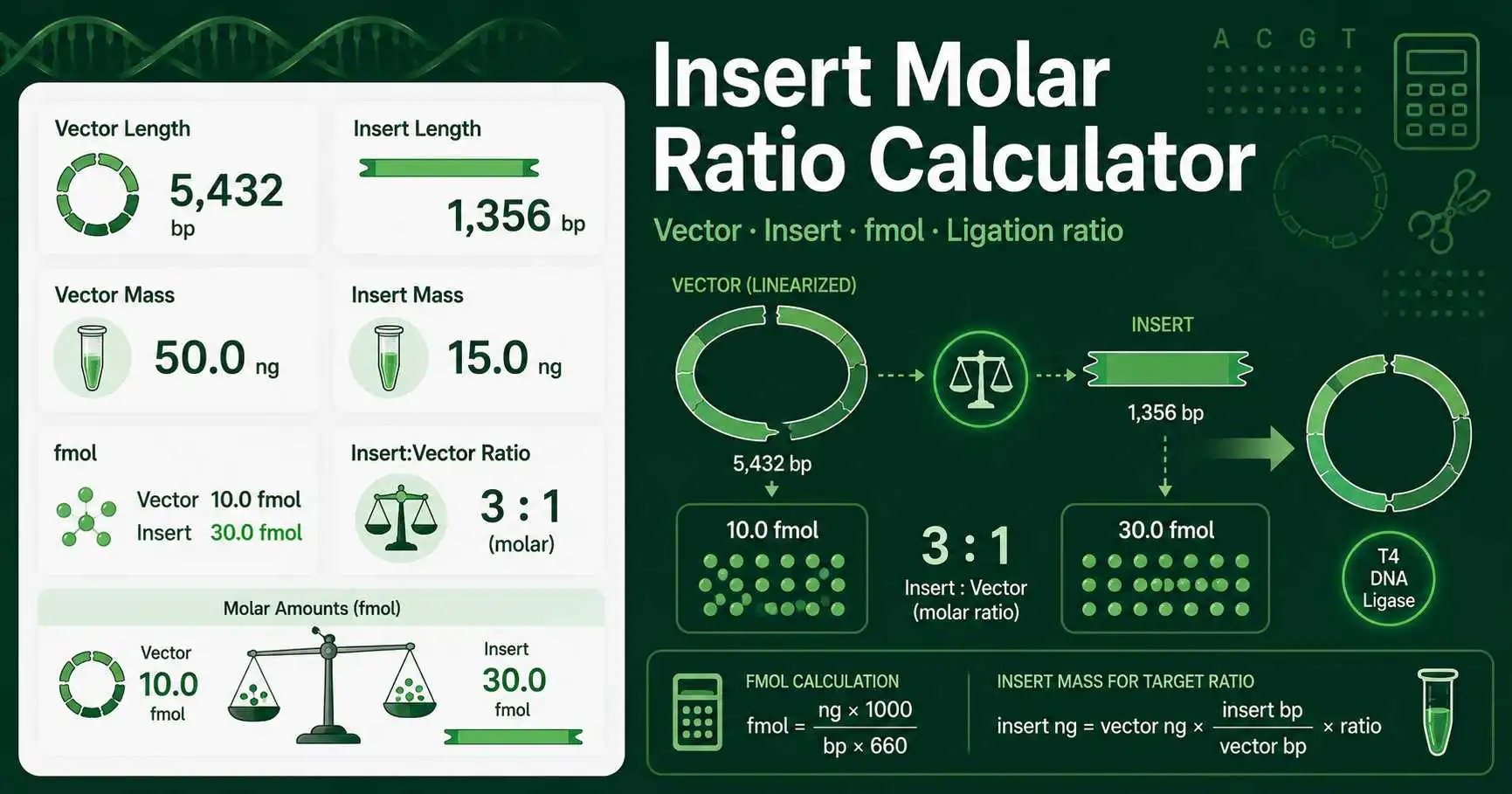
Insert molar ratio calculator for cloning setup
This Insert Molar Ratio Calculator helps you compare insert DNA molecules with vector DNA molecules. It converts DNA mass in nanograms and fragment length in base pairs into femtomoles. The result tells you the current insert:vector molar ratio and the insert mass needed for your chosen ratio.
Use it when you prepare a ligation reaction after restriction digestion, gel purification, PCR cleanup, or vector linearization. The tool is useful for students learning molecular cloning and for lab workers who need a fast planning check before setting up a bench reaction.
Why insert:vector molar ratio matters
Ligation depends on molecule number, not only DNA mass. A 900 bp insert has more molecules per nanogram than a 3000 bp vector because each insert molecule is smaller. That is why cloning protocols usually describe insert:vector ratio as a molar ratio, such as 1:1, 3:1, or 5:1.
If you use a simple mass ratio, you may add too few insert molecules or too much insert DNA. Too little insert can leave many vectors without inserts. Too much insert can increase concatemer formation or background, especially when DNA ends are compatible with each other.
Insert molar ratio formula
The calculator uses a common double-stranded DNA approximation. One base pair has an average molecular weight of about 660 g/mol. From that, the calculator converts DNA mass into femtomoles.
fmol DNA = ng × 1000 ÷ (bp × 660)
insert:vector ratio = insert fmol ÷ vector fmol
required insert ng = vector ng × insert bp ÷ vector bp × desired ratio
This method gives a practical planning estimate. It assumes double-stranded DNA and does not adjust for damaged ends, incomplete digestion, salt carryover, DNA quantification error, or ligation efficiency.
Worked example for a 3:1 insert:vector ratio
Suppose your vector is 3000 bp and you want to use 50 ng vector. Your insert is 900 bp. You want a 3:1 insert:vector molar ratio.
First, calculate the vector amount: 50 × 1000 ÷ (3000 × 660) = 25.25 fmol. For a 3:1 ratio, the insert should be 25.25 × 3 = 75.75 fmol. Convert that insert amount into mass: 75.75 × 900 × 660 ÷ 1000 = 45 ng.
In this example, 50 ng of a 3000 bp vector needs about 45 ng of a 900 bp insert for a 3:1 molar ratio. If your insert length changes, the required mass changes even when the desired ratio stays the same.
How to use the insert molar ratio tool
Enter the full vector length in base pairs. Use the linearized vector size after digestion. Enter the insert length in base pairs. Then enter the vector mass in nanograms and the insert mass you plan to add. Finally, choose your target insert:vector ratio.
The result shows vector fmol, insert fmol, current ratio, required insert mass, and the adjustment needed from your current insert amount. If you only want to calculate the required insert mass, set current insert mass to 0 and read the required insert result.
Practical use case: cohesive-end ligation
For a standard sticky-end ligation, many researchers start near a 3:1 insert:vector molar ratio. This gives more insert molecules than vector molecules and can improve the chance that a vector end meets a compatible insert end.
After calculation, check whether the total DNA mass fits your reaction volume. A 10 µL or 20 µL ligation should not become crowded with too much DNA solution. If the insert volume is too large, concentrate the insert or use less vector.
Practical use case: testing multiple ratios
A cloning experiment may benefit from testing more than one ratio. You can calculate 1:1, 3:1, and 5:1 reactions using the same vector and insert lengths. This is useful when the insert is large, blunt-ended, toxic, repetitive, or difficult to clone.
Keep the vector mass constant when comparing ratios. Change only the insert mass. This makes the transformation results easier to interpret because the number of vector molecules stays similar across reactions.
Common mistakes in insert molar ratio calculations
Do not enter plasmid stock size if the vector has been cut and a fragment has been removed. Use the actual linearized vector length. Do not enter insert concentration instead of insert mass. Convert concentration and volume into ng first if your quantification result is in ng/µL.
Do not assume a 3:1 ratio always gives the best result. End type, vector background, insert purity, dephosphorylation, ligase activity, incubation time, and competent-cell quality can all affect colony number.
How this differs from a ligation calculator
This tool focuses on molecule ratio and required insert mass. A full Ligation Calculator may also include buffer volume, ligase volume, total reaction volume, vector volume, insert volume, and water volume. Use this page when your main question is the insert:vector ratio.
If you already know vector mass and insert mass but want to check whether they match your cloning plan, this calculator is the direct choice. For a broader setup comparison, the Vector Insert Ratio Calculator can help you review vector and insert amounts from another angle.
What to verify before ligation
Verify DNA concentration with a suitable method. Check digestion on a gel when needed. Purify the vector and insert if enzymes, salts, or small fragments may interfere with ligation. Confirm that the DNA ends are compatible and that the vector background is controlled.
Treat the result as a planning estimate. Before running a critical experiment, compare your setup with your ligase supplier protocol. NEB also provides a cloning calculator that supports insert mass planning for ligation reactions.NEBioCalculator ligation tool