
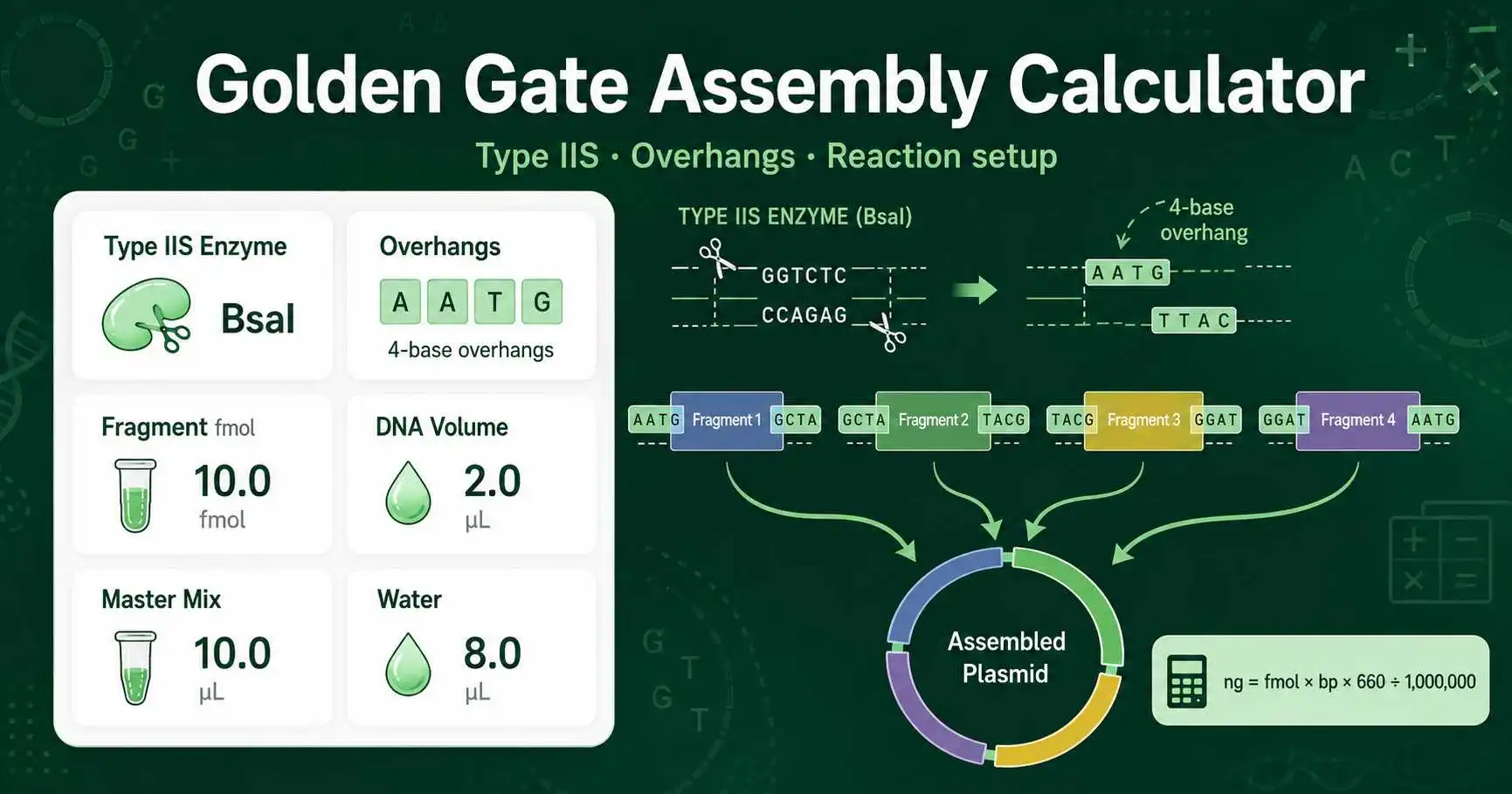
Golden Gate Assembly Calculator for Type IIS cloning
This Golden Gate Assembly Calculator helps you plan a one-tube DNA assembly reaction. It estimates how much vector and insert DNA to add when you know each fragment length, DNA concentration, and target molar amount. It also checks basic overhang problems before you set up the reaction.
Golden Gate Assembly uses a Type IIS restriction enzyme and DNA ligase in the same reaction. Type IIS enzymes cut outside their recognition sequence. That feature lets the designed overhangs control the order of assembly. The calculator treats the DNA fragments as double-stranded DNA and uses base-pair length to estimate mass and femtomoles.
How to use Golden Gate Assembly Calculator
Choose the Type IIS enzyme first. Then enter the target amount in femtomoles, the final reaction volume, and the master mix percentage. A 2X Golden Gate mix usually occupies half of the final reaction volume, so 50% is a sensible starting value.
Add each DNA fragment with its name, length in base pairs, concentration in ng/µL, and molar ratio. Use a molar ratio of 1 for an equimolar setup. Use a higher value if a short insert should be added in excess. The result table shows target fmol, required ng, and pipetting volume for each fragment.
Golden Gate Assembly formula for DNA mass
The calculator uses a common double-stranded DNA approximation:
DNA mass in ng = fmol × fragment length in bp × 660 ÷ 1,000,000
The value 660 g/mol per base pair is an average molecular weight for double-stranded DNA. After mass is estimated, the tool divides the required mass by the DNA concentration to calculate the volume in microliters.
DNA volume in µL = required DNA mass in ng ÷ concentration in ng/µL
Worked example for a Golden Gate reaction
Imagine you want a 10 µL Golden Gate reaction with a 3,000 bp vector, a 900 bp insert, and a 650 bp insert. You want 20 fmol of each fragment. If the vector is 25 ng/µL, the 900 bp insert is 18 ng/µL, and the 650 bp insert is 15 ng/µL, the calculator first converts each fragment from fmol to ng.
For the vector, mass = 20 × 3,000 × 660 ÷ 1,000,000 = 39.6 ng. At 25 ng/µL, the vector volume is 1.58 µL. The same method gives 11.88 ng for the 900 bp insert and 8.58 ng for the 650 bp insert. The tool then adds all DNA volumes, subtracts the master mix volume, subtracts any extra reagent volume, and reports the water volume.
Use case 1: planning a multi-fragment plasmid build
A cloning workflow may need a backbone, promoter, coding sequence, and terminator in one assembly. In that case, every part should have planned junction overhangs. The calculator helps you keep each part near the same molar amount, so the number of molecules is balanced instead of the DNA mass alone.
This matters because a 500 bp insert and a 5,000 bp vector do not have the same molecule count at the same mass. Molar planning gives the reaction a more useful comparison between fragments.
Use case 2: checking Golden Gate overhang design
Golden Gate overhangs define the order of assembly. A duplicate overhang can let fragments join at the wrong junction. A reverse complement conflict can also create unwanted pairing. The overhang review in this tool flags invalid lengths, non-DNA letters, duplicate overhangs, and reverse-complement conflicts.
For more detailed enzyme-site mapping before cloning, compare your design with a restriction digest map. If you need to check two-enzyme fragment behavior, the Double Digest Calculator is more suitable.
Golden Gate Assembly inputs explained
Fragment length is the size of each DNA piece in base pairs. DNA concentration is the measured concentration from a spectrophotometer, fluorometer, or supplier report. Target fmol is the desired molecule amount for a 1× fragment. Molar ratio changes that amount for a specific fragment.
Reaction volume is the final tube volume. Master mix percentage is the portion of the reaction occupied by Golden Gate enzyme mix. Extra reagent volume is useful when your protocol adds a separate enzyme, additive, or water-soluble supplement outside the main mix.
Practical problem: too much DNA volume
A common problem appears when one fragment has a low concentration. For example, a 900 bp insert at 2 ng/µL needs about 5.94 µL to provide 20 fmol. In a 10 µL reaction with 5 µL of 2X master mix, that one fragment already uses most of the available space.
The practical fix is simple. Concentrate the DNA, reduce target fmol, increase final reaction volume if the protocol allows it, or prepare a scaled master reaction and aliquot carefully. Do not pipette volumes below the reliable range of your pipette.
What to verify before real Golden Gate cloning
Verify the Type IIS enzyme recognition site, overhang sequence, cut position, reading frame, domestication status, fragment purity, DNA concentration, and cycling protocol. Also confirm whether your enzyme generates 3-base or 4-base overhangs. BsaI, BsmBI, and BbsI commonly produce 4-base overhangs, while SapI can be used in workflows with 3-base overhangs.
NEB explains that Type IIS restriction enzymes recognize asymmetric DNA sequences and cleave outside the recognition sequence, which is why they are useful for Golden Gate Assembly.Type IIS restriction enzymes