
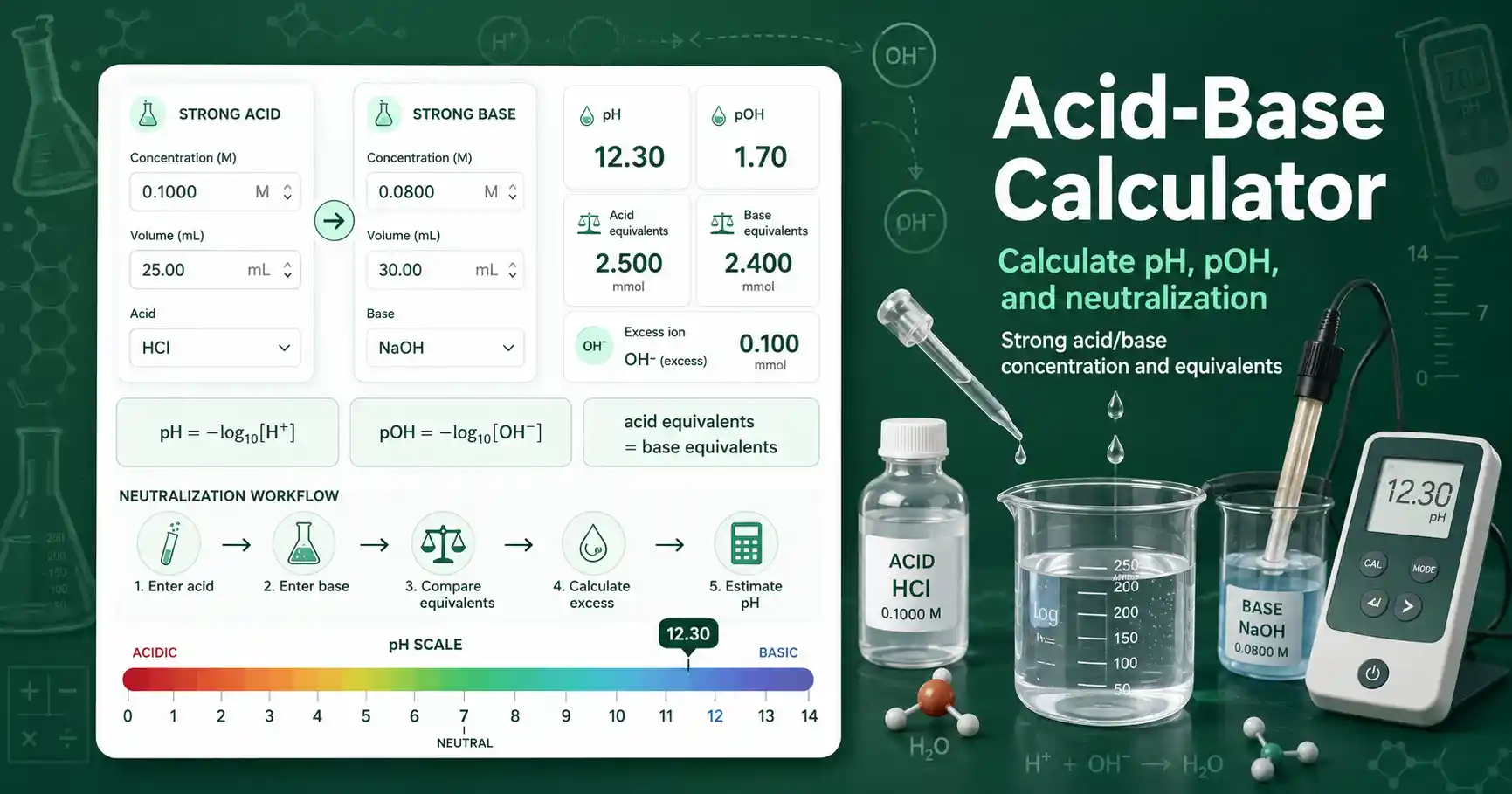
Acid-Base Calculator for pH, pOH, and neutralization
This calculator helps you solve common strong acid and strong base problems without hiding the chemistry. You can enter a formal acid concentration and calculate pH from the hydrogen ion concentration. You can enter a formal base concentration and calculate pOH from the hydroxide ion concentration. You can also compare acid equivalents with base equivalents in a simple neutralization mixture.
The tool is most useful for introductory chemistry, analytical chemistry practice, wet-lab math checks, and quick teaching examples. It assumes complete dissociation for strong acids and strong bases. It uses the 25 °C water relationship where pH + pOH = 14. It does not model weak acid equilibrium, activity coefficients, temperature-dependent Kw, or buffered systems.
If your problem starts with hydrogen ion concentration only, the dedicated pH Calculator gives a faster single-purpose workflow. If your problem starts with hydroxide ion concentration only, the pOH Calculator focuses directly on that conversion. This Acid-Base Calculator is better when you want both ion conversion and acid/base equivalent comparison in one place.
Acid-Base Calculator formulas and assumptions
For a strong acid, the calculator estimates active hydrogen ion concentration from formal concentration multiplied by the number of acidic protons used in the exercise. It then applies pH = −log10[H+]. For a strong base, it estimates active hydroxide ion concentration from formal concentration multiplied by the number of hydroxide equivalents. It then applies pOH = −log10[OH−].
The neutralization mode uses equivalents rather than only moles. Acid equivalents equal acid molarity multiplied by acid volume in liters multiplied by acidic protons per molecule. Base equivalents equal base molarity multiplied by base volume in liters multiplied by hydroxide equivalents per molecule. The smaller equivalent amount is limiting. The leftover excess determines whether the final ideal solution is acidic or basic.
The pH result is an estimate, not a complete thermodynamic model. Concentrated acids can have pH values below 0, and concentrated bases can have pH values above 14. Those values are possible in formal calculations, but real solutions can deviate because activity differs from concentration. Chemistry LibreTexts gives a useful background discussion of strong acids and strong bases for students who want the concept behind the calculation.
Acid-Base Calculator result interpretation
A pH below 7 means the ideal solution is acidic at 25 °C. A pH near 7 means the ideal solution is near neutral. A pH above 7 means the ideal solution is basic. The pOH value gives the same information from the hydroxide side.
In neutralization mode, the calculator reports acid equivalents, base equivalents, limiting side, excess concentration, and final estimated pH. If acid equivalents exceed base equivalents, acid remains after reaction. If base equivalents exceed acid equivalents, base remains after reaction. If the equivalents balance closely, the ideal strong acid/base endpoint is pH 7.00 at 25 °C.
Unit choice matters because concentration and volume combine directly in equivalent calculations. A 0.1 M solution is not the same as a 0.1 mM solution. A 25 mL volume is not the same as a 25 µL volume. The calculator converts common units before it compares chemical equivalents.
Rounding matters because pH is logarithmic. A small change in pH can represent a large fold change in hydrogen ion concentration. The calculator rounds pH and pOH to two decimals for readability and shows concentrations with enough precision for study and planning. Verify critical lab calculations independently before using them in real experiments.
Acid-Base Calculator worked example
Given values: 25.0 mL of 0.100 M HCl is mixed with 22.0 mL of 0.100 M NaOH.
Formula: acid equivalents = M × L × acidic protons, and base equivalents = M × L × OH− equivalents.
Substitution: acid equivalents = 0.100 × 0.0250 × 1 = 0.00250 mol. Base equivalents = 0.100 × 0.0220 × 1 = 0.00220 mol.
Result: excess acid = 0.00030 mol. Total volume = 0.0470 L. Excess [H+] = 0.00030 ÷ 0.0470 = 0.00638 M. pH = −log10(0.00638) = 2.20.
Interpretation: the final ideal solution remains acidic because HCl equivalents exceed NaOH equivalents.
When to use this Acid-Base Calculator
Students can use the calculator to check homework problems that involve strong acids, strong bases, pH, pOH, and equivalents. Teachers can use it to create quick demonstrations that show why equal volumes do not always neutralize when concentrations differ. Lab workers can use it as a first-pass check for simple acid/base dilution or neutralization math. Researchers can use it for educational checks, but they should use validated lab calculations for regulated, clinical, or safety-critical work.
The calculator differs from a buffer calculator because it does not use a weak acid conjugate base ratio. It differs from a titration calculator because it does not plot a full titration curve or model weak acid regions. It focuses on simple strong acid/base arithmetic and clear interpretation. That makes it fast, transparent, and easy to teach.